Enumeration district 1 in Registration district 89 appears to encompass some very remote areas of Lewis, on and offshore. In 1901, we find the following houses:
1. Mealista House, a mile south of Brenish has a family of Mitchells in residence.
2. Hamnaway, about 8 miles south of Carnish, houses a family of Mathisons.
3. Beyond Hamnaway, a mile or two round the bay, we find the hamlet of Ardbeg. At no 1, we see Donald (72) and May (78) Mcleanan, with three of their children (aged in their 30s).
At 2 Ardbeg, there are a family of Mcdonalds.
4. At Crolaw [Crola] house, near the eastern extremity of Loch Resort a family of Macdonalds is in residence.
5. Kenreasort House, a few miles east of Crola shows Kenneth Mcdonald (51, gamekeeper), married to Catherine (28), and with Catherine Mciver (28) as a general servant there. John Mciver is registered as a sailor, aged 60.
6. Thirty miles out at sea, the Flannan Isles Lighthouse is also in the census returns.
Wm Beggs 43), lightkeeper, born at Kirkpatrick, Wigtownshire
D Ross (37), ass lightkeeper, born at Scrabster, Caithness
J Mclachlan (34), ass lightkeeper, born at Kilboandon [?], Argyll
A Mciver (39), shoemaker, born at Cullanish [Callanish?], Ross-shire
It was four months before the 1901 census that three of their predecessors were inexplicably lost from the lighthouse during a violent storm.
I refer to Comann Eachdraidh Uig for further details on the locations and people mentioned.
Showing posts with label uig. Show all posts
Showing posts with label uig. Show all posts
Sunday, 17 April 2011


Saturday, 16 April 2011
Napier witnesses: John Matheson
John Matheson gave evidence to Lord Napier's Commission on behalf of the people of Aird Uig. We find him in the 1881 census, living with his father Malcolm (74), mother Catherine (60), and wife Isabella (36). His siblings Isabella (26) and Dorothy (37) are also present, together with niece Dorothy Mackay (15) and Catherine Patterson (18), a servant. The 1871 census confirms his location as Aird Uig. This also shows another of John's sisters, Peggy, at that time a laundry-maid aged 20. Dorothy Mackay is present in the household as well in 1871. A decade before, we see all of John's siblings: Alex, Ann, Dorathia, Margaret (Peggy in 1871) and Isabella. John Matheson's record on Hebridean Connections shows he lived at 4 Aird Uig.
Going forward in time, John and Isabella had children by 1891: Bella (8) and Kate (6). In 1901, the family had located to Carloway, and John was a missionary at the Church of Scotland Missionary's Manse.
The death record shows, I believe, incorrect information, in that it shows John's wife as Elizabeth. He died at 33 Callanish on 9 March 1921, aged 82. He is listed as an Established Church Missionary, and his father Malcolm was a United Free Church Missionary. John died of natural causes, and no doctor attended his death. I have been unable to trace Isabella Matheson's death record.
Going forward in time, John and Isabella had children by 1891: Bella (8) and Kate (6). In 1901, the family had located to Carloway, and John was a missionary at the Church of Scotland Missionary's Manse.
The death record shows, I believe, incorrect information, in that it shows John's wife as Elizabeth. He died at 33 Callanish on 9 March 1921, aged 82. He is listed as an Established Church Missionary, and his father Malcolm was a United Free Church Missionary. John died of natural causes, and no doctor attended his death. I have been unable to trace Isabella Matheson's death record.
Friday, 15 April 2011
Napier witnesses: Alexander Macdonald
Alexander Macdonald was the witness for Crowlista in Uig, giving evidence to Lord Napier's Commission on 4 June 1883 at Miavaig.
We find him on the 1881 census aged 46, with his spouse Catherine (33) and four children Dolina (7), John (6), Anne (3) and Jessie (8 months); also Christina Buchanan, a 46-year old pauper, who is visiting. Hebridean Connections states that the couple lived at 16 Crowlista.
A decade before, Alexander still lives with his mother (Ann, 69) and siblings Murdoch (30, fisherman), Malcolm (23, fisherman), Ann (27, agricultural labourer) and Christina. (25, agricultural labourer). Alexander is a fisherman at Crowlista. This information is linked to the record on Heb. Conn.
In 1891, we find Alexander and Catherine at the School House, with their children Ann (13), Janet (9), Kate (6) and Florance (4). Ten years later, the 1901 census lists this family of Macdonalds at 16 Crowlista, providing final confirmation.
Alexander Macdonald passed away on 27 March 1911 at the age of 76, still married to Catherine. Alexander had been suffering paralysis for 2 years before his death. Catherine followed her husband into death in 1929, aged 80.
We find him on the 1881 census aged 46, with his spouse Catherine (33) and four children Dolina (7), John (6), Anne (3) and Jessie (8 months); also Christina Buchanan, a 46-year old pauper, who is visiting. Hebridean Connections states that the couple lived at 16 Crowlista.
A decade before, Alexander still lives with his mother (Ann, 69) and siblings Murdoch (30, fisherman), Malcolm (23, fisherman), Ann (27, agricultural labourer) and Christina. (25, agricultural labourer). Alexander is a fisherman at Crowlista. This information is linked to the record on Heb. Conn.
In 1891, we find Alexander and Catherine at the School House, with their children Ann (13), Janet (9), Kate (6) and Florance (4). Ten years later, the 1901 census lists this family of Macdonalds at 16 Crowlista, providing final confirmation.
Alexander Macdonald passed away on 27 March 1911 at the age of 76, still married to Catherine. Alexander had been suffering paralysis for 2 years before his death. Catherine followed her husband into death in 1929, aged 80.
Napier witnesses: John Ferguson
John Ferguson was the witness from Carishader, Uig, Lewis, who gave evidence at Miavaig on 4 June 1883. He is quoted as being 67 years of age, which is born out when we find his entry in the 1881 census at 12 Carishader. John is a farmer of 10 acres, living with his wife Mary (also 63) and daughters Christina (39) and Ann (22). Jane Macaulay (9) is a granddaughter in the house; John Ferguson (4) is a grandson; he was born in the Black Isle.
I refer to Hebridean Connections for John's family history and movement between Uig and Bernera.
I refer to Hebridean Connections for John's family history and movement between Uig and Bernera.
Tuesday, 12 April 2011
Napier witnesses: Angus Maciver
Rev Angus Maciver was the parish minister for Uig, when he gave evidence to Lord Napier at Miavaig on 4 June 1883. In the 1881 census, we see him at the Manse of Uig, married to Margaret Jane, 11 years younger than her husband. She was born at Lerwick, the daughter of Robert Bannatyne. He is in the house with his daughter, but the census transcription on Ancestry gives his name as an erroneous 14; Robert's age is in fact 74. He originates from Rothesay, Bute, a retired officer of fisheries. The household also comprises a number of domestic and farm servants.
Hebridean Connections provides further clues on this minister of the Free Church. He grew up at Tobson, Great Bernera, where he was born in 1832, the son of Angus Maciver and Ann Macleod. Rev Angus Maciver was the minister at Uig for 13 years until 1889, and was involved with the land struggle for Kneep and Valtos. It is therefore no surprise he was called upon to give evidence to Lord Napier in 1883.
Hebridean Connections provides further clues on this minister of the Free Church. He grew up at Tobson, Great Bernera, where he was born in 1832, the son of Angus Maciver and Ann Macleod. Rev Angus Maciver was the minister at Uig for 13 years until 1889, and was involved with the land struggle for Kneep and Valtos. It is therefore no surprise he was called upon to give evidence to Lord Napier in 1883.
Napier witnesses: George Macaulay
George Macaulay (also known as Seoras Dubh or Seoras Iain Bhan) was one of the witnesses from Great Bernera. He mentions in his evidence that he was removed from Croir in 1880, something that tallies with the George Macaulay that is on Hebridean Connections, born in 1819.
In 1881, we find George (62) with his wife Ann (54) in a private house in Hacklet. Peggy Macleod (20) is there as a domestic servant, and Catherine Smith (16) is a cattleherd. Ten years before, George and Ann's location is not specified. They are in a house with William Smith (16, agricultural labourer), Christy Murray (21, servant) and cowherd Peggy Macleod (11).
In 1861, George (41) and Ann (35) are listed at Croir. His mother, Cathrine (73) is in the house, together with visitors William Smith (6), Cathrine Macleod (16) and Rachel Mcdonald (17).
Hebridean Connections mentions the date of George's marriage as 1853, meaning that we find him at home with his parents John (68) and Catherine (66) in the 1851 census. George (30) is a fisher at Croir. His sister Christy (29), Mary (24), home scholar Catherine Mckenzie (granddaughter, 9) and visiting Donald Mcaulay (20, fisher).
George (71) and Ann (64) remain at Hacklet in 1891. Norman and Maggie Patterson are boarders with them. with two infant children. George and Ann Macaulay never had children of their own.The last time we find George Macaulay in a census was in 1901, when, aged 82, he is listed at 5 Hacklete. Marion Martin (30) is a domestic servant.
George Macaulay passed away on 8 July 1908, aged 89. His wife followed him into death two years and two days later, aged 85. Ann was the daughter of Norman Macdonald and Rachael Macritchie of Uigen.
In 1881, we find George (62) with his wife Ann (54) in a private house in Hacklet. Peggy Macleod (20) is there as a domestic servant, and Catherine Smith (16) is a cattleherd. Ten years before, George and Ann's location is not specified. They are in a house with William Smith (16, agricultural labourer), Christy Murray (21, servant) and cowherd Peggy Macleod (11).
In 1861, George (41) and Ann (35) are listed at Croir. His mother, Cathrine (73) is in the house, together with visitors William Smith (6), Cathrine Macleod (16) and Rachel Mcdonald (17).
Hebridean Connections mentions the date of George's marriage as 1853, meaning that we find him at home with his parents John (68) and Catherine (66) in the 1851 census. George (30) is a fisher at Croir. His sister Christy (29), Mary (24), home scholar Catherine Mckenzie (granddaughter, 9) and visiting Donald Mcaulay (20, fisher).
George (71) and Ann (64) remain at Hacklet in 1891. Norman and Maggie Patterson are boarders with them. with two infant children. George and Ann Macaulay never had children of their own.The last time we find George Macaulay in a census was in 1901, when, aged 82, he is listed at 5 Hacklete. Marion Martin (30) is a domestic servant.
George Macaulay passed away on 8 July 1908, aged 89. His wife followed him into death two years and two days later, aged 85. Ann was the daughter of Norman Macdonald and Rachael Macritchie of Uigen.
Monday, 11 April 2011
Napier witnesses: Angus Macarthur
Angus Macarthur gave evidence at Miavaig, Uig, Lewis as a representative of Great Bernera. Although the census does not specify the township where he lived, enumeration district 9 does include that island.
We find Angus, aged 52, in the 1881 census with a family of 8 children. He is married to Margaret (44), with Catherine (24), Donald (22, fisherman), Henrietta (19), Chirsty (14), Mahu [?] (9), Isabella (7), Kenina (4) and Mary (9 mo). The same family appears in 1871, when Angus's mother Ann (85) is also in the house.
In 1861, we find Angus and his wife Margaret (25) at Bosta, where they are staying with his parents Donald (75) and Ann (74). One of Angus's siblings resides at home, Margaret (31). Three of Angus's children are in the house as well, Cathrine (6), Donald (3) and Mary Ann (1). Donald senior was to die some 7 months after the census was taken. Helen was another sister of Angus's, which is not shown in the 1861 census.
Angus and Margaret were married in 1854. Angus Macarthur died on 1 July 1903; Margaret passed away nearly fifteen years later on 13 January 1918.
Hebridean Connections holds more information on this witness.
We find Angus, aged 52, in the 1881 census with a family of 8 children. He is married to Margaret (44), with Catherine (24), Donald (22, fisherman), Henrietta (19), Chirsty (14), Mahu [?] (9), Isabella (7), Kenina (4) and Mary (9 mo). The same family appears in 1871, when Angus's mother Ann (85) is also in the house.
In 1861, we find Angus and his wife Margaret (25) at Bosta, where they are staying with his parents Donald (75) and Ann (74). One of Angus's siblings resides at home, Margaret (31). Three of Angus's children are in the house as well, Cathrine (6), Donald (3) and Mary Ann (1). Donald senior was to die some 7 months after the census was taken. Helen was another sister of Angus's, which is not shown in the 1861 census.
Angus and Margaret were married in 1854. Angus Macarthur died on 1 July 1903; Margaret passed away nearly fifteen years later on 13 January 1918.
Hebridean Connections holds more information on this witness.
Sunday, 10 April 2011
Napier witnesses: Norman Morrison
Norman Morrison was aged 61 when he spoke at the Napier inquiry at Miavaig, Uig, Lewis. He had come across from Brenish, about 12 miles away. Norman was a fisherman and crofter.
In the 1881 census we find Norman and his wife Catherine (who was 4 years younger) with their children Donald (25, fisherman), John (22, fisherman), Malcolm (18, fisherman) and Margaret (16). In the 1871 census, we learn that the family lived at 30 Brenish.
The 1851 census shows Norman and Katerine (incorrectly marked as his sister) at 'Breynish' as a fisher and land tenant. His sister Jannet (30) is listed there as well. A male infant, 2 months old, is noted as Not Bass.
In 1901, we last see Norman (78) and Catherine (74) together at Brenish. Their son John (40) and his wife Marion (37) are present, with their young sons George (2) and Norman (3 months).
Norman Morrison passed away on 30 April 1911 aged 84 at Brenish. He is marked as the widower of Catherine, and the son of Donald and Peggy, having suffered senile decay for 6 weeks. His son Donald, living at Mangersta, reported the death at Miavaig.
The village of Brenish is not (yet) covered by Hebridean Connections.
In the 1881 census we find Norman and his wife Catherine (who was 4 years younger) with their children Donald (25, fisherman), John (22, fisherman), Malcolm (18, fisherman) and Margaret (16). In the 1871 census, we learn that the family lived at 30 Brenish.
The 1851 census shows Norman and Katerine (incorrectly marked as his sister) at 'Breynish' as a fisher and land tenant. His sister Jannet (30) is listed there as well. A male infant, 2 months old, is noted as Not Bass.
In 1901, we last see Norman (78) and Catherine (74) together at Brenish. Their son John (40) and his wife Marion (37) are present, with their young sons George (2) and Norman (3 months).
Norman Morrison passed away on 30 April 1911 aged 84 at Brenish. He is marked as the widower of Catherine, and the son of Donald and Peggy, having suffered senile decay for 6 weeks. His son Donald, living at Mangersta, reported the death at Miavaig.
The village of Brenish is not (yet) covered by Hebridean Connections.
Napier witnesses: Donald Matheson
Donald Matheson gave evidence at Miavaig, Uig, Lewis. He was 65 years of age, and in the 1881 census we find him at Kneep with his wife Anabella (7 years younger). She is marked on the census as blind. He is marked as a crofter. His children Annie (26), Malcolm (21), Donald (19, fisherman) and Peter (15, scholar) are at home. In 1871, his address is given as Schoolhouse and as a fisherman.
In 1861, Donald is a crofter at Kneep. In addition to his growing young family, we find a Margaret Maclean (70), his mother-in-law, and a crofter's widow. Her son, Annabella's brother Malcolm (38, tailor) is also in the house. In 1851, Donald Matheson appears to be visiting an address on Kenneth Street in Stornoway. In 1841, Donald is a 21-year old living with his father John (53) and mother Christina (47). This is corroborated by information on Hebridean Connections. His siblings are Anne (14), Malcolm (12), Angus (9), Christiana (6) and Peter (3).
Donald died suddenly on 17 October 1883 aged 65, just over four months after giving evidence to Lord Napier. No doctor attended his death. His son Malcolm, who was not literate, reported the death to the registrar at Miavaig, a couple of miles or so from his home.
In 1861, Donald is a crofter at Kneep. In addition to his growing young family, we find a Margaret Maclean (70), his mother-in-law, and a crofter's widow. Her son, Annabella's brother Malcolm (38, tailor) is also in the house. In 1851, Donald Matheson appears to be visiting an address on Kenneth Street in Stornoway. In 1841, Donald is a 21-year old living with his father John (53) and mother Christina (47). This is corroborated by information on Hebridean Connections. His siblings are Anne (14), Malcolm (12), Angus (9), Christiana (6) and Peter (3).
Donald died suddenly on 17 October 1883 aged 65, just over four months after giving evidence to Lord Napier. No doctor attended his death. His son Malcolm, who was not literate, reported the death to the registrar at Miavaig, a couple of miles or so from his home.
Saturday, 9 April 2011
Napier witnesses: Murdo Mclean
Murdo Mclean gave evidence during the Commission's visit to Meavaig, in the Parish of Uig in Lewis. He is mentioned in the Report as a fish-curer.
His entry in the 1881 census confirms his activities as a merchant and fisherman of Valtos. He is married to Maggie (8 years his junior at 47), and has a family of 6 children - John (18, scholar), Bell Ann (16, dress maker), Alexr (14, assistant teacher (English)), Maggee (12, scholar), Jane (9, scholar) and Annie (6).
In 1871, Murdo is a general merchant in Valtos, with his wife Margaret and children Alexander, Bella Ann and Margaret. Bess Macaulay is a 50-year old visitor, a pauper.
The 1861 census shows Murdo as the single person in his household, a 35-year old merchant, in Valtos.
I have been unable to trace him through the 1851 census, but a decade earlier we find Murdo as a 15-year old, living with his parents John (55) and Isabella (50) at Mangurstadh, which is confirmed through his entry in Hebridean Connections. His siblings are Katherine (25), Betsy (20), Malcolm (20), John (13) and Angus (7).
In 1901, we see Murdo (74) with his wife Margaret (65) still a general merchant at 20 Valtos. He passed away on 2 April 1911 at the age of 84, suffering from old age and paralysis of 21 days. No doctor attended his death; a cousin-in-law reported the death to the registrar at Miavaig.
His entry in the 1881 census confirms his activities as a merchant and fisherman of Valtos. He is married to Maggie (8 years his junior at 47), and has a family of 6 children - John (18, scholar), Bell Ann (16, dress maker), Alexr (14, assistant teacher (English)), Maggee (12, scholar), Jane (9, scholar) and Annie (6).
In 1871, Murdo is a general merchant in Valtos, with his wife Margaret and children Alexander, Bella Ann and Margaret. Bess Macaulay is a 50-year old visitor, a pauper.
The 1861 census shows Murdo as the single person in his household, a 35-year old merchant, in Valtos.
I have been unable to trace him through the 1851 census, but a decade earlier we find Murdo as a 15-year old, living with his parents John (55) and Isabella (50) at Mangurstadh, which is confirmed through his entry in Hebridean Connections. His siblings are Katherine (25), Betsy (20), Malcolm (20), John (13) and Angus (7).
In 1901, we see Murdo (74) with his wife Margaret (65) still a general merchant at 20 Valtos. He passed away on 2 April 1911 at the age of 84, suffering from old age and paralysis of 21 days. No doctor attended his death; a cousin-in-law reported the death to the registrar at Miavaig.
Wednesday, 15 December 2010
An Uig soldier
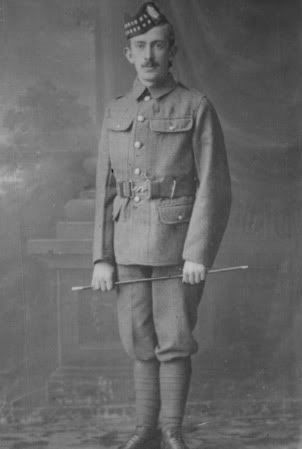
His father has by then moved to Invershin, a small village in Sutherland near Lairg, and receives the news of the death of his son. Donald's personal effects are sent to Duncan, which includes religious books, a wallet, a photo, letters and a bible.
Donald is remembered on the Tyne Cot memorial in Flanders, but his exact last resting place is unknown. He is also commemorated on the memorial at Timsgarry in Uig, Lewis.
Image copyright Uig Historical Society
Private DONALD MATHESON FRASER
Son of Duncan Fraser, of Achnairn, Lairg, Sutherlandshire, and of the late Mary Matheson Fraser.
Service unit: 2nd Royal Scots
Service number: 18744
Date of death: 26 September 1917 at the age of 25
Killed in action in France
Memorial: Tyne Cot Memorial, panel 11 to 14 and 162
Local memorial: Uig, Timsgarry
Thursday, 2 September 2010
John Macaulay, 7 Islivig
A tribute and account of the fate of Leading Deckhand John Macaulay.
Please note that further research into John, his ship and shipmates is relayed on this site.
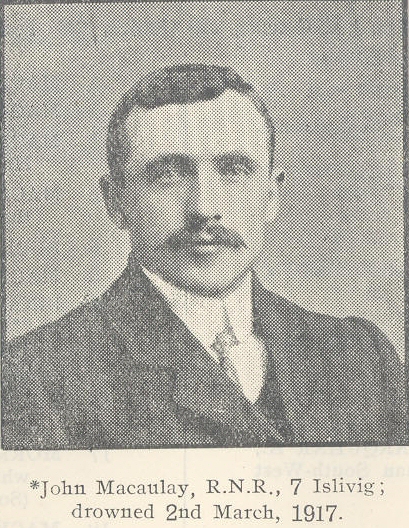 John Macaulay was lost when SS Kenmare was torpedoed in the Irish Sea on Saturday, 2 March 1918. He came from the village of Islivig in the district of Uig in Lewis. His remains turned up on the east coast of Ireland, north of Dublin, and lie buried in a grave in Balrothery. His grave is marked by a Commonwealth War¬graves Commission headstone.
This tribute is dedicated to his memory, and endeavours to tell the story of SS Kenmare, the German submarine U-104 which fired the fatal torpedo and John Macaulay’s final resting place.
John’s family history
John was the son of fisherman Donald Macaulay of Islivig and domestic servant Margaret Macaulay who were married at Miavaig on 4 April 1878. Both were aged 26 at the time. It is worth pointing out that in the Gaelic community, the name Margaret is sometimes converted to Peggy. They continued to live in Islivig after their marriage. Donald and Peggy were blessed with the birth of a son, John, on 7 December 1881. It has not been part of my investigations to find out whether they had any more children.
Thirty-six years later, on 16 January 1917, John (now living at 7 Islivig) was married to Catherine Ann Macaulay, a 29-year old nurse from 19 Brenish. She is the daughter of boat-builder John Macaulay and Isabella Matheson. The marriage was conducted at Seaforth House on Scotland Street in Stornoway.
By that time, John’s mother Peggy had died, and Donald, by that time aged 62, was a crofter. His son, John, was a seaman in the Merchant Service, but (1917 being a war year) also marked as being in the Royal Naval Reserve, as so many islanders were.
S.S. Kenmare
The Kenmare was launched on 16 February 1895 at Wigham, Richardson and Co. of Newcastle upon Tyne. She was powered by a triple-expansion steam engine, generating 437 hp. She was completed for the City of Cork Steam Packet Co. Ltd. Her dimensions were 264.5 x 36.5 x 16.9 feet, measuring 1,346 gross tons.
During the First World War, she found herself under attack by German submarines (U-boats) on four occasions. On 27 June 1915, SS Kenmare was attacked by gunfire off Youghall, but outran her attacker with minimal damage. Two years later, on 21 October 1917, Kenmare was off Holyhead, bound from Liverpool to Cork, when a torpedo passed only a few feet from her stern. A few weeks later, the Kenmare had to fire at a submarine that was chasing her. However, the last attack, on 2 March 1918, proved fatal.
That day, SS Kenmare was sailing from Liverpool to Cork with a general cargo at position 53°40’095”N 5°06’099”W. This is 60 km (approximately 35 nautical miles) north of east from Skerries, Co Dublin and 40kms (approximately 25 nautical miles) north west from The Skerries, Anglesey.. At around 7pm, U-104 fired a torpedo without warning. It inflicted severe damage, and Kenmare sank by the stern within two minutes. Only one lifeboat was serviceable, and the three who had managed to get into it tried to find other crew members. Three more were saved. In spite of shouting being heard, the occupants of the lifeboat did not manage to locate these unfortunates as it was dark by that time and the sea covered in wreckage. Twenty-nine members of crew perished, 24 of whom were in a boat which overturned – the weather being poor and the sea rough at the time. The First Mate, four crewmen and Gunner James Henry Chamberlain Brougham RNVR, aged 20 survived the torpedoing of the ship. This was remarkable, bearing in mind that the ship sank in just two minutes. Two other gunners, Able Seaman Albert Edward Aston RNVR and Leading Deck Hand John Macaulay RNR did not survive. Apparently, the ship’s gun had been thrown from its mountings by the force of the explosion. The survivors were picked up by the steamer Glenside the next morning, and taken to Dublin.
U-boat postscript
U-boat 104 had been in service for only five months at the time of the attack on the Kenmare. U-104 sank a total of eight ships, which accounted for a third of the number of ships (25) sunk by its commander, 32-year old Kapitän-Leutnant zur See Kurt Bernis, until he was killed in the sinking of his U-boat on 25 April 1918.
On 23 April 1918, U-104 was attacked by USS Cushing using depth charges. These damaged the submarine. Two days later, HMS Jessamine came across the submarine on the surface in St George’s Channel as its crew were attempting to repair the damage, caused by the depth charges. KLt Bernis dived his submarine, but depth charges from HMS Jessamine forced him to surface. The U-boat was finally sunk, taking 31 to the bottom with her. Ten sailors were left in the water, after their vessel went down, of whom only one was picked up by the warship. The other nine were left to drown in the sea.
Found in Ireland
John Macaulay was not saved from the sinking of the Kenmare. Although the one working lifeboat remained on the scene as long as possible, the shouting of the floundering seamen ceased after some 10 minutes. It is a matter of conjecture what happened during the next fourteen days.
 Coast Watchman John Doherty and Constable Masterson found the body of John Macaulay on a beach at King’s Point (shown left) north of Balbriggan Co. Dublin on Saturday 16th March 1918. Two other bodies of sailors were found on the same day washed up on nearby beaches at Skerries Co. Dublin and Gormanston Co. Meath, but only John Macaulay’s body could be identified. He carried a letter which is said to have identified him as George [sic] Mcauley of Stornaway. He is described as a fine young sailor of about 25 – however, at the time of his death, John Macaulay was actually aged thirty-five. All three were dressed in semi-naval uniform.
Inquests into the deaths of the three sailors were held by Coroners Friery and Corry, and the evidence disclosed nothing further than that two of the men carried beads and scapulars, while a disc showed that McAuley was a Presbyterian. The bodies, which were only a few days in the water, bore no sign of violence, and the medical testimony was that death was due to drowning. A verdict of “found drowned” was duly returned by the Jury under foreman Mr George Mongey.
News found its way to John’s native Isle of Lewis, and was relayed by local weekly newspaper Stornoway Gazette, on 15 March 1918.
“It is with deep regret we have to record the death by drowning of Seaman John Macaulay (Iain Dhomhnaill an Taillear) [John the son of Donald the Tailor] Islivig on Saturday 2nd inst. His boat the “Kenmore” [sic] was torpedoed, and only six out of a crew of thirty-five were saved. John was one of the finest young men that could be met in a day’s march. To his young and sorrowing widow, and to his other near relatives and friends, the heartfelt sympathy of the whole community is extended in their very sad and sore bereavement.”
John’s family had endeavoured to have the body transferred home, but the authorities would not sanction this. An account of the funeral was forwarded to his family by the Acting Divisional Officer of Coastguard at Rush, and the Stornoway Gazette copies this; I insert additional information as supplied by the Drogheda Independent and Drogheda Advertiser in their editions of March 23rd, 1918.


The funeral started from the Coastguard Station, Balbriggan (shown left, about 1920). The military supplied four horses and the coffin was place on the limber, and we marched through the town of Balbriggan. The military firing party, with a piper at its head, led the procession; a military funeral party and a body of police followed behind the coffin with as many of the Coastguard as could be obtained; and a large crowd of the inhabitants followed to the churchyard. the piper played a lament and other Scottish airs suitable for the occasion. (Pipers’ Band of the Royal Engineers playing the Dead March) The military also took photographs of the funeral and if they turn out successful you will be sent copies. Your son is buried at Balrothery Churchyard, and the funeral service was carried out by the Protestant minister (Rev. H. B. Good, Rector, Rev. C. Benson L.L.D. and Rev. R. Scriven). Your son was given the grandest funeral that was ever seen in Balbriggan and I think it is particularly gratifying to know that full honours were paid to his remains. Three volleys were fired over the grave and the piper played between each volley.”
Postscript
It would stand to reason that such a grand occasion would be remembered for many years to come in a small town like Balbriggan. Not in this instance. British armed forces burned and looted the centre of the town on 9 September 1920 in reprisal for the alleged killing of an R.I.C officer by the I.R.A. earlier in the evening, as the unfortunate policeman left a local pub. This would have eclipsed if not erased the burial in the collective and popular memory of the inhabitants of the town.
In the 1930s, the Commonwealth War Graves Commission commissioned the erection of a grave-stone over John Macaulay’s grave at Balrothery, a gravestone which faces east. His was one of many such gravestones in Ireland that were put up by the Office of Public Works, a branch of the Irish Government. In the 1920s, the family ordered the installation of iron railings around the grave site. The spelling of John Macaulay’s name on the gravestone (Macauley) is noted, but the information on the stone confirms the identity of the casualty.
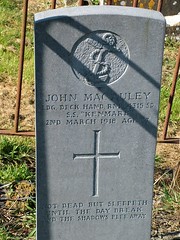
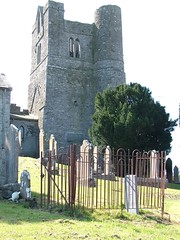
Catherine Ann, John’s wife, died in Stornoway on 17 April 1961, aged 73. From the limited resources available to me, I have not been able to find out if she remarried and / or had children.
John’s father, Donald Macaulay, passed away in the district of Uig in 1933, aged 80.
John Macaulay is also remembered on the commemorative panel in Grangegorman Military Cemetery, Blackhorse Avenue, Dublin.

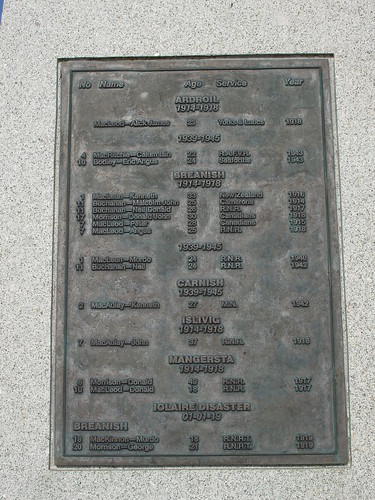
He is also mentioned on the West Uig division of the Lewis War Memorial at Stornoway

and on the Uig War Memorial at Timsgarry
Sources
• David J. Grundy, Skerries, Dublin
• Scotland’s People
• The Drogheda Historical Society, from the archives of The Drogheda Independent and The Drogheda Advertiser, Mellmount Museum, Drogheda, Co Louth, Ireland
• Stornoway Gazette, 15th March 1918 and 12th April 1918, from transcript of original copies, held on microfiche at Stornoway Library
• Comann Eachdraidh Uig, Uig Museum, Timsgarry, Isle of Lewis
• Commonwealth War Graves Commission
• Cork Examiner archives (now Irish Examiner), courtesy Brendan Mooney
• From book: The Irish Boats (Cork & Waterford), courtesy Brendan Mooney
• Uboat.net
• Portrait photograph: Loyal Lewis Roll of Honour 1914-1918, Stornoway Gazette, 1921 (held at Stornoway Library)
• Photographs of Balbriggan Coast Guard Station are the copyright of Mr. David Brangan and is reproduced with his kind permission.
Please note that further research into John, his ship and shipmates is relayed on this site.
John Macaulay was lost when SS Kenmare was torpedoed in the Irish Sea on Saturday, 2 March 1918. He came from the village of Islivig in the district of Uig in Lewis. His remains turned up on the east coast of Ireland, north of Dublin, and lie buried in a grave in Balrothery. His grave is marked by a Commonwealth War¬graves Commission headstone. This tribute is dedicated to his memory, and endeavours to tell the story of SS Kenmare, the German submarine U-104 which fired the fatal torpedo and John Macaulay’s final resting place.
John’s family history
John was the son of fisherman Donald Macaulay of Islivig and domestic servant Margaret Macaulay who were married at Miavaig on 4 April 1878. Both were aged 26 at the time. It is worth pointing out that in the Gaelic community, the name Margaret is sometimes converted to Peggy. They continued to live in Islivig after their marriage. Donald and Peggy were blessed with the birth of a son, John, on 7 December 1881. It has not been part of my investigations to find out whether they had any more children.
Thirty-six years later, on 16 January 1917, John (now living at 7 Islivig) was married to Catherine Ann Macaulay, a 29-year old nurse from 19 Brenish. She is the daughter of boat-builder John Macaulay and Isabella Matheson. The marriage was conducted at Seaforth House on Scotland Street in Stornoway.
By that time, John’s mother Peggy had died, and Donald, by that time aged 62, was a crofter. His son, John, was a seaman in the Merchant Service, but (1917 being a war year) also marked as being in the Royal Naval Reserve, as so many islanders were.
S.S. Kenmare
The Kenmare was launched on 16 February 1895 at Wigham, Richardson and Co. of Newcastle upon Tyne. She was powered by a triple-expansion steam engine, generating 437 hp. She was completed for the City of Cork Steam Packet Co. Ltd. Her dimensions were 264.5 x 36.5 x 16.9 feet, measuring 1,346 gross tons.
During the First World War, she found herself under attack by German submarines (U-boats) on four occasions. On 27 June 1915, SS Kenmare was attacked by gunfire off Youghall, but outran her attacker with minimal damage. Two years later, on 21 October 1917, Kenmare was off Holyhead, bound from Liverpool to Cork, when a torpedo passed only a few feet from her stern. A few weeks later, the Kenmare had to fire at a submarine that was chasing her. However, the last attack, on 2 March 1918, proved fatal.
That day, SS Kenmare was sailing from Liverpool to Cork with a general cargo at position 53°40’095”N 5°06’099”W. This is 60 km (approximately 35 nautical miles) north of east from Skerries, Co Dublin and 40kms (approximately 25 nautical miles) north west from The Skerries, Anglesey.. At around 7pm, U-104 fired a torpedo without warning. It inflicted severe damage, and Kenmare sank by the stern within two minutes. Only one lifeboat was serviceable, and the three who had managed to get into it tried to find other crew members. Three more were saved. In spite of shouting being heard, the occupants of the lifeboat did not manage to locate these unfortunates as it was dark by that time and the sea covered in wreckage. Twenty-nine members of crew perished, 24 of whom were in a boat which overturned – the weather being poor and the sea rough at the time. The First Mate, four crewmen and Gunner James Henry Chamberlain Brougham RNVR, aged 20 survived the torpedoing of the ship. This was remarkable, bearing in mind that the ship sank in just two minutes. Two other gunners, Able Seaman Albert Edward Aston RNVR and Leading Deck Hand John Macaulay RNR did not survive. Apparently, the ship’s gun had been thrown from its mountings by the force of the explosion. The survivors were picked up by the steamer Glenside the next morning, and taken to Dublin.
U-boat postscript
U-boat 104 had been in service for only five months at the time of the attack on the Kenmare. U-104 sank a total of eight ships, which accounted for a third of the number of ships (25) sunk by its commander, 32-year old Kapitän-Leutnant zur See Kurt Bernis, until he was killed in the sinking of his U-boat on 25 April 1918.
On 23 April 1918, U-104 was attacked by USS Cushing using depth charges. These damaged the submarine. Two days later, HMS Jessamine came across the submarine on the surface in St George’s Channel as its crew were attempting to repair the damage, caused by the depth charges. KLt Bernis dived his submarine, but depth charges from HMS Jessamine forced him to surface. The U-boat was finally sunk, taking 31 to the bottom with her. Ten sailors were left in the water, after their vessel went down, of whom only one was picked up by the warship. The other nine were left to drown in the sea.
Found in Ireland
John Macaulay was not saved from the sinking of the Kenmare. Although the one working lifeboat remained on the scene as long as possible, the shouting of the floundering seamen ceased after some 10 minutes. It is a matter of conjecture what happened during the next fourteen days.
Coast Watchman John Doherty and Constable Masterson found the body of John Macaulay on a beach at King’s Point (shown left) north of Balbriggan Co. Dublin on Saturday 16th March 1918. Two other bodies of sailors were found on the same day washed up on nearby beaches at Skerries Co. Dublin and Gormanston Co. Meath, but only John Macaulay’s body could be identified. He carried a letter which is said to have identified him as George [sic] Mcauley of Stornaway. He is described as a fine young sailor of about 25 – however, at the time of his death, John Macaulay was actually aged thirty-five. All three were dressed in semi-naval uniform. Inquests into the deaths of the three sailors were held by Coroners Friery and Corry, and the evidence disclosed nothing further than that two of the men carried beads and scapulars, while a disc showed that McAuley was a Presbyterian. The bodies, which were only a few days in the water, bore no sign of violence, and the medical testimony was that death was due to drowning. A verdict of “found drowned” was duly returned by the Jury under foreman Mr George Mongey.
News found its way to John’s native Isle of Lewis, and was relayed by local weekly newspaper Stornoway Gazette, on 15 March 1918.
“It is with deep regret we have to record the death by drowning of Seaman John Macaulay (Iain Dhomhnaill an Taillear) [John the son of Donald the Tailor] Islivig on Saturday 2nd inst. His boat the “Kenmore” [sic] was torpedoed, and only six out of a crew of thirty-five were saved. John was one of the finest young men that could be met in a day’s march. To his young and sorrowing widow, and to his other near relatives and friends, the heartfelt sympathy of the whole community is extended in their very sad and sore bereavement.”
John’s family had endeavoured to have the body transferred home, but the authorities would not sanction this. An account of the funeral was forwarded to his family by the Acting Divisional Officer of Coastguard at Rush, and the Stornoway Gazette copies this; I insert additional information as supplied by the Drogheda Independent and Drogheda Advertiser in their editions of March 23rd, 1918.


The funeral started from the Coastguard Station, Balbriggan (shown left, about 1920). The military supplied four horses and the coffin was place on the limber, and we marched through the town of Balbriggan. The military firing party, with a piper at its head, led the procession; a military funeral party and a body of police followed behind the coffin with as many of the Coastguard as could be obtained; and a large crowd of the inhabitants followed to the churchyard. the piper played a lament and other Scottish airs suitable for the occasion. (Pipers’ Band of the Royal Engineers playing the Dead March) The military also took photographs of the funeral and if they turn out successful you will be sent copies. Your son is buried at Balrothery Churchyard, and the funeral service was carried out by the Protestant minister (Rev. H. B. Good, Rector, Rev. C. Benson L.L.D. and Rev. R. Scriven). Your son was given the grandest funeral that was ever seen in Balbriggan and I think it is particularly gratifying to know that full honours were paid to his remains. Three volleys were fired over the grave and the piper played between each volley.”
Postscript
It would stand to reason that such a grand occasion would be remembered for many years to come in a small town like Balbriggan. Not in this instance. British armed forces burned and looted the centre of the town on 9 September 1920 in reprisal for the alleged killing of an R.I.C officer by the I.R.A. earlier in the evening, as the unfortunate policeman left a local pub. This would have eclipsed if not erased the burial in the collective and popular memory of the inhabitants of the town.
In the 1930s, the Commonwealth War Graves Commission commissioned the erection of a grave-stone over John Macaulay’s grave at Balrothery, a gravestone which faces east. His was one of many such gravestones in Ireland that were put up by the Office of Public Works, a branch of the Irish Government. In the 1920s, the family ordered the installation of iron railings around the grave site. The spelling of John Macaulay’s name on the gravestone (Macauley) is noted, but the information on the stone confirms the identity of the casualty.
Catherine Ann, John’s wife, died in Stornoway on 17 April 1961, aged 73. From the limited resources available to me, I have not been able to find out if she remarried and / or had children.
John’s father, Donald Macaulay, passed away in the district of Uig in 1933, aged 80.
John Macaulay is also remembered on the commemorative panel in Grangegorman Military Cemetery, Blackhorse Avenue, Dublin.

He is also mentioned on the West Uig division of the Lewis War Memorial at Stornoway
and on the Uig War Memorial at Timsgarry
Sources
• David J. Grundy, Skerries, Dublin
• Scotland’s People
• The Drogheda Historical Society, from the archives of The Drogheda Independent and The Drogheda Advertiser, Mellmount Museum, Drogheda, Co Louth, Ireland
• Stornoway Gazette, 15th March 1918 and 12th April 1918, from transcript of original copies, held on microfiche at Stornoway Library
• Comann Eachdraidh Uig, Uig Museum, Timsgarry, Isle of Lewis
• Commonwealth War Graves Commission
• Cork Examiner archives (now Irish Examiner), courtesy Brendan Mooney
• From book: The Irish Boats (Cork & Waterford), courtesy Brendan Mooney
• Uboat.net
• Portrait photograph: Loyal Lewis Roll of Honour 1914-1918, Stornoway Gazette, 1921 (held at Stornoway Library)
• Photographs of Balbriggan Coast Guard Station are the copyright of Mr. David Brangan and is reproduced with his kind permission.
Saturday, 10 April 2010
Crola and Islivig
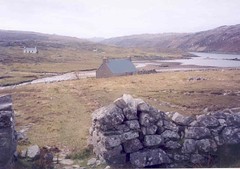
 Two interesting findings in the course of my local history research (see map above, click on markers to see locations). First was an interesting census record of the village of Crola. This is no longer inhabited. It stands at Kinlochresort, the head of Loch Resort, in the remote west of Lewis. In 1891, a shepherd's family resided there. Catherine Macdonald, aged 63, is quoted as a shepherd's widow, living there with her two fishermen sons John (41), Malcolm (26) and daughter Annie (22). There is also a granddaughter Ann, aged 13, presumably (but not certain) the child of John. Catherine's home is marked as having two rooms with windows. The noteworthy thing is that her offspring is marked as living in Lewis, whereas she and her granddaughter Ann, aged 13, are marked as being born in Harris. This is significant, because Lewis used to be part of Ross and Cromarty, and Harris was part of Inverness-shire.The confusion arises on account of the fact that the county boundary ran at Kinlochresort. On the Harris side of the river lies Luachair, also uninhabited today (white house in image to the right). Would you believe that there was once a school at Crola, which was a so-called side school to the main village school at Loch Croistean, a mere ten miles away. More stories on the local historical society website.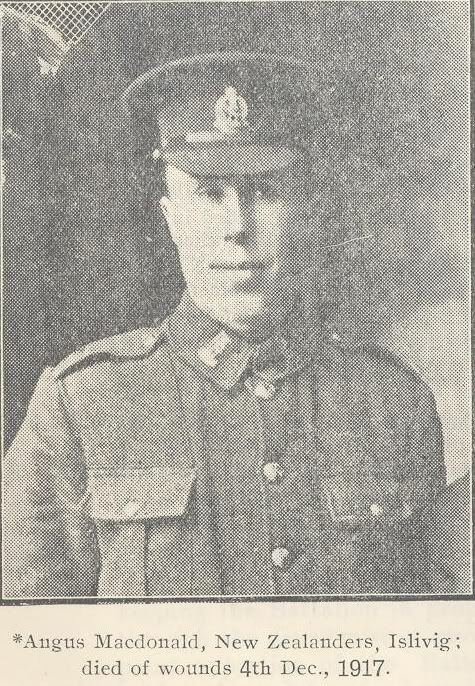
Thursday, 16 April 2009
Bragar Cemetery
One of men buried there, Duncan Macleod, died in 1943 whilst held in a POW camp in Burma. He himself is interred near the camp on the infamous Burma railway, where so many Allied POWs perished. His name is mentioned on one of the private gravestones at Bragar, and as I had him on record for the World War II memorial for Lewis, I looked into it further. I had little information on him, save that he came from Lochcroistean, a schoolhouse in the Uig district of Lewis.
His father was one of the school's headmasters, Norman Macleod, who held sway there until 1923. He died 20 January 1938 at the age of 75. He was married to Bell Ann Mackay, who died 8 December 1944 at the age of 69.
The website for the Commonwealth War Graves Commission interestingly state that they came from Tighnabruaich in Argyll. They had four children, two of whom (Iain and Chirsty Mary) died in infancy. Jessie died in May 1980 at the age of 73; their son Duncan died on 19 September 1943 at the age of 42.
Lochcroistean is located in a remote part of the island, but was itself a central school (of sorts). It acted as a hub for several side-schools, in places like Morsgail, Luachar and Ardbeag. The latter two places no longer exist. Luachar lies by the head of Loch Reasort, some 10 miles from Lochcroistean to the south; Ardbeag is even further away, by my estimation at least 15 miles to the southwest.
His father was one of the school's headmasters, Norman Macleod, who held sway there until 1923. He died 20 January 1938 at the age of 75. He was married to Bell Ann Mackay, who died 8 December 1944 at the age of 69.
The website for the Commonwealth War Graves Commission interestingly state that they came from Tighnabruaich in Argyll. They had four children, two of whom (Iain and Chirsty Mary) died in infancy. Jessie died in May 1980 at the age of 73; their son Duncan died on 19 September 1943 at the age of 42.
Lochcroistean is located in a remote part of the island, but was itself a central school (of sorts). It acted as a hub for several side-schools, in places like Morsgail, Luachar and Ardbeag. The latter two places no longer exist. Luachar lies by the head of Loch Reasort, some 10 miles from Lochcroistean to the south; Ardbeag is even further away, by my estimation at least 15 miles to the southwest.
Subscribe to:
Posts (Atom)