Aberdeen Weekly, 19 May 1877
THE DISTRESS IN ST KILDA
ARRIVAL OF HMS FLIRT IN ABERDEEN
Yesterday afternoon HM gunboat Flirt arrived in Aberdeen from Stornoway. She left Greenock on Tuesday 8 May for St Kilda, with provisions and seeds for the inhabitants. The island of St Kilda consists of three rocks, only one of which, however, is inhabited. It belongs to Macleod of Macleod. It is situated in the Atlantic 36 miles from the nearest island of the Hebrides - the Monach - and 70 miles from the mainland.
As we have reported from time to time, great privation existed on the island, and owing to the publicity given to the state of matters by the press, the Government took the matter up, and the result was the despatching of the Flirt with food. The Flirt arrived on the following Saturday night, and the captain got out the provisions, put them in the ship's boats for transference to the boats belonging to the islanders - the Flirt's boats being unable to reach the shore owing to the peculiar construction of the coast. It being Saturday night, however, the islanders refused to land them for fear of encroaching on the Sabbath. The anchorage at St Kilda being unsafe, Captain O'Rorke was very anxious to get the supplies ashore without unnecessary delay. He therefore went ashore and remonstrated with them, but acting on the instructions of the Free Church minister the islanders refused to land the goods. His remonstrances were unavailing and he was reluctantly obliged to reship the goods and remain till Monday. All the provisions were landed on Monday morning, between two o'clock and seven o'clock, and the vessel sailed for Stornoway at eight o'clock.
Staff-surgeon Scott went ashore and visited the sick, and sent all the medicines that were likely to be of any use on shore. There were no serious cases, the chief troubles being rheumatism and dyspepsia - the latter due to the nature of the food. The most of the inhabitants appeared healthy and well fed. The families live in 18 one-storey cottages, built of stone and roofed with zinc. The total number is 75 individuals. The officers of the Flirt attended the church on Sunday, the congregation of which numbered 40 women and 20 men. The service was conducted by the Rev Mr Mackay, who preached in Gaelic. The singing was of a most unusual description, and resembled the wailing of a pibroch. The men were dressed like Aberdeen fishermen. The women wore a Rob Roy tartan plaid folded over their heads, blue serge short petticoats reaching to their ankles. white stockings, and no shoes. The few that had shoes took them off immediately on entering the church, and put them on again when they retired.
Each house has about an acre of ground attached to it, in which are sown corn seed, potatoes &c. The occupation to which the inhabitants are most devoted is the catching of the fulma, a species of seagull. The capture of this bird is attended with great difficulty. The men are lowered down steep cliffs by means of ropes, and catch the birds in their nests. The egg of the fulma is larger than a turkey's. The flesh is eaten by the natives, and the oil and feathers are transported to Glasgow principally. There are about 600 sheep on the island, the pasture being very good. The turf is also used for fuel. It is collected, heaped up and covered over with stones until it dries. The inhabitants were very thankful for the stores brought to them by the Flirt. None of them speak English, with the exception of one woman - a Mrs Macdonald, from Skye - and she acted as interpreter to Dr Scott in his visits to the sick. Before the arrival of the Flirt, Macleod had sent a quantity of provisions, but the supply of weed was short. The islanders said they could make whisky from their barley, but that industry is discouraged by the clergyman.
Showing posts with label "st kilda". Show all posts
Showing posts with label "st kilda". Show all posts
Monday, 10 October 2011


Saturday, 21 May 2011
Trip to St Kilda
The Glasgow Herald, 14 June 1873
Our Stornoway correspondent writes:
Her Majesty's steamer Jackal (Lieutenant Clanchy commander), at present cruising about the Hebrides, an in charge of the fisheries at Barra, &c, recently visited St Kilda. After taking on board a supply of coal, the Jackal left Stornoway on Tuesday 3rd [June 1873] at 9 o'clock PM and arrived at the island the following morning, about ten o'clock. After a stay of two hours, the steamer took her departure, and returned to Stornoway harbour shortly after midnight same day, accomplishing the passage - via the Sound of Harris, a distance of nearly 200 miles - in about 27½ hours. The weather was all that could be wished by day and by night, and the waters of the Atlantic were as smooth as Stornoway Loch. The Kildeans, who presented a respecteable appearance, met those on board of the steamer at the landing place and gave them a hearty welcome, many of them speaking good English. The village is situated about a quarter of a mile from the bay on the southeast, the only accessible part of the island, and is in the form of a semi-circle. The houses are pretty well kept. The roofs are covered with zinc, this metal having been substituted by the proprietor some years ago, after the old roofs of the houses had been blown off by a gale of wind. At present, the general health of the people is good. During last year, there were five births, and what is very exceptional, all the children have lived. Of late years, few born in the island survived beyond infancy. The population is between 71 and 80, being an increase since the last census was taken. There is a minister placed over the people in connection with the Free Church, and a suitable church and manse have been built. Mr George Coats, Collector of Customs, Stornoway, and Receiver of Wreck for the Hebrides, went to visit the island on duty, in connection with the Board of Trade. It may be added that St Kilda is the most remote of the Hebridean group.
"Whose lonely race
Resigns the setting sun to Indian worlds "
The nearest land to it is Harris, and the Butt of Lews is 82 miles distant. It is about 3 miles long, from east to west; 2 broad, north to south; and 9½ miles in circumference. The proprietor is Macleod of Macleod.
[End of Article]
It is noteworthy that the censuses for 1871 and 1881 do not show Mr George Coats as collector of customs, or in any other capacity at Stornoway. Direcleit has summed up who the collectors were between 1841 and 1901.
The 1871 census shows that there were 71 people on St Kilda, spread out over 19 households.
Our Stornoway correspondent writes:
Her Majesty's steamer Jackal (Lieutenant Clanchy commander), at present cruising about the Hebrides, an in charge of the fisheries at Barra, &c, recently visited St Kilda. After taking on board a supply of coal, the Jackal left Stornoway on Tuesday 3rd [June 1873] at 9 o'clock PM and arrived at the island the following morning, about ten o'clock. After a stay of two hours, the steamer took her departure, and returned to Stornoway harbour shortly after midnight same day, accomplishing the passage - via the Sound of Harris, a distance of nearly 200 miles - in about 27½ hours. The weather was all that could be wished by day and by night, and the waters of the Atlantic were as smooth as Stornoway Loch. The Kildeans, who presented a respecteable appearance, met those on board of the steamer at the landing place and gave them a hearty welcome, many of them speaking good English. The village is situated about a quarter of a mile from the bay on the southeast, the only accessible part of the island, and is in the form of a semi-circle. The houses are pretty well kept. The roofs are covered with zinc, this metal having been substituted by the proprietor some years ago, after the old roofs of the houses had been blown off by a gale of wind. At present, the general health of the people is good. During last year, there were five births, and what is very exceptional, all the children have lived. Of late years, few born in the island survived beyond infancy. The population is between 71 and 80, being an increase since the last census was taken. There is a minister placed over the people in connection with the Free Church, and a suitable church and manse have been built. Mr George Coats, Collector of Customs, Stornoway, and Receiver of Wreck for the Hebrides, went to visit the island on duty, in connection with the Board of Trade. It may be added that St Kilda is the most remote of the Hebridean group.
"Whose lonely race
Resigns the setting sun to Indian worlds "
The nearest land to it is Harris, and the Butt of Lews is 82 miles distant. It is about 3 miles long, from east to west; 2 broad, north to south; and 9½ miles in circumference. The proprietor is Macleod of Macleod.
[End of Article]
It is noteworthy that the censuses for 1871 and 1881 do not show Mr George Coats as collector of customs, or in any other capacity at Stornoway. Direcleit has summed up who the collectors were between 1841 and 1901.
The 1871 census shows that there were 71 people on St Kilda, spread out over 19 households.
Friday, 8 April 2011
Napier witnesses: Angus Gillies
Angus Gillies can be seen in the 1881 census of St Kilda, aged 34, living with his parents Finlay (72) and Mary (66), wife Ann (39) as well as his sister Mary (41). His son Finlay (3) is present, as well as niece Mary Macqueen (9).
In 1891, he is shown just with his wife and son, and in 1901 the couple are living together at 6 St Kilda.
In 1871 Angus and Ann are shown at Finlay's house, with occupations cottar and cragsman. Also present is Angus's sister Merion, whom we saw in 1881 as Mary.
In 1861, we have a more complete picture of Angus's siblings: Ewen (19), Angus (14), John (23), Marion (21), Mary (17) and Christian (9).
Angus Gillies passed away on 4 March 1924, aged 77, having suffered from internal cancer for 3 years. He is mentioned as being from 6 Main Street, and his death was registered by his neighbours from no 7. Angus's widow, Annie, died a year later, aged 83.
In 1891, he is shown just with his wife and son, and in 1901 the couple are living together at 6 St Kilda.
In 1871 Angus and Ann are shown at Finlay's house, with occupations cottar and cragsman. Also present is Angus's sister Merion, whom we saw in 1881 as Mary.
In 1861, we have a more complete picture of Angus's siblings: Ewen (19), Angus (14), John (23), Marion (21), Mary (17) and Christian (9).
Angus Gillies passed away on 4 March 1924, aged 77, having suffered from internal cancer for 3 years. He is mentioned as being from 6 Main Street, and his death was registered by his neighbours from no 7. Angus's widow, Annie, died a year later, aged 83.
Wednesday, 6 April 2011
A tragedy at St Kilda
Further to the information on the death of Donald Macdonald in the previous post, I can add that an article in the Scottish Field Magazine explains that the accident occurred when the men's boat capsized when it got caught by a wave whilst returning from tending to sheep on Dun. Norman John Gillies says that his mother, who lost her two brothers Norman and John in the drowning, named him after her brothers.
Napier witnesses: Donald Macdonald, St Kilda
Donald Macdonald is quoted aged 36 at the time that he gives evidence to Lord Napier's Commission in St Kilda. We find him in the 1881 census as a joint crofter with his mother Cath (60). He is in the same household as his niece Christina Gillies (28) and young son Donald (5).
Ten years later, Donald can be seen with his wife Rachel, who is 20 years his junior. Whether this is accurate is debatable, as it would mean she had her son Donald (now 15) at the age of 11. They had Ewen (3) and Catherine (1) between 1881 and '91.
In 1901, Donald is listed at 16 Main Street, St Kilda, with Rachel and his children Ewen (12), Catherine (11), Angus (2), Donald (5) and Rachel (18 months). Mother Rachel is a handspinner of wool; Donald senior's occupation has been corrupted in transcription, but appears to read "Crofter, handloom weaver of wool".
Donald Macdonald drowned in Village Bay, St Kilda at 11 am on 22 March 1909, aged 66. He is only marked as 'married', with his parents names Donald Macdonald and Catherine Mackinnon. The entry on the death record is one of three men who all died in Village Bay on the same date. The others were married man Norman Macleod Macqueen (29) and John Macqueen (17), single - these two were brothers. As a result of this tragedy, the island school was closed for a week.
Rachel, Donald's widow, was evacuated from St Kilda with all other residents on 29 August 1930, aged 67, and ended up in Lochaline.
Ten years later, Donald can be seen with his wife Rachel, who is 20 years his junior. Whether this is accurate is debatable, as it would mean she had her son Donald (now 15) at the age of 11. They had Ewen (3) and Catherine (1) between 1881 and '91.
In 1901, Donald is listed at 16 Main Street, St Kilda, with Rachel and his children Ewen (12), Catherine (11), Angus (2), Donald (5) and Rachel (18 months). Mother Rachel is a handspinner of wool; Donald senior's occupation has been corrupted in transcription, but appears to read "Crofter, handloom weaver of wool".
Donald Macdonald drowned in Village Bay, St Kilda at 11 am on 22 March 1909, aged 66. He is only marked as 'married', with his parents names Donald Macdonald and Catherine Mackinnon. The entry on the death record is one of three men who all died in Village Bay on the same date. The others were married man Norman Macleod Macqueen (29) and John Macqueen (17), single - these two were brothers. As a result of this tragedy, the island school was closed for a week.
Rachel, Donald's widow, was evacuated from St Kilda with all other residents on 29 August 1930, aged 67, and ended up in Lochaline.
Tuesday, 5 April 2011
Napier witnesses: Rev John Mackay
Rev. John Mackay was Free Church minister in St Kilda at the time of the visit by Lord Napier. He had held this charge for 18 years by that time, and we see him in the 1881 census. At that time, he is aged 64 and is quoted at the St Kilda manse with housekeeper Ann Macdonald, 9-year old scholar John Macdonald (boarder) and 67-year old Ann Mackinlay, nurse and teacher. She hailed from Bracadale in Skye.
The entry for the minister in the 1871 census is not easily found, but is soon spotted among the 87 people present on the island of St Kilda. John (54) is joined at the FC Manse by his sister Marge (40) and Ann Macdonald, housekeeper. Rev Mackay, who had been in office in St Kilda since 1844, does not show up on the 1851 or 1861 censuses. St Kilda cannot be differentiated in the 1841 census.
By 1891, the Rev Angus Viddes (48) is on the census as United Free Church minister for St Kilda, in the company of Catherine Maclennan (59), domestic servant, born in the district of Carloway in Lewis and a Jessie 'Chrouabl', a nurse. This minister, his surname transmuted to Fiddes, remains on St Kilda at the time of the 1901 census. He is quoted as being born at Tarbat in Rossshire.
The church history for St Kilda is adequately summarised on this Wikipedia page.
The entry for the minister in the 1871 census is not easily found, but is soon spotted among the 87 people present on the island of St Kilda. John (54) is joined at the FC Manse by his sister Marge (40) and Ann Macdonald, housekeeper. Rev Mackay, who had been in office in St Kilda since 1844, does not show up on the 1851 or 1861 censuses. St Kilda cannot be differentiated in the 1841 census.
By 1891, the Rev Angus Viddes (48) is on the census as United Free Church minister for St Kilda, in the company of Catherine Maclennan (59), domestic servant, born in the district of Carloway in Lewis and a Jessie 'Chrouabl', a nurse. This minister, his surname transmuted to Fiddes, remains on St Kilda at the time of the 1901 census. He is quoted as being born at Tarbat in Rossshire.
The church history for St Kilda is adequately summarised on this Wikipedia page.
Sunday, 5 December 2010
Lady Grange on St Kilda
Rachel Chiesley, who is also known as Lady Grange, died in 1745 after spending 13 years in enforced exile on remote islands off the Scottish west coast. In 1732, she separated from her husband, James Erskine, Lord Grange and Lord Advocate. She accused him of having Jacobite leanings, something that caused her to be declared insane. Lady Grange was declared dead, but whilst her funeral was in progress, she was being shipped off to the Scottish west coast.
The first two years of her exile were spent in the Monach Isles, six miles west of North Uist. In 1734, she was transferred to St Kilda, where she apparently lived in miserable circumstances - in a cleit. After being spirited off the island in a hurry in 1740, she was taken to various other locations, but finally ended her days in Skye, where she died in 1745.
I wonder whether the account of her story was an inspiration to Robert Louis Stevenson's Kidnapped, which is set at around the same time. An extensive account can be read on Wikipedia.
The first two years of her exile were spent in the Monach Isles, six miles west of North Uist. In 1734, she was transferred to St Kilda, where she apparently lived in miserable circumstances - in a cleit. After being spirited off the island in a hurry in 1740, she was taken to various other locations, but finally ended her days in Skye, where she died in 1745.
I wonder whether the account of her story was an inspiration to Robert Louis Stevenson's Kidnapped, which is set at around the same time. An extensive account can be read on Wikipedia.
Monday, 30 August 2010
30 August 1930
On that day, the villagers of St Kilda were packing up their belongings, before leaving the island of their birth forever. Some left a bowl of grain on the table, with the Bible open at the chapter of Exodus. A community, a culture, a way of life was coming to a close after thousands of years. Life on their outpost in the Atlantic had become untenable, to their minds, and the Hiorteachs had requested their own removal. The steamer Harebell took them to the village of Lochaline, on the mainland and on to Glasgow.
A lot has been written about St Kilda, with insights changing as the years and researches progress. Someone has recently mooted the idea to repopulate the islands with permanent inhabitants - an idea that is as fanciful as it is unrealistic. Even today, with modern, powerful boats, it is not always possible to cross the sea to the islands. In the past, there would be no communication with St Kilda for 8 months of the year, due to the severity of the weather and the ocean. That has not changed.
Work is in progress to establish a St Kilda Centre at Mangersta in Lewis, where culture and history of St Kilda will be remembered. For it is no longer alive.
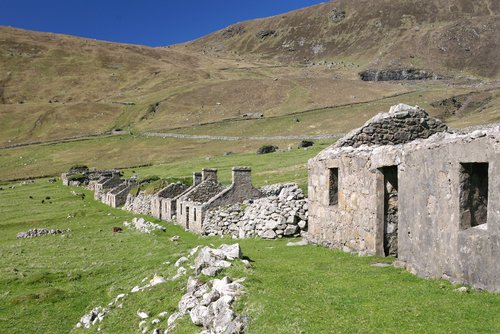
Image courtesy planetware.com
A lot has been written about St Kilda, with insights changing as the years and researches progress. Someone has recently mooted the idea to repopulate the islands with permanent inhabitants - an idea that is as fanciful as it is unrealistic. Even today, with modern, powerful boats, it is not always possible to cross the sea to the islands. In the past, there would be no communication with St Kilda for 8 months of the year, due to the severity of the weather and the ocean. That has not changed.
Work is in progress to establish a St Kilda Centre at Mangersta in Lewis, where culture and history of St Kilda will be remembered. For it is no longer alive.
Image courtesy planetware.com
Monday, 24 May 2010
Napier Commission in St Kilda
On August 29th this year, it will be 80 years ago since the people of St Kilda left their native isle, never to return (to live there). They had requested to be removed as life there had become untenable. It is perhaps noteworthy to read the submissions to the Napier Commission, which visited St Kilda in June 1883. The replies by the three people who were called to give evidence have been transcribed into separate postings on the blog. Read the entries first, then return here, I ask.
In order to get an idea of the attitude of the “have’s” versus the “have-nots” of the day, I copy a few lines from a submission from the factor for St Kilda, in effect the landowner’s manager of the islands. John T. Mackenzie was not a bad man, as he did not pressurise any people if they could not pay the rent. Others in his position would have their tenants evicted in case of default.
I can tell you that I have found the attitude, stated in the blockquote from John T. Mackenzie above, echoed to this day in certain quarters of those studying the social history of the Highlands and Islands. I am still angry at the Scottish First Minister who hailed the achievements of the emigrant Highlanders overseas, without making reference to the fact that many of them were kicked out under the most excruciating circumstances. Achievements that certainly deserve to be acknowledged - but why were they not allowed to make them at home.
I’ll get off my high horse now.
In order to get an idea of the attitude of the “have’s” versus the “have-nots” of the day, I copy a few lines from a submission from the factor for St Kilda, in effect the landowner’s manager of the islands. John T. Mackenzie was not a bad man, as he did not pressurise any people if they could not pay the rent. Others in his position would have their tenants evicted in case of default.
[...] the ” land question” to a great extent is in the hands of educated people, who know the danger of breaking the law, and who are responsible for their own actions. The crofter grievance is the ” land question ” in another form, but in the hands of a class who, fancying they have some hardships, know not what to do, but who are under the guidance and advice of irresponsible and, I am afraid in many cases, of thoughtless leaders, eager to gain notoriety through the simplicity and credulity of their followersIf you feel anger when seeing condescension and arrogance at such a breathtaking degree, stop for a minute and reflect upon the era we’re talking about. In the Great Britain of 1883, there was a gaping divide between classes in society. St Kilda people were regarded as “noble savages”, who could not look after themselves, and needed the benevolent hand of an educated and munificent landowner to guide their ignorant ways. Looking at this from a 21st century perspective, it is in fact the landowners who contributed in no mean proportion to the plight of their tenants - as the Napier Commission was finding out in 1883. Not all lairds were bad and evil, and neither were all their agents.
I can tell you that I have found the attitude, stated in the blockquote from John T. Mackenzie above, echoed to this day in certain quarters of those studying the social history of the Highlands and Islands. I am still angry at the Scottish First Minister who hailed the achievements of the emigrant Highlanders overseas, without making reference to the fact that many of them were kicked out under the most excruciating circumstances. Achievements that certainly deserve to be acknowledged - but why were they not allowed to make them at home.
I’ll get off my high horse now.
Wednesday, 28 April 2010
St Kilda
his year, it will be 80 years ago since the islanders of St Kilda (Hiort) were evacuated to the Scottish mainland at their own request. It was on 29th August 1930 that the culture of St Kilda died with the passing to other shores of its inhabitants. This evening, Monty Halls in his Hebridean Hideaway visited the islands. The scenery was absolutely stunning. But otherwise, there was nothing there. There are no permanent residents left, the houses are ruinous, with a few exceptions, and the storage huts (cleits) stand empty and derelict. In other words, St Kilda is dead.
Monty Halls, who stayed in North Uist for six months from July 2009 onwards, got involved with the controversy surrounding the location of the St Kilda Centre. It will be a point where the culture and people of St Kilda will be celebrated and kept alive. The strife was bitter, and already reflected in Monty's programme. The other contestants were Mangersta (Lewis) and Leverburgh (Harris). Cleitraval (North Uist) is a hilltop location near Sollas, where a plaque sits on the hill, pointing out where St Kilda can be seen, 41 miles (70 km) away to the west.
In the end, the St Kilda Centre was allocated to Lewis, and will be erected off the road between Mangersta and Islivig, overlooking the cliffs of Mangersta to be reminiscent of the St Kilda clifftops. (This link will take you to the location courtesy Google Streetview). The people of Harris and North Uist are deeply upset over losing out over the centre. It will obviously bring tourists to the location involved, and Uig (in which Mangersta lies) can very well do with the revenue.
Some people in these islands have voiced misgivings over having a St Kilda Centre in the first place. I can have some sympathy with those who say it is not right to make money off people who were cruelly neglected by the Government of the day - and neglected they were. Conversely though, nothing will bring them back, and it is a way of keeping their memory and the memory of their culture alive.
Monty Halls, who stayed in North Uist for six months from July 2009 onwards, got involved with the controversy surrounding the location of the St Kilda Centre. It will be a point where the culture and people of St Kilda will be celebrated and kept alive. The strife was bitter, and already reflected in Monty's programme. The other contestants were Mangersta (Lewis) and Leverburgh (Harris). Cleitraval (North Uist) is a hilltop location near Sollas, where a plaque sits on the hill, pointing out where St Kilda can be seen, 41 miles (70 km) away to the west.
In the end, the St Kilda Centre was allocated to Lewis, and will be erected off the road between Mangersta and Islivig, overlooking the cliffs of Mangersta to be reminiscent of the St Kilda clifftops. (This link will take you to the location courtesy Google Streetview). The people of Harris and North Uist are deeply upset over losing out over the centre. It will obviously bring tourists to the location involved, and Uig (in which Mangersta lies) can very well do with the revenue.
Some people in these islands have voiced misgivings over having a St Kilda Centre in the first place. I can have some sympathy with those who say it is not right to make money off people who were cruelly neglected by the Government of the day - and neglected they were. Conversely though, nothing will bring them back, and it is a way of keeping their memory and the memory of their culture alive.
Saturday, 29 August 2009
29 August 1930
It was 79 years ago since the last few dozen people were evacuated from the archipelago of St Kilda (Hiort), 40 miles west of the Outer Hebrides. The move, requested by the people themselves, came in the wake of a decline in population and the increasing problems posed by their remoteness. St Kilda has remained without permanent habitation since, with only Ministry of Defense personnel monitoring the rocket range on Uist and National Trust for Scotland staff looking after the remains of the houses there. Upon departing their shores, the St Kildans left a handful of grain on their tables, alongside the family bible, opened at the chapter Exodus.
A few houses have been restored, and cruiseliners regularly call in the summer. Reaching the islands is still difficult, due to the weather and sea conditions found in the North Atlantic. Efforts have been made to retain the history and culture of the islands, and quite a few books have been written. Yesterday was the first-ever St Kilda day. It is a good thing to celebrate culture. Celebrating an extinct culture in 21st century fashion is something that doesn’t sit very easy with me.
A few houses have been restored, and cruiseliners regularly call in the summer. Reaching the islands is still difficult, due to the weather and sea conditions found in the North Atlantic. Efforts have been made to retain the history and culture of the islands, and quite a few books have been written. Yesterday was the first-ever St Kilda day. It is a good thing to celebrate culture. Celebrating an extinct culture in 21st century fashion is something that doesn’t sit very easy with me.
Sunday, 18 December 2005
Pollution
Pollution is not a word commonly associated with the Hebrides. Certainly not when I mention that I'm referring to St Kilda. It would appear that pollution was one of the factors that led to the demise of that community. Strange, but true.
The two main pollutants were heavy metals and dioxins. Heavy metals are present in fatty deposits in seabirds. The elements concerned are zinc, cadmium, platinum and many others. The people on St Kilda lived off seabirds, which were culled from the islands' cliffs. After eating the birds, the remains were disposed off by plouging into the earth for the purpose of fertilisation. Once crops were harvested, the heavy metals would come back to the islanders. Heavy metals are toxic.
Dioxins are the products of combustion of carbon-based fuels in the presence of chlorine. They are very toxic at low concentrations. The islanders on St Kilda used peat for fuel. As the islands are only small, the soil is impregnated with salt, which (chemically) is sodium chloride. When the peats are burned, dioxins are formed. These are present in the smoke and the ashes. In the original blackhouse, there is no such thing as a chimney stack; smoke would dissipate through the thatch. After the peat had burned out, the ashes were scattered on the floor. Behold an environment rich in dioxins.
One of the more poignant aspects of life on St Kilda was its incredible infant mortality rate: 50%. Only 1 out of every 2 babies born would survive the first year of life. It was thought that the deaths were caused by infant tetanus (tetanus is commonly known as lockjaw). When a child was born on St Kilda, some fulmar oil would be applied to the umbilical stump after the umbilical cord was cut. Fulmar oil was kept in a dedicated bottle, but not at all in sterile conditions.
Recent research has suggested that the tetanus bacterium was not present in the oil at all, but in the soil.
The 8-day illness was thought to be the result of unhygienic living conditions, pollution by heavy metals and dioxins. It was eradicated after 1891 following the introduction of hygienic nursing practices.
Postscript: I do want to stress that many factors contributed to the decline and death of the community of St Kilda, but it would appear that health related problems were one of the main causes.
The two main pollutants were heavy metals and dioxins. Heavy metals are present in fatty deposits in seabirds. The elements concerned are zinc, cadmium, platinum and many others. The people on St Kilda lived off seabirds, which were culled from the islands' cliffs. After eating the birds, the remains were disposed off by plouging into the earth for the purpose of fertilisation. Once crops were harvested, the heavy metals would come back to the islanders. Heavy metals are toxic.
Dioxins are the products of combustion of carbon-based fuels in the presence of chlorine. They are very toxic at low concentrations. The islanders on St Kilda used peat for fuel. As the islands are only small, the soil is impregnated with salt, which (chemically) is sodium chloride. When the peats are burned, dioxins are formed. These are present in the smoke and the ashes. In the original blackhouse, there is no such thing as a chimney stack; smoke would dissipate through the thatch. After the peat had burned out, the ashes were scattered on the floor. Behold an environment rich in dioxins.
One of the more poignant aspects of life on St Kilda was its incredible infant mortality rate: 50%. Only 1 out of every 2 babies born would survive the first year of life. It was thought that the deaths were caused by infant tetanus (tetanus is commonly known as lockjaw). When a child was born on St Kilda, some fulmar oil would be applied to the umbilical stump after the umbilical cord was cut. Fulmar oil was kept in a dedicated bottle, but not at all in sterile conditions.
Recent research has suggested that the tetanus bacterium was not present in the oil at all, but in the soil.
The 8-day illness was thought to be the result of unhygienic living conditions, pollution by heavy metals and dioxins. It was eradicated after 1891 following the introduction of hygienic nursing practices.
Postscript: I do want to stress that many factors contributed to the decline and death of the community of St Kilda, but it would appear that health related problems were one of the main causes.
Subscribe to:
Posts (Atom)