On 9 June 1888, Annie Macleod, living in the village of Knock, Point (in Lewis), gave birth to another child, Donald. He was the sixth, and not the last child. Two more followed, and by the start of 1894, eight children, varying in ages from 1 to 15 years, crowded into the dwelling. It drove the father, Hector, to distraction, to such an extent that he ended his life in September that year. Three months later, Annie also passed away.
The eight youngsters were taken into the care of the Quarrier Homes in Glasgow, and emigrated to Canada two years later.
Donald signed up for the Canadian Expeditionary Force at Calgary in October 1914, and was injured during the Battle of the Somme. He was transferred to War Hospital at Napsbury, where he passed away on 4 August 1916, at 9.45pm.
Due to an error in the paperwork, his remains were transferred to Benbecula, rather than Lewis, and the next-of-kin notified. The next of kin was thought to be Alex Macleod of Gramsdale, but when Alex came to the quayside at Peter Port in Benbecula, he did not recognise the dead man as his son. Nobody came to claim the soldier's remains, so the authorities interred it at Nunton, Benbecula, after a week. Donald Macleod, son of Alex, was alive, also serving with the Canadian Forces, and under a service number that only differed from the Lewis man by one digit. The Benbecula Donald Macleod was 79119, the Lewis man was 79110. Donald Macleod, Gramsdale, lived until 1952.
It has taken a century for this mystery to be cleared up. This morning, three islanders stood by Donald's grave in Nunton Cemetery, and remembered his sacrifice. I did so from 64 miles away in Stornoway.
Showing posts with label uist. Show all posts
Showing posts with label uist. Show all posts
Thursday, 4 August 2016


Friday, 7 November 2014
Remember, remember, the 11th of November
Armistice Day is nearly upon us, and I feel it is appropriate
to post a reminder of my links that commemorate the Fallen from the
Outer Hebrides in both World Wars.
Centenary of Sacrifice is an on-going project, which will post the names of all the Fallen from these islands on the date, 100 years later, on which they died.
Isle of Lewis
Faces from the Lewis War Memorial
A listing of the casualties from Lewis from WW1.
Lewismen lost in the Great War
A listing of the casualties from Lewis from WW1, including all available information (e.g. images of war graves, transcript of Stornoway Gazette tributes etc).
Roll of Honour, Isle of Lewis 1914-1919
A transcript of Loyal Lewis, Roll of Honour, listing all from the island who served during WW1
Tributes for the War Memorial
A transcript of tributes from the Stornoway Gazette to WW1 casualties from Lewis
Tributes for the War Memorial (WW2)
A transcript of tributes from the Stornoway Gazette to WW2 casualties from Lewis
John Macaulay RNR and SS Kenmare
The story of one WW1 casualty, the ship on which he died and the U-boat that launched the fatal torpedo
Lewismen in Australian service
A listing of those WW1 casualties who served with the Australian forces
Lewismen in Canadian service
A listing of those WW1 casualties from Lewis who served with the Canadian Expeditionary Force
Lewismen from the 2nd Seaforth Highlanders
A listing of WW1 casualties from the 2nd battalion Seaforth Highlanders , accompanied by transcripts from the battalion war diary for the day on which they died.
Iolaire Disaster 1919
Listing of all casualties who died in the sinking of HMY Iolaire on New Year's Day 1919
HMS Timbertown
About the internment camp at Groningen, Holland, where 105 Lewismen were interned during WW1
World War II tribute for Lewis
A listing of WW2 casualties from Lewis
Wargraves in Lewis
Photographs of all CWGC and private wargraves in Lewis and information on the casualties
War memorials in Lewis
Photographs of all war memorials in Lewis with transcripts.
Southern Isles
Outer Hebrides losses in the Great War
A listing of military and personal details of the WW1 casualties from Harris, Berneray, North Uist, Grimsay, South Uist, Eriskay and Barra
Berneray to Vatersay tribute
A listing of the WW1 and WW2 casualties from Berneray, North Uist, Grimsay, South Uist, Eriskay and Barra
Harris War Memorial
A listing of the casualties from Harris from WW1 and WW2.
Western Isles wargraves
A listing of all wargraves in the Western Isles, listed by cemetery
Western Isles war memorials
A listing of all war memorials in the Western Isle
Other
Lyness Royal Naval Cemetery
A listing of photographs of wargraves and military information of the casualties, interred at the Lyness Royal Naval Cemetery in Orkney
Centenary of Sacrifice is an on-going project, which will post the names of all the Fallen from these islands on the date, 100 years later, on which they died.
Isle of Lewis
Faces from the Lewis War Memorial
A listing of the casualties from Lewis from WW1.
Lewismen lost in the Great War
A listing of the casualties from Lewis from WW1, including all available information (e.g. images of war graves, transcript of Stornoway Gazette tributes etc).
Roll of Honour, Isle of Lewis 1914-1919
A transcript of Loyal Lewis, Roll of Honour, listing all from the island who served during WW1
Tributes for the War Memorial
A transcript of tributes from the Stornoway Gazette to WW1 casualties from Lewis
Tributes for the War Memorial (WW2)
A transcript of tributes from the Stornoway Gazette to WW2 casualties from Lewis
John Macaulay RNR and SS Kenmare
The story of one WW1 casualty, the ship on which he died and the U-boat that launched the fatal torpedo
Lewismen in Australian service
A listing of those WW1 casualties who served with the Australian forces
Lewismen in Canadian service
A listing of those WW1 casualties from Lewis who served with the Canadian Expeditionary Force
Lewismen from the 2nd Seaforth Highlanders
A listing of WW1 casualties from the 2nd battalion Seaforth Highlanders , accompanied by transcripts from the battalion war diary for the day on which they died.
Iolaire Disaster 1919
Listing of all casualties who died in the sinking of HMY Iolaire on New Year's Day 1919
HMS Timbertown
About the internment camp at Groningen, Holland, where 105 Lewismen were interned during WW1
World War II tribute for Lewis
A listing of WW2 casualties from Lewis
Wargraves in Lewis
Photographs of all CWGC and private wargraves in Lewis and information on the casualties
War memorials in Lewis
Photographs of all war memorials in Lewis with transcripts.
Southern Isles
Outer Hebrides losses in the Great War
A listing of military and personal details of the WW1 casualties from Harris, Berneray, North Uist, Grimsay, South Uist, Eriskay and Barra
Berneray to Vatersay tribute
A listing of the WW1 and WW2 casualties from Berneray, North Uist, Grimsay, South Uist, Eriskay and Barra
Harris War Memorial
A listing of the casualties from Harris from WW1 and WW2.
Western Isles wargraves
A listing of all wargraves in the Western Isles, listed by cemetery
Western Isles war memorials
A listing of all war memorials in the Western Isle
Other
Lyness Royal Naval Cemetery
A listing of photographs of wargraves and military information of the casualties, interred at the Lyness Royal Naval Cemetery in Orkney
Tuesday, 30 September 2014
Thomas Coull
The war memorial for North Uist at Clachan lists Thomas Coull, Fairfield Works as one of the casualties from the First World War. Although he is referred to as a private, it soon becomes clear that he was a civilian.
The Fairfield Works was a shipyard in Govan, Glasgow. Thomas's death certificate says he was an iron driller at the yard, living at 1269 Govan Road. He was aged 23, the son of James and Sarah-Ann Coull. Thomas died at 11.55pm on 1 June 1915, having suffered from meningitis for eight days. His death was reported by his brother Duncan.
Thomas also had a brother, Frank, who had joined the Royal Engineers. He died in military hospital at Etaples, on the northwestern coast of France, in 1919. Research into Frank Coull yielded the census return for 1901 from which the above information on Thomas was corroborated.
Frank appears in the 1901 census aged 17, a game watcher, the son of James (48) and Sarah Ann (47) and brother of Rhoda (15), William James (13) and Duncan (11) and Thomas (8). That same census also shows that Thomas was born in South Knapdale, an area in the Kintyre peninsula of Argyll. His father was born in Strath (Isle of Skye), and his mother came from Devon.
The Fairfield Works was a shipyard in Govan, Glasgow. Thomas's death certificate says he was an iron driller at the yard, living at 1269 Govan Road. He was aged 23, the son of James and Sarah-Ann Coull. Thomas died at 11.55pm on 1 June 1915, having suffered from meningitis for eight days. His death was reported by his brother Duncan.
Thomas also had a brother, Frank, who had joined the Royal Engineers. He died in military hospital at Etaples, on the northwestern coast of France, in 1919. Research into Frank Coull yielded the census return for 1901 from which the above information on Thomas was corroborated.
Frank appears in the 1901 census aged 17, a game watcher, the son of James (48) and Sarah Ann (47) and brother of Rhoda (15), William James (13) and Duncan (11) and Thomas (8). That same census also shows that Thomas was born in South Knapdale, an area in the Kintyre peninsula of Argyll. His father was born in Strath (Isle of Skye), and his mother came from Devon.
Friday, 1 August 2014
Tipperton, South Uist
During my recent visit to South Uist, I came across a house called Tipperton (Tobar Tiobairt), near the Polochar Inn on the extreme southwestern point of the island. Searching the Internet revealed the Gaelic name, and the story of human remains found in a crouching position nearby. The 2005 hurricane caused severe coastal erosion in the area. Tipperton was the home of James and Margaret Morrison, both now deceased. James died in 1979, aged 85, and is pictured with a bottle of "Politician" whisky in this tweet from Struileag. His wife Margaret followed him out of this world in 1996, aged 93. The Hallan Cemetery website gives further information on the two people that lived at Tipperton.
Sunday, 8 December 2013
Second World War casualties from the Southern Isles
Completed the WW2 listings from the Southern Isles.
Barra & Vatersay: 55 (51 served in the Merchant Navy).
Benbecula: 6
Berneray: 4
Eriskay: 5
Grimsay: 3
Harris: 62
North Uist: 30
South Uist: 41
Total: 211 (there is a degree of cross-over between the islands)
1939: 4
1940: 44
1941: 36
1942: 25
1943: 19
1944: 20
1945: 11
and 4 died in 1946 and 1947
There are 48 casualties on whom I have very little information.
Of the 211 casualties:
121 were in the Merchant Navy
55 were in the Army, of whom 28 in the Queen's Own Cameron Highlanders
13 in the RAF
19 in the Royal Navy or Royal Naval Reserves
4 were women
Barra & Vatersay: 55 (51 served in the Merchant Navy).
Benbecula: 6
Berneray: 4
Eriskay: 5
Grimsay: 3
Harris: 62
North Uist: 30
South Uist: 41
Total: 211 (there is a degree of cross-over between the islands)
1939: 4
1940: 44
1941: 36
1942: 25
1943: 19
1944: 20
1945: 11
and 4 died in 1946 and 1947
There are 48 casualties on whom I have very little information.
Of the 211 casualties:
121 were in the Merchant Navy
55 were in the Army, of whom 28 in the Queen's Own Cameron Highlanders
13 in the RAF
19 in the Royal Navy or Royal Naval Reserves
4 were women
Saturday, 28 July 2012
The Danish connection
Crossposted from Atlantic Lines
This evening, I found a comment, made on one of my local history sites by a Danish man who had visited the Outer Hebrides. Upon crossing North Uist, he visited the cemetery of Clachan Sands, about 6 miles west of Lochmaddy on the road to Berneray. I visited that graveyard in July 2009 and photographed the gravestone of Ewen Nicholson, who was lost during the First World War. An image of the actual gravestone in the Railway Dugouts Cemetery can be viewed on this link.
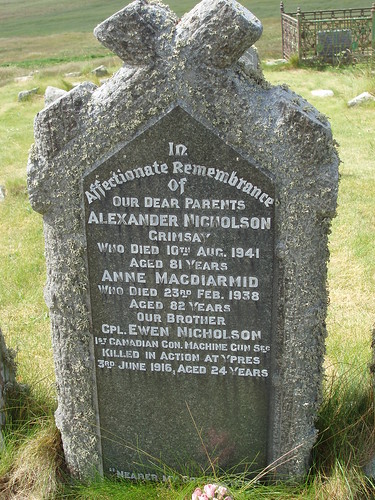
My Danish correspondent researched the fate of Ewen, displaying some very graphic and gruesome images of conditions on the frontline. I have looked into Ewen Nicholson's information and came out with the following:
Ewen Nicholson
Born: Grimsay, North Uist
Date of birth: 29 May 1892
Trade / calling: Labourer
Married: No
Volunteered at Valcartier on 23 September 1914
Age upon enlistment: 22 years 4 months
Height: 5 ft 10¼ in
Complexion: fresh
Eyes: light brown
Hair: brown
Religious denomination: presbyterian
Son of Alexander and Ann Nicholson, of Grimsay, Lochmaddy, North Uist.
Last known address in North Uist: 4 Aird nan Sruban Grimsay
Military unit: 7th Canadian Infantry (British Columbia Regiment)
Service number: 21065
Date of death: 3 June 1916 at the age of 24
Interred: Railway Dugouts Burial Ground, Sp Mem G. 29
In 1901, Ewen was 8 years old. His father Alexander was a crofter, 41 years of age, married to Ann. There were four other children in the family: Mary (12), John Archie (10), Alexander (5) and Andrew John Macalpine, age 1 month.
Five days after his 24th birthday, Ewen lost his life in fierce battles near Ypres. He was buried in one of the many cemeteries around the town.
This evening, I found a comment, made on one of my local history sites by a Danish man who had visited the Outer Hebrides. Upon crossing North Uist, he visited the cemetery of Clachan Sands, about 6 miles west of Lochmaddy on the road to Berneray. I visited that graveyard in July 2009 and photographed the gravestone of Ewen Nicholson, who was lost during the First World War. An image of the actual gravestone in the Railway Dugouts Cemetery can be viewed on this link.
My Danish correspondent researched the fate of Ewen, displaying some very graphic and gruesome images of conditions on the frontline. I have looked into Ewen Nicholson's information and came out with the following:
Ewen Nicholson
Born: Grimsay, North Uist
Date of birth: 29 May 1892
Trade / calling: Labourer
Married: No
Volunteered at Valcartier on 23 September 1914
Age upon enlistment: 22 years 4 months
Height: 5 ft 10¼ in
Complexion: fresh
Eyes: light brown
Hair: brown
Religious denomination: presbyterian
Son of Alexander and Ann Nicholson, of Grimsay, Lochmaddy, North Uist.
Last known address in North Uist: 4 Aird nan Sruban Grimsay
Military unit: 7th Canadian Infantry (British Columbia Regiment)
Service number: 21065
Date of death: 3 June 1916 at the age of 24
Interred: Railway Dugouts Burial Ground, Sp Mem G. 29
In 1901, Ewen was 8 years old. His father Alexander was a crofter, 41 years of age, married to Ann. There were four other children in the family: Mary (12), John Archie (10), Alexander (5) and Andrew John Macalpine, age 1 month.
Five days after his 24th birthday, Ewen lost his life in fierce battles near Ypres. He was buried in one of the many cemeteries around the town.
Wednesday, 6 June 2012
Alexander Carmichael Watson
Today, 100 years ago, Alexander Carmichael Watson passed away at the age of 80. In his time, Carmichael Watson travelled the length and breadth of the Hebrides, amassing a vast collection of folk-lore. The Carmichael Watson project have been working hard to digitise this collection, which you can access here.
Anyone who is near one of Carmichael Watson's abodes is invited to take a picture and share it with the project on its Facebook page.
Alexander Carmichael Watson was born and lies buried in the Isle of Lismore, a few miles northwest of Oban.
Anyone who is near one of Carmichael Watson's abodes is invited to take a picture and share it with the project on its Facebook page.
Alexander Carmichael Watson was born and lies buried in the Isle of Lismore, a few miles northwest of Oban.
Thursday, 31 March 2011
Boreray, 1851
Boreray is a small island off the north coast of North Uist, which suffered a population decline during the 19th century. From 181 in 1841, down to 151 in 1851 it now has just 1 permanent inhabitant. More on the island's history on this page on the Boreray Island website. It features in the Napier Report, but Boreray is not distinguishable in any of the 19th century censuses, except for 1851. In that year, 29 families were recorded in Boreray. A number of visitors, mostly young children, as well as a Sheriff's Officer, are also on the listings. I give the breakdown below. All those mentioned were born in the parish of North Uist, except where indicated otherwise.
(1)
Evan Mcdagald junior (60) Head, Farmer of 8 acres
Maron Mcdugald (47) Wife,
Children: Euphemia (21), Christian (17), Catharine (12), Hector (10, Scholar), Maron (8) and Cein (6)
Visitor: Archibald Mclean (37) Sheriff Officer
(2)
John Macdougald (64) Head, Farmer of 8 acres
Children: Meron (28), Euphemia (22), Peggy Macdougald (20), Christian (18, Weaver), Niel (16, Scholar) and John (12, Scholar)
(3)
Peter Macintosh (23) Head, Farmer of 3 acres
Catharin Macintosh (23) Wife,
Child: Ronald Macintosh (6 months)
(4)
John Macdonald (54) Head, Farmer 16 acres
Meron Macdonald (36) Wife,
Children: Peggy Macdonald (17), Angus Macdonald (15), Meron (13), Donald (10), Niel (7), and
Euphemia (9 months)
Visitors: Catharine Macrailt (32, Cottager), Kenneth (8), Donald (6), John (3): all born in Harris
(5)
John Macdonald (32) Head, Ag Labourer
Mary Macdonald (31) Wife, Weaver
(6)
Niel Macphail (36) Head, Tailor
Meron Macphail (30) Wife,
Children: Niel (5, Scholar) and Catharine (1, Scholar)
(7)
Catharine Macvicar (57) Head, Farmer of 16 acres
Children: Ronald Macvicar (25), Donald (22), Alexander (17), Niel (14, Scholar)
Visiting grandson: John Macdonald (10)
(8)
Archibald Macdougald (58) Head, Ag Labourer
Children: Euphemia (21), Margaret (18), Niel (15), Ann (11), Lexy (9), and John (6)
(9)
Catharine Maclean (62) Head, Farmer of 16 acres
Stepchildren: Margaret Maclean (34), Meron Maclean (32), Donald Maclean (30)
Son: Allan Maclean (27)
Visitors: Christian Munro (4) and Rabecca Macleod (50) (born in Harris)
(10)
Donald Maclean (40) Head, Farmer of 8 acres
Margaret Maclean (40) Wife,
Children: Ann (16), Ronald (10, scholar), Catharine (8), Allan (6, Scholar)
(11)
Meron Macdonald (52) Head, Farmer of 8 acres
Children: Rachel (17), Mary (15) and Donald (13)
(12)
Alexander Macdonald (54) Head, Farmer of 8 acres
Euphemia Macdonald (40) Wife,
Roderick Macdonald (57) Brother,
Children: Angus (16), Donald (13), John (11, scholar), Malcolm (8, scholar), Donald jr (5), Catharine (4 months)
(13)
Angus Macintosh (60) Head, Farmer of 8 acres
Margaret Macintosh (50) Wife,
Children: Isabella (19), Mary (14), Christian (12), Maryann (9),
Visitors: James Macintosh (51, Cottager), Isabella Macintosh (15, Cottar's daughter)
(14)
Allan Macdonald (60) Head, Farmer of 16 acres
Meron Macdonald (58) Wife,
Norman Macdonald (16) Servant, Ag Labourer (it is not clear if Norman is one of Allan's children)
Children: Donald (39, Boat carpenter), Finlay (34, Ground officer) and Margaret (21)
(15)
Donald Mackinnon (40) Head, Boat carpenter (born in Greenock)
Christian Mackinnon (33) Wife
Children: Donald (7, Scholar), Mary (4) and Peggy (1)
(16)
Euphemia Macdonald (23) Head, Cottager
Angus Macdonald (21) Brother, Ag Labourer
(17)
Alexander Maclean (56) Head, Cottager
Mary Maclean (42) Wife,
Children: Mary (14), Ann (8), Margaret (4)
(18)
Angus Macdonald (23) Head, Ag Labourer
Euphemia Macdonald (14) Sister,
Allan Macdonald (11) Brother,
(19)
John Munro (23) Head, Ag labourer (born in Skye)
Mary Munro (23) Wife,
Children: Anna (2) and Donald (7)
(20)
Donald Maclean (66) Head, Farmer of 4 acres
Catharine Maclean (65) Wife, Farmer wife
Children: Meron (27), Niel (22) and Euphemia (19)
Visiting granddaughter: Mary Macintosh (4)
(21)
Alex P Macdonald (42) Head, Farmer of 8 acres
Dorady Macdonald (30) Wife,
Children: John (4) and Donald (1)
(22)
Donald Macdonald (79) Head, Farmer 8 acres
Mary Macdonald (64) Wife,(born in Harris)
Children: Archibald (23) and Mary (20)
Visiting granddaughter: Rachel Macdonald (6)
(23)
Malcolm Macdonald (27) Head, Shoemaker
(23A)
Christian Morrison (75) Head, Cottager
Rachel Morrison (69) Sister, Cottager
(24)
James Macintosh (33) Head, Fisherman
Lexy Macintosh (26) Wife,
Child: Catharine Macintosh (6 months) Daughter,
(25)
Ewen Macdougald Sem (63) Head, Farmer of 4 acres
Mary Macdougald (63) Wife,
Children: Mary (22), Christian (17), and Peggy (15)
(26)
John Fraser (50) Head, Schoolmaster
Jannet Fraser (50) Wife,
Jannet Mckenzie (50) Wife,(it is not clear whose wife she is)
Children: Donald (28), Alexander (22), Margaret (19, born at Gairloch), John (13, born at Gairloch), Janet (10), Isabella (15, born at Gairloch) and Hannah (6).
(27)
William Macdonald (42) Head, Farmer of 8 acres
Margaret Macdonald (29) Wife, Farmer wife
Children: Allan (7), Euphemia (1) and Donald (3)
(28)
Meron Macdonald (67) Head, Cottager
Saturday, 26 March 2011
Napier witnesses: Berneray
On 31 May 1883, two residents of the island of Berneray gave evidence to the Napier Commission at Obbe, now known as Leverburgh. The two men were Malcolm Mcleod and Lachlan Munro. At that time, Berneray (referred to as Bernera in the Napier report) was part of the parish of Harris. Nowadays, it is more closely associated with North Uist.
Malcolm Mcleod, aged 42, was a fisherman, born in 1842 in Berneray. In the 1881 census, he is shown as married to Mary Mcleod, ten years his junior, with children Marion (8), Allan (6), Effy Kate (4), Roderick (2) and Malcolm (4 months).
Malcolm senior is the son of Roderick and Chirsty Macleod of Ruishgarry, which is the farm at the northeastern end of Berneray. He is the second child, with Neil being the eldest brother (as shown in the 1871 census), and Allan (23), Mary Anne (17) and Peggy (14) the younger children. Peggy is shown as Margaret in the 1861 census. Roderick Mcleod can be traced (with some uncertainty) to a visit to Upper Sandwick in Lewis at the time of the 1851 census. He is marked as a tenant at Harris.
Malcolm went on to have Donald, Angus, Christy and Ann by the 1891 census, having 9 of a family whilst being a cottar at Ruishgarry. He ended his days at the district asylum in Inverness, where he passed away on 4 March 1892, aged 50. His cause of death is given as melancholia for 1 year and organic stomach disease for 4 months.
Lachlan Munro(e) has left less of a record in the census returns. He is quoted in the Napier Reports as being about 60. Bearing that in mind, the 1881 census yields a Lachlan Munro who was born in 1819, making him about 64 at the time that he attends the hearings in Obbe. He is shown as married to Margaret, 6 years his junior and being a farmer of 10 acres at Ruishgarry, Bernera, in 1871. Not until we go back to 1851 do we see Lachlan's parentage; at that time, he is still living with his mother Mary, who is quoted as a farmer of about 8 acres. Lachlan's siblings at the time were Malcolm, Euphemia and Alexander. Going back another decade, we encounter a degree of uncertainty when the 1841 census shows Lachlan Munro as an 18-year old at Pabbay, the island northnorthwest of Berneray.
Following the trail of census returns forward in time, we encounter a Lachlan Munro in South Harris in 1891 as a missionary at Borve, married to Margaret. I am not at all sure that this is the same man as the Lachlan Munro in Berneray. The man at Borve, who died on 19 February 1892 aged 75, was a catechist from the Free Church Highland Committee. His mother's name is given as Mary, which would tally with the man above; his father's name, Archibald, is not given in the census returns.
Malcolm Mcleod, aged 42, was a fisherman, born in 1842 in Berneray. In the 1881 census, he is shown as married to Mary Mcleod, ten years his junior, with children Marion (8), Allan (6), Effy Kate (4), Roderick (2) and Malcolm (4 months).
Malcolm senior is the son of Roderick and Chirsty Macleod of Ruishgarry, which is the farm at the northeastern end of Berneray. He is the second child, with Neil being the eldest brother (as shown in the 1871 census), and Allan (23), Mary Anne (17) and Peggy (14) the younger children. Peggy is shown as Margaret in the 1861 census. Roderick Mcleod can be traced (with some uncertainty) to a visit to Upper Sandwick in Lewis at the time of the 1851 census. He is marked as a tenant at Harris.
Malcolm went on to have Donald, Angus, Christy and Ann by the 1891 census, having 9 of a family whilst being a cottar at Ruishgarry. He ended his days at the district asylum in Inverness, where he passed away on 4 March 1892, aged 50. His cause of death is given as melancholia for 1 year and organic stomach disease for 4 months.
Lachlan Munro(e) has left less of a record in the census returns. He is quoted in the Napier Reports as being about 60. Bearing that in mind, the 1881 census yields a Lachlan Munro who was born in 1819, making him about 64 at the time that he attends the hearings in Obbe. He is shown as married to Margaret, 6 years his junior and being a farmer of 10 acres at Ruishgarry, Bernera, in 1871. Not until we go back to 1851 do we see Lachlan's parentage; at that time, he is still living with his mother Mary, who is quoted as a farmer of about 8 acres. Lachlan's siblings at the time were Malcolm, Euphemia and Alexander. Going back another decade, we encounter a degree of uncertainty when the 1841 census shows Lachlan Munro as an 18-year old at Pabbay, the island northnorthwest of Berneray.
Following the trail of census returns forward in time, we encounter a Lachlan Munro in South Harris in 1891 as a missionary at Borve, married to Margaret. I am not at all sure that this is the same man as the Lachlan Munro in Berneray. The man at Borve, who died on 19 February 1892 aged 75, was a catechist from the Free Church Highland Committee. His mother's name is given as Mary, which would tally with the man above; his father's name, Archibald, is not given in the census returns.
Wednesday, 26 January 2011
Berneray to Vatersay
A new site is currently being compiled on the Fallen from World War I and World War II from the islands of Berneray, Boreray, North Uist, Grimsay, Benbecula, South Uist, Eriskay, Barra and Vatersay. All information welcome.
Friday, 4 June 2010
Boreray
Boreray is a small island in the Sound of Harris (between Harris and North Uist), which was home to 150 people in the 1880s, as testified in this submission to the Napier Commission. Nowadays, only one person lives there – as a crofter. The complaint in 1883 was overcrowding. The below map shows how small the island is.
Attitudes towards Gaelic
The estate factor in North Uist gave a good insight into why the Gaelic language continued on its long, slow decline in the latter years of the 19th century. I quote the relevant parts of his submission to the Napier Commission, sitting at Loch Eport on 30 May 1883.
12793. There was a statement made by some of the people here with respect to teaching the children Gaelic. Has the school board any educational views on that question? Other things being equal, would they consider that an advantage in the education of the children?
—I do not think they would.
12794. The great object is to endeavour to get as much English as possible ?
—As much English as possible.
12795. And the belief of the board is that anything done in the way of teaching the children Gaelic rather stands in the way of teaching English ?
—Well, if the teacher had plenty of time it would not do the children any harm to be taught their native language.
* and *
12854. You said something which I consider very heterodox about Gaelic. You speak Gaelic yourself?
—Yes.
12855. And have done so all your life?
—Yes.
12856. You read it?
—Yes.
12857. And write it ?
—I cannot say I can write it well
12858. You would not wish that you never had Gaelic?
—No, I would not.
12859. Then why is it that you discourage the teaching of it in schools, and therefore prevent Gaelic scholars from having that proper knowledge of the language which could be so easily given ?
—Without an additional staff of teachers, it could not be done. It would take up too much of their time.
12860. It is only a question of expense ?
—It is only a question of expense.
12861. You would not go to the length of saying that Gaelic is of no importance in the Highlands ?
—I believe the importance is getting less every day.
12793. There was a statement made by some of the people here with respect to teaching the children Gaelic. Has the school board any educational views on that question? Other things being equal, would they consider that an advantage in the education of the children?
—I do not think they would.
12794. The great object is to endeavour to get as much English as possible ?
—As much English as possible.
12795. And the belief of the board is that anything done in the way of teaching the children Gaelic rather stands in the way of teaching English ?
—Well, if the teacher had plenty of time it would not do the children any harm to be taught their native language.
* and *
12854. You said something which I consider very heterodox about Gaelic. You speak Gaelic yourself?
—Yes.
12855. And have done so all your life?
—Yes.
12856. You read it?
—Yes.
12857. And write it ?
—I cannot say I can write it well
12858. You would not wish that you never had Gaelic?
—No, I would not.
12859. Then why is it that you discourage the teaching of it in schools, and therefore prevent Gaelic scholars from having that proper knowledge of the language which could be so easily given ?
—Without an additional staff of teachers, it could not be done. It would take up too much of their time.
12860. It is only a question of expense ?
—It is only a question of expense.
12861. You would not go to the length of saying that Gaelic is of no importance in the Highlands ?
—I believe the importance is getting less every day.
Wednesday, 2 June 2010
North Uist, 1883
My transcription of the Napier Commission, which I have been doing over the past week or so, is slowly progressing and we are presently in North Uist. Once more the issue appears to be the size (or lack of it) of the land that each crofter holds. Malcolm Mcinnes, a crofter from the township of Tigharry, summarises it in his reply to question 12298.
12298. Then what I understand is that though you are not dissatisfied with your present holdings, you wish to have such large holdings as would enable you to live as farmers on a farm, and not be dependent upon labour
to maintain your families?
—That is it exactly—the very thing we want—that we could make a living out of our crofts by our own labour. We don't want to be gentlemen.
In his perspective, gentlemen, (I remind you of the date, 1883) were people who made a living out of other people's labours. It appears to have been a matter of pride to Malcolm that he be able to make a living by his own hard graft.
12298. Then what I understand is that though you are not dissatisfied with your present holdings, you wish to have such large holdings as would enable you to live as farmers on a farm, and not be dependent upon labour
to maintain your families?
—That is it exactly—the very thing we want—that we could make a living out of our crofts by our own labour. We don't want to be gentlemen.
In his perspective, gentlemen, (I remind you of the date, 1883) were people who made a living out of other people's labours. It appears to have been a matter of pride to Malcolm that he be able to make a living by his own hard graft.
Sunday, 30 May 2010
Let them drink beer
Napier Commission Report on South Uist.
Due to sheer poverty, the people of that island were reduced to feeding their children tea, rather than milk in the 1880s. A translator, acting for the Gaelic speaking witnesses at the inquiry, had this to say on the subject.
11529. Do you find that the children are properly clothed generally 1
—Well, upon the whole they are. You meet with exceptions, but upon the whole, they are fairly well clad. Of course there are cases where clothing is pretty scanty.
11530. You don't think they are so badly clothed that it has any generally injurious effect upon their growth or health ?
—I don't think so. It is insufficient feeding that has to do with their health, as I find, especially tea-drinking.
11531. A man to-day spoke about giving tea to the children. Is it common ?
—Quite prevalent.
11532. I suppose you don't consider that good for children ?
—I think it most injurious.
11533. In the absence of milk, what would you recommend them to drink?
—Beer, if they had cheap beer; certainly anything but tea. I think it is doing a great deal of harm to the people, especially to the rising generation.
11534. [...] At what age would you begin to give beer to the children ?
—At a year or two or three years of age. I think if there was cheap beer made it would be much healthier than living upon tea.
Due to sheer poverty, the people of that island were reduced to feeding their children tea, rather than milk in the 1880s. A translator, acting for the Gaelic speaking witnesses at the inquiry, had this to say on the subject.
11529. Do you find that the children are properly clothed generally 1
—Well, upon the whole they are. You meet with exceptions, but upon the whole, they are fairly well clad. Of course there are cases where clothing is pretty scanty.
11530. You don't think they are so badly clothed that it has any generally injurious effect upon their growth or health ?
—I don't think so. It is insufficient feeding that has to do with their health, as I find, especially tea-drinking.
11531. A man to-day spoke about giving tea to the children. Is it common ?
—Quite prevalent.
11532. I suppose you don't consider that good for children ?
—I think it most injurious.
11533. In the absence of milk, what would you recommend them to drink?
—Beer, if they had cheap beer; certainly anything but tea. I think it is doing a great deal of harm to the people, especially to the rising generation.
11534. [...] At what age would you begin to give beer to the children ?
—At a year or two or three years of age. I think if there was cheap beer made it would be much healthier than living upon tea.
Friday, 28 May 2010
Clearances: South Uist
These quotes from the Napier Commission's report from South Uist, describe the clearances there. It starts with an excerpt from a statement of complaint from the township of Kilpheder in the far south of South Uist. The Commission then proceeds to quiz John Mackay from question 11143 onwards on the actual events. John is 75 years old at the time of the Commission's visit in May 1883.
[People were] compelled to emigrate to America; some of whom had been tied before our eyes, others hiding themselves in caves and crevices for fear of being caught by authorised officers.
11143. Will you relate what you heard and saw?
—I saw a policeman chasing a man down the macher towards Askernish, with a view to catch him, in order to send him on board an emigrant ship lying in Loch Boisdale. I saw a man who lay down on his face and nose on a little island, hiding himself from the policeman, and the policeman getting a dog to search for this missing man in order to get him on board the emigrant ship.
11144. What was the name of the man ?
—Lachlan Macdonald.
11145. What was the name of the previous person you referred to?
—Donald Smith.
11146. Did the dog find this unfortunate youth
—The dog did not discover him, but the man was afterwards discovered all the same. He had got into the trench of a lazy bed.
11147. What was done with him ?
—He was taken off.
11148. And really sent off like an animal that was going to the southern markets ?
—Just the same way.
11149. Did you hear that the same thing was done to others, although you did not see it ?
—A man named Angus Johnston, whose wife gave birth to three children, and another child was dead before, he was seized and tied upon the pier of Loch Boisdalc ; and it was by means of giving him a kick that he was put into the boat and knocked down. The old priest interfered, and said, ' What arc you doing to this man ? Let him alone. It is against the law.' The four children were dead in the house when he was caught and tied, and knocked down by a kick, and put on board.
11156. Were they in the habit of sending away husbands without their wives?
—No. I never heard any instance of that kind, unless a man voluntarily left his wife when they would disagree.
11157. But you understand that one man was put on board a vessel by force with four dead children in the house, where was the wife at that time ?
—She followed him on board.
11158. The dead children would be buried before that ?
—The four dead bodies were buried before the mother went on board.
[People were] compelled to emigrate to America; some of whom had been tied before our eyes, others hiding themselves in caves and crevices for fear of being caught by authorised officers.
11143. Will you relate what you heard and saw?
—I saw a policeman chasing a man down the macher towards Askernish, with a view to catch him, in order to send him on board an emigrant ship lying in Loch Boisdale. I saw a man who lay down on his face and nose on a little island, hiding himself from the policeman, and the policeman getting a dog to search for this missing man in order to get him on board the emigrant ship.
11144. What was the name of the man ?
—Lachlan Macdonald.
11145. What was the name of the previous person you referred to?
—Donald Smith.
11146. Did the dog find this unfortunate youth
—The dog did not discover him, but the man was afterwards discovered all the same. He had got into the trench of a lazy bed.
11147. What was done with him ?
—He was taken off.
11148. And really sent off like an animal that was going to the southern markets ?
—Just the same way.
11149. Did you hear that the same thing was done to others, although you did not see it ?
—A man named Angus Johnston, whose wife gave birth to three children, and another child was dead before, he was seized and tied upon the pier of Loch Boisdalc ; and it was by means of giving him a kick that he was put into the boat and knocked down. The old priest interfered, and said, ' What arc you doing to this man ? Let him alone. It is against the law.' The four children were dead in the house when he was caught and tied, and knocked down by a kick, and put on board.
11156. Were they in the habit of sending away husbands without their wives?
—No. I never heard any instance of that kind, unless a man voluntarily left his wife when they would disagree.
11157. But you understand that one man was put on board a vessel by force with four dead children in the house, where was the wife at that time ?
—She followed him on board.
11158. The dead children would be buried before that ?
—The four dead bodies were buried before the mother went on board.
Wednesday, 28 April 2010
St Kilda
his year, it will be 80 years ago since the islanders of St Kilda (Hiort) were evacuated to the Scottish mainland at their own request. It was on 29th August 1930 that the culture of St Kilda died with the passing to other shores of its inhabitants. This evening, Monty Halls in his Hebridean Hideaway visited the islands. The scenery was absolutely stunning. But otherwise, there was nothing there. There are no permanent residents left, the houses are ruinous, with a few exceptions, and the storage huts (cleits) stand empty and derelict. In other words, St Kilda is dead.
Monty Halls, who stayed in North Uist for six months from July 2009 onwards, got involved with the controversy surrounding the location of the St Kilda Centre. It will be a point where the culture and people of St Kilda will be celebrated and kept alive. The strife was bitter, and already reflected in Monty's programme. The other contestants were Mangersta (Lewis) and Leverburgh (Harris). Cleitraval (North Uist) is a hilltop location near Sollas, where a plaque sits on the hill, pointing out where St Kilda can be seen, 41 miles (70 km) away to the west.
In the end, the St Kilda Centre was allocated to Lewis, and will be erected off the road between Mangersta and Islivig, overlooking the cliffs of Mangersta to be reminiscent of the St Kilda clifftops. (This link will take you to the location courtesy Google Streetview). The people of Harris and North Uist are deeply upset over losing out over the centre. It will obviously bring tourists to the location involved, and Uig (in which Mangersta lies) can very well do with the revenue.
Some people in these islands have voiced misgivings over having a St Kilda Centre in the first place. I can have some sympathy with those who say it is not right to make money off people who were cruelly neglected by the Government of the day - and neglected they were. Conversely though, nothing will bring them back, and it is a way of keeping their memory and the memory of their culture alive.
Monty Halls, who stayed in North Uist for six months from July 2009 onwards, got involved with the controversy surrounding the location of the St Kilda Centre. It will be a point where the culture and people of St Kilda will be celebrated and kept alive. The strife was bitter, and already reflected in Monty's programme. The other contestants were Mangersta (Lewis) and Leverburgh (Harris). Cleitraval (North Uist) is a hilltop location near Sollas, where a plaque sits on the hill, pointing out where St Kilda can be seen, 41 miles (70 km) away to the west.
In the end, the St Kilda Centre was allocated to Lewis, and will be erected off the road between Mangersta and Islivig, overlooking the cliffs of Mangersta to be reminiscent of the St Kilda clifftops. (This link will take you to the location courtesy Google Streetview). The people of Harris and North Uist are deeply upset over losing out over the centre. It will obviously bring tourists to the location involved, and Uig (in which Mangersta lies) can very well do with the revenue.
Some people in these islands have voiced misgivings over having a St Kilda Centre in the first place. I can have some sympathy with those who say it is not right to make money off people who were cruelly neglected by the Government of the day - and neglected they were. Conversely though, nothing will bring them back, and it is a way of keeping their memory and the memory of their culture alive.
Tuesday, 1 September 2009
Remembering - WW2
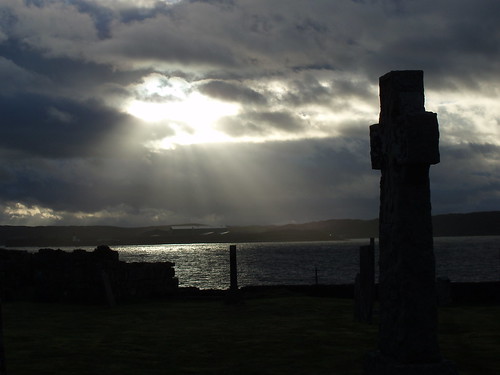
Today is the 70th anniversary of the invasion of Poland, a military campaign that sparked off the Second World War. In the 6 years following, many thousands would lay down their lives in the defense of freedom. The Western Isles, once more, stood in the breach and supplied dozens of its young men to the services between 1939 and 1945. The death toll makes for sobering reading - having just transcribed the war memorials for all of the islands in the Western Isles (courtesy the Scottish War Memorials Project).
Lewis - 448
Harris - 58
North Uist & Berneray - 36
Benbecula - 6
South Uist & Eriskay - 51
Barra - 54
Total: 653
Lest we forget.
Subscribe to:
Posts (Atom)