One of men buried there, Duncan Macleod, died in 1943 whilst held in a POW camp in Burma. He himself is interred near the camp on the infamous Burma railway, where so many Allied POWs perished. His name is mentioned on one of the private gravestones at Bragar, and as I had him on record for the World War II memorial for Lewis, I looked into it further. I had little information on him, save that he came from Lochcroistean, a schoolhouse in the Uig district of Lewis.
His father was one of the school's headmasters, Norman Macleod, who held sway there until 1923. He died 20 January 1938 at the age of 75. He was married to Bell Ann Mackay, who died 8 December 1944 at the age of 69.
The website for the Commonwealth War Graves Commission interestingly state that they came from Tighnabruaich in Argyll. They had four children, two of whom (Iain and Chirsty Mary) died in infancy. Jessie died in May 1980 at the age of 73; their son Duncan died on 19 September 1943 at the age of 42.
Lochcroistean is located in a remote part of the island, but was itself a central school (of sorts). It acted as a hub for several side-schools, in places like Morsgail, Luachar and Ardbeag. The latter two places no longer exist. Luachar lies by the head of Loch Reasort, some 10 miles from Lochcroistean to the south; Ardbeag is even further away, by my estimation at least 15 miles to the southwest.
Showing posts with label bragar. Show all posts
Showing posts with label bragar. Show all posts
Thursday, 16 April 2009


Tuesday, 3 April 2007
Graveyard
I have been going round a few of the island’s cemeteries in recent times, looking for and photographing tombstones of victims of the Iolaire Disaster in 1919. On my visit to Bragar’s cemetery this week, I came across the tombstone for Kenneth MacLeod of Shawbost, an important figure in the Harris Tweed industry. He died in 1949 at the age of 67.
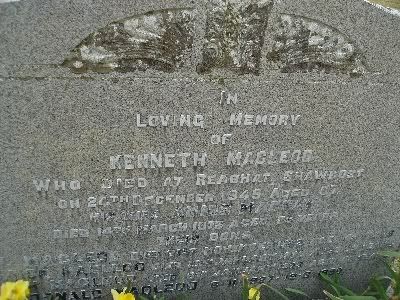
Standing there on a cloudy, windswept day, the news came back to me about ongoing developments in the industry today. And what would he make of it now? Mr Macleod got local weavers to weave tweed for him in the first half of the 20th century.
Late in 2006, Yorkshire industrialist Brian Haggas bought over the remaining Harris Tweed mills in Lewis, of which the largest stands in Stornoway. Shortly beforehand, the closure of the mill in North Shawbost was announced, with the loss of about 30 jobs. Last week, plans were announced to shrink the range of tweeds to 5, although not directly in such words. The announcement was to the effect that single-width weavers would be laid off. Not many of them left, but it was seen as a sign on the wall. Some 20 years ago, there were hundreds if not thousands of different tweeds in circulation. It was a top of the range product. Fears are now being expressed that this prestige will be lost.
It sounds as if Harris Tweed is heading for its own graveyard in history.
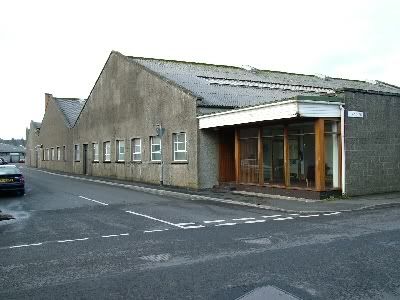
On a related note, I came across streets of derelict business premises in the Newton area of Stornoway. This used to be the centre of the Harris Tweed industry in years gone by, but is now broadly in disuse. A line in the recent Budget caught my attention, as the tax on disused business premises was due to be increased, or words to that effect.
I am surprised that the non-residential side of Newton is allowed to fall into ruin like it is at the moment. I hope that following the local council elections on May 3rd someone will have the foresight to come up with a plan for a major revamp of the area. Yes, I am aware that a number of businesses are thriving there
Standing there on a cloudy, windswept day, the news came back to me about ongoing developments in the industry today. And what would he make of it now? Mr Macleod got local weavers to weave tweed for him in the first half of the 20th century.
Late in 2006, Yorkshire industrialist Brian Haggas bought over the remaining Harris Tweed mills in Lewis, of which the largest stands in Stornoway. Shortly beforehand, the closure of the mill in North Shawbost was announced, with the loss of about 30 jobs. Last week, plans were announced to shrink the range of tweeds to 5, although not directly in such words. The announcement was to the effect that single-width weavers would be laid off. Not many of them left, but it was seen as a sign on the wall. Some 20 years ago, there were hundreds if not thousands of different tweeds in circulation. It was a top of the range product. Fears are now being expressed that this prestige will be lost.
It sounds as if Harris Tweed is heading for its own graveyard in history.
On a related note, I came across streets of derelict business premises in the Newton area of Stornoway. This used to be the centre of the Harris Tweed industry in years gone by, but is now broadly in disuse. A line in the recent Budget caught my attention, as the tax on disused business premises was due to be increased, or words to that effect.
I am surprised that the non-residential side of Newton is allowed to fall into ruin like it is at the moment. I hope that following the local council elections on May 3rd someone will have the foresight to come up with a plan for a major revamp of the area. Yes, I am aware that a number of businesses are thriving there
Subscribe to:
Posts (Atom)