The following information was submitted by a reader of the Lewismen in Canadian Service website, regarding Donald Smith, of 11 Aird Tong. The Roll of Honour says he was wounded twice, but that must have been a mistake.
Donald enlisted with the 94th Battalion, Fort William, Ontario (Canada) on 10 Jan
1916. Arriving in England he was transferred to the 43rd (Cameron
Highlanders of Winnipeg) Battalion in France. He was decorated twice.
Distinguished Conduct Medal
Deed of Action
198766 Sergeant Donald Smith
43rd Battalion
For conspicuous gallantry and devotion to duty throughout forty
hour's continuous fighting on 27th and 28 August 1918 near
Vis-en-Artois, involving two attacks and repeated enemy counter-attacks.
He was in the thick of the fighting, accounting for five of
the enemy and setting a fine aggressive example to his men.
(Authority: London Gazette number 31726, dated 10 January, 1920)
Bar to Distinguished Conduct Medal
Deed of Action
198766 Sergeant Donald Smith
43rd Battalion
In the attack through Tilloy on the 1st Oct. 1918, he single-handed
captured an enemy machine-gun crew and getting the gun in action,
inflicted many casualties on the enemy. Later on he took charge of two
platoons after they had lost their officers, and
by his gallant leadership enabled them to take their objectives and
consolidate their positions. When the enemy succeeded in penetrating one
post he single-handed drove them out, killing fire and taking seven
prisoners. he showed splendid gallantry and initiative.
(Authority: London Gazette number 31668, dated 2 December, 1919)
Showing posts with label canadians. Show all posts
Showing posts with label canadians. Show all posts
Sunday, 4 December 2016


Thursday, 4 August 2016
A tale of two Donalds
On 9 June 1888, Annie Macleod, living in the village of Knock, Point (in Lewis), gave birth to another child, Donald. He was the sixth, and not the last child. Two more followed, and by the start of 1894, eight children, varying in ages from 1 to 15 years, crowded into the dwelling. It drove the father, Hector, to distraction, to such an extent that he ended his life in September that year. Three months later, Annie also passed away.
The eight youngsters were taken into the care of the Quarrier Homes in Glasgow, and emigrated to Canada two years later.
Donald signed up for the Canadian Expeditionary Force at Calgary in October 1914, and was injured during the Battle of the Somme. He was transferred to War Hospital at Napsbury, where he passed away on 4 August 1916, at 9.45pm.
Due to an error in the paperwork, his remains were transferred to Benbecula, rather than Lewis, and the next-of-kin notified. The next of kin was thought to be Alex Macleod of Gramsdale, but when Alex came to the quayside at Peter Port in Benbecula, he did not recognise the dead man as his son. Nobody came to claim the soldier's remains, so the authorities interred it at Nunton, Benbecula, after a week. Donald Macleod, son of Alex, was alive, also serving with the Canadian Forces, and under a service number that only differed from the Lewis man by one digit. The Benbecula Donald Macleod was 79119, the Lewis man was 79110. Donald Macleod, Gramsdale, lived until 1952.
It has taken a century for this mystery to be cleared up. This morning, three islanders stood by Donald's grave in Nunton Cemetery, and remembered his sacrifice. I did so from 64 miles away in Stornoway.
The eight youngsters were taken into the care of the Quarrier Homes in Glasgow, and emigrated to Canada two years later.
Donald signed up for the Canadian Expeditionary Force at Calgary in October 1914, and was injured during the Battle of the Somme. He was transferred to War Hospital at Napsbury, where he passed away on 4 August 1916, at 9.45pm.
Due to an error in the paperwork, his remains were transferred to Benbecula, rather than Lewis, and the next-of-kin notified. The next of kin was thought to be Alex Macleod of Gramsdale, but when Alex came to the quayside at Peter Port in Benbecula, he did not recognise the dead man as his son. Nobody came to claim the soldier's remains, so the authorities interred it at Nunton, Benbecula, after a week. Donald Macleod, son of Alex, was alive, also serving with the Canadian Forces, and under a service number that only differed from the Lewis man by one digit. The Benbecula Donald Macleod was 79119, the Lewis man was 79110. Donald Macleod, Gramsdale, lived until 1952.
It has taken a century for this mystery to be cleared up. This morning, three islanders stood by Donald's grave in Nunton Cemetery, and remembered his sacrifice. I did so from 64 miles away in Stornoway.
Saturday, 28 July 2012
The Danish connection
Crossposted from Atlantic Lines
This evening, I found a comment, made on one of my local history sites by a Danish man who had visited the Outer Hebrides. Upon crossing North Uist, he visited the cemetery of Clachan Sands, about 6 miles west of Lochmaddy on the road to Berneray. I visited that graveyard in July 2009 and photographed the gravestone of Ewen Nicholson, who was lost during the First World War. An image of the actual gravestone in the Railway Dugouts Cemetery can be viewed on this link.
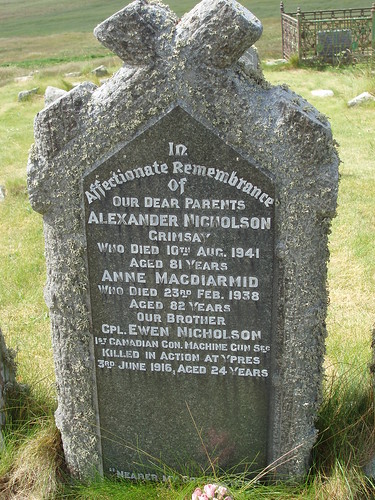
My Danish correspondent researched the fate of Ewen, displaying some very graphic and gruesome images of conditions on the frontline. I have looked into Ewen Nicholson's information and came out with the following:
Ewen Nicholson
Born: Grimsay, North Uist
Date of birth: 29 May 1892
Trade / calling: Labourer
Married: No
Volunteered at Valcartier on 23 September 1914
Age upon enlistment: 22 years 4 months
Height: 5 ft 10¼ in
Complexion: fresh
Eyes: light brown
Hair: brown
Religious denomination: presbyterian
Son of Alexander and Ann Nicholson, of Grimsay, Lochmaddy, North Uist.
Last known address in North Uist: 4 Aird nan Sruban Grimsay
Military unit: 7th Canadian Infantry (British Columbia Regiment)
Service number: 21065
Date of death: 3 June 1916 at the age of 24
Interred: Railway Dugouts Burial Ground, Sp Mem G. 29
In 1901, Ewen was 8 years old. His father Alexander was a crofter, 41 years of age, married to Ann. There were four other children in the family: Mary (12), John Archie (10), Alexander (5) and Andrew John Macalpine, age 1 month.
Five days after his 24th birthday, Ewen lost his life in fierce battles near Ypres. He was buried in one of the many cemeteries around the town.
This evening, I found a comment, made on one of my local history sites by a Danish man who had visited the Outer Hebrides. Upon crossing North Uist, he visited the cemetery of Clachan Sands, about 6 miles west of Lochmaddy on the road to Berneray. I visited that graveyard in July 2009 and photographed the gravestone of Ewen Nicholson, who was lost during the First World War. An image of the actual gravestone in the Railway Dugouts Cemetery can be viewed on this link.
My Danish correspondent researched the fate of Ewen, displaying some very graphic and gruesome images of conditions on the frontline. I have looked into Ewen Nicholson's information and came out with the following:
Ewen Nicholson
Born: Grimsay, North Uist
Date of birth: 29 May 1892
Trade / calling: Labourer
Married: No
Volunteered at Valcartier on 23 September 1914
Age upon enlistment: 22 years 4 months
Height: 5 ft 10¼ in
Complexion: fresh
Eyes: light brown
Hair: brown
Religious denomination: presbyterian
Son of Alexander and Ann Nicholson, of Grimsay, Lochmaddy, North Uist.
Last known address in North Uist: 4 Aird nan Sruban Grimsay
Military unit: 7th Canadian Infantry (British Columbia Regiment)
Service number: 21065
Date of death: 3 June 1916 at the age of 24
Interred: Railway Dugouts Burial Ground, Sp Mem G. 29
In 1901, Ewen was 8 years old. His father Alexander was a crofter, 41 years of age, married to Ann. There were four other children in the family: Mary (12), John Archie (10), Alexander (5) and Andrew John Macalpine, age 1 month.
Five days after his 24th birthday, Ewen lost his life in fierce battles near Ypres. He was buried in one of the many cemeteries around the town.
Friday, 23 September 2011
Local connections: Ness, 1943
Associated with Fivepenny
Pilot Officer DONALD MORRISON MCLENNAN
Son of Donald and Jessie McLennan, of 2056 West Thirteenth Street, Vancouver.
Service: Royal Canadian Air Force
Service number: J/26332
Date of death: 24 June 1943 at the age of 19
Interred: Burnaby Masonic Cemetery, Plot 12. Sec. G. Grave 1.
You may think, what does a Canadian airman do in the listings for Fivepenny, Ness? Well, it was a tribute in the Stornoway Gazette for 20 August 1943 that made the connection - as the father came from Fivepenny.
Relatives and friends in the Ness district will regret to learn that P.O. Donald Maclennan, son of Mr and Mrs Donald Maclennan, 2056 West Thirteenth Street, Vancouver, has been killed in a flying accident in Eastern Canada. P.O. Maclennan, 19, was born in Vancouver and attended Lord Tennyson and Kitsilano High Schools and University of British Columbia. He enlisted in the R.C.A.F. in July last year and was later attached to the R.A.F. Ferry Command. Mr Donald Maclennan, snr., was a native of Fivepenny, Ness. His son had never been in Lewis.
Pilot Officer DONALD MORRISON MCLENNAN
Son of Donald and Jessie McLennan, of 2056 West Thirteenth Street, Vancouver.
Service: Royal Canadian Air Force
Service number: J/26332
Date of death: 24 June 1943 at the age of 19
Interred: Burnaby Masonic Cemetery, Plot 12. Sec. G. Grave 1.
You may think, what does a Canadian airman do in the listings for Fivepenny, Ness? Well, it was a tribute in the Stornoway Gazette for 20 August 1943 that made the connection - as the father came from Fivepenny.
Relatives and friends in the Ness district will regret to learn that P.O. Donald Maclennan, son of Mr and Mrs Donald Maclennan, 2056 West Thirteenth Street, Vancouver, has been killed in a flying accident in Eastern Canada. P.O. Maclennan, 19, was born in Vancouver and attended Lord Tennyson and Kitsilano High Schools and University of British Columbia. He enlisted in the R.C.A.F. in July last year and was later attached to the R.A.F. Ferry Command. Mr Donald Maclennan, snr., was a native of Fivepenny, Ness. His son had never been in Lewis.
Friday, 3 December 2010
Disaster to Halifax
On December 6th, it will be 93 years ago since the Great Explosion at Halifax. The Nova Scotia Archives, tweeting on twitter.com/NS_Archives, reminded me of this event. The strong bonds between Lewis and Canada were implicitly shown by the inclusion of this article in the Stornoway Gazette a week after the disaster.
Stornoway Gazette, 14 December 1917
20,000 homeless
On Thursday morning of last week, a great part of the city of Halifax, Nova Scotia, was wrecked by the explosion on a munition ship in the harbour, which collided with a large steamer containing food provisions for Belgium. Fires broke out in the part of the city nearest the harbour. Over 2000 people, it is said, were killed by the explosion and the falling of buildings.
Fierce Blizzard
Later news, on Monday morning, says that terrible suffering among the homeless population of Halifax has followed in the wake of the great disaster which swept the city on Thursday morning. A fierce blizzard is driving in from the Atlantic, and has cut off the stricken city from all direct communication with th eouter world. No trains reached Halifax on Sunday and the snow storm is interfering greatly with the work of relief among the inhabitants. The fires which spread throughout the city immediately after the explosion, and which in some instances burned for several days, have now been extinguished, and search is being made for the bodies of the killed and those seriously wounded who may still be lying buried beneath the wreckage. The heaviest loss of life was, unfortunately, amongst children. In some areas, whole schools were totally destroyed, every child in them being killed, and the loss of life among those innocent little ones alone rode into hundreds.
4000 Dwellings Destroyed
Twenty thousandof the survivors of this greatest disaster in Canada's history are homeless and destitute. Every building, not only in Halifax but in Dartmouth and other surrounding cities, was more or less damaged.
It is learned that the munition ship carried 4000 tons of the terrific explosive known as TNT. The force of the explosion was so great that a 40-foot tidal wave followed in the wake of the explosion and washed over the main lines of the rail road, sweeping 300 freight cars, 100 passenger coaches and 20 locomotives from the rails, and round houses, damaging most of them beyond repair.
Hospital cars and supplies are being sent from all parts of the States and Canada.
Stornoway Gazette, 14 December 1917
20,000 homeless
On Thursday morning of last week, a great part of the city of Halifax, Nova Scotia, was wrecked by the explosion on a munition ship in the harbour, which collided with a large steamer containing food provisions for Belgium. Fires broke out in the part of the city nearest the harbour. Over 2000 people, it is said, were killed by the explosion and the falling of buildings.
Fierce Blizzard
Later news, on Monday morning, says that terrible suffering among the homeless population of Halifax has followed in the wake of the great disaster which swept the city on Thursday morning. A fierce blizzard is driving in from the Atlantic, and has cut off the stricken city from all direct communication with th eouter world. No trains reached Halifax on Sunday and the snow storm is interfering greatly with the work of relief among the inhabitants. The fires which spread throughout the city immediately after the explosion, and which in some instances burned for several days, have now been extinguished, and search is being made for the bodies of the killed and those seriously wounded who may still be lying buried beneath the wreckage. The heaviest loss of life was, unfortunately, amongst children. In some areas, whole schools were totally destroyed, every child in them being killed, and the loss of life among those innocent little ones alone rode into hundreds.
4000 Dwellings Destroyed
Twenty thousandof the survivors of this greatest disaster in Canada's history are homeless and destitute. Every building, not only in Halifax but in Dartmouth and other surrounding cities, was more or less damaged.
It is learned that the munition ship carried 4000 tons of the terrific explosive known as TNT. The force of the explosion was so great that a 40-foot tidal wave followed in the wake of the explosion and washed over the main lines of the rail road, sweeping 300 freight cars, 100 passenger coaches and 20 locomotives from the rails, and round houses, damaging most of them beyond repair.
Hospital cars and supplies are being sent from all parts of the States and Canada.
Friday, 19 November 2010
Daniel Maciver, Coll - the full story
This story starts on 13th December 1866, when Kenneth Maciver, a fisherman from Coll, Isle of Lewis, wed his bride, Mary Munro, a domestic servant, living in the same village. Kenneth was the son of crofter Colin Maciver and Margaret Matheson. Mary was the daughter of grieve Alexander Munro and Janet Macdairmid.
Nearly fifteen years after their marriage, the enumerators for the 1881 census found Kenneth and Mary with their children Alexander (aged 13), James (11), Murdo (9), Donald (3) and Margaret (1). The child called Donald was born on 4 February 1878, and he is the subject of this article. Kenneth and Mary had twelve children in all, but by the beginning of 1917, only five were left alive.
On 14 April 1889, Kenneth and his family embarked the emigrant ship “Scandinavian” for Canada at Glasgow. They were among about 300 Scottish and Irish emigrants who were seeking a new life in the colonies. Upon arrival in Halifax, they proceeded inland and settled at the Lothian colony, 60 miles southeast of present-day Saskatoon.
Whilst still in his teens, Donald, now known as Dan, along with Malcolm Docherty (…) journeyed to Winnipeg and joined the Canadian Dragoons. On 19 October 1899, again at Winnipeg, he joined the Canadian Special Service Forces for the war in South Africa. Fourteen months and twenty-three campaigns later, he was discharged on Christmas Day 1900, bearing the Queen’s Medal with four clasps (Paardeberg, Driefontein, Cape Colony and Transvaal).
Fourteen years later, the spectre of war once more descended over Europe and Daniel responded quickly. Six weeks after the outbreak of war, he enlisted at the Valcartier barracks in Quebec on 17 September 1914. On his attestation paper he was quoted as a Real-Estate Agent, with his father Kenneth Mcivor (sic) living in Saltcoats, Saskatchewan, although elsewhere Maciver senior is listed at Barvas, Saskatchewan. This hamlet is located a dozen miles north of Saltcoats. On enlistment, Daniel is described as 5 ft 10 (1.77 m) tall, of fair complexion with brown eyes and brown hair. A mole was seen at the centre of his back. He professes to be of the Presbyterian faith.
Daniel, an accomplished soldier by all accounts, does well on the fields of battle, and is promoted to the rank of Company Sergeant-Major in the 5th battalion Canadian Infantry (Saskatchewan Regiment), the Fighting Fifth. He is Mentioned in Despatches twice, a distinction in itself. References to a Distinguished Conduct Medal being awarded to Daniel Maciver are, unfortunately, incorrect. He is offered to opportunity to return to Canada for further promotion, but he declines, wishing to remain “with the game”, to quote a contemporary newspaper cutting.
On 28th April 1917, the battle for Vimy Ridge is nearly over when Company Sergeant Major Daniel Maciver is killed in action. He was aged 41. The news took a few weeks to filter through to his father in Canada. It took another few weeks for the news to make it to the columns of the Stornoway Gazette. This is a transcript of that article, dated June 1917.
LEWISMAN OF THE FIGHTING FIFTH KILLED
From the “Yorkton Enterpise” (Sask, Canada) to hand we cull the following:-
“Word was received by Mr Maciver, Saltcoats, on 19th May, that his son, Sergt Major Dan Maciver, D.C.M. of the Fighting Fifth battalion, had been killed in action. Dan, who was well known and a prime favourite throughout the district, was born at Coll, Lewis, Scotland, and came to Canada with his parents in 1889, settling in the Lothian Colony. Whilst still in his teens, Dan, along with Malcolm Docherty (now Major Docherty, DSO) journeyed to Winnipeg and joined the Canadian Dragoons. When the South African War broke out, he was one of the first to volunteer for active service, taking part in no less than twenty-three campaigns. At the outbreak of the present conflict Dan again showed his military spirit by enlisting and went overseas with the first contingent. After reaching France, he gave a splendid account of himself, and was promoted on the field to the rank of Sergt.-Major, being also frequently mentioned in despatches for bravery and coolness in action. Some time he was offered the chance to return to Canada for promotion, but preferred to stay with the game. His death is the fourth that has occurred in the family within the last five years, and he is survived by his parents and two brothers and two sisters out of a family of twelve.”
A year last Christmas, Sergt.-Major Maciver paid a visit to the haunts of his youth at Coll, and needless to say had a very cordial welcome.[end of article]
Daniel Maciver was named Donald by his parents, but seems to have adopted Dan or Daniel as a first name in Canada. His surname appears to have modified a little as well; his service record in the Canadian Army is under the name of Mcivor. Taking all the historical documentation into account, there can be little doubt that this is the story of Daniel Maciver, a Lewis-born soldier who served with distinction, and made the supreme sacrifice for King and country.
It is therefore puzzling that his name was omitted from the war memorials at Stornoway and Back. Neither is he included in Loyal Lewis Roll of Honour 1914-1918. However, even the Lewis War Memorial does not list all the names of those lost in the Great War, and neither is the Roll of Honour comprehensive, complete and correct. However, it has transpired that he is also not listed in the first volume of the regimental history of The Royal Canadian Regiment (by Fetherstonaugh, covering 1883-1933).
Daniel Maciver is remembered by the Commonwealth War Graves Commission, and through an inscription on the Vimy Memorial near Arras, France.
Nearly fifteen years after their marriage, the enumerators for the 1881 census found Kenneth and Mary with their children Alexander (aged 13), James (11), Murdo (9), Donald (3) and Margaret (1). The child called Donald was born on 4 February 1878, and he is the subject of this article. Kenneth and Mary had twelve children in all, but by the beginning of 1917, only five were left alive.
On 14 April 1889, Kenneth and his family embarked the emigrant ship “Scandinavian” for Canada at Glasgow. They were among about 300 Scottish and Irish emigrants who were seeking a new life in the colonies. Upon arrival in Halifax, they proceeded inland and settled at the Lothian colony, 60 miles southeast of present-day Saskatoon.
Whilst still in his teens, Donald, now known as Dan, along with Malcolm Docherty (…) journeyed to Winnipeg and joined the Canadian Dragoons. On 19 October 1899, again at Winnipeg, he joined the Canadian Special Service Forces for the war in South Africa. Fourteen months and twenty-three campaigns later, he was discharged on Christmas Day 1900, bearing the Queen’s Medal with four clasps (Paardeberg, Driefontein, Cape Colony and Transvaal).
Fourteen years later, the spectre of war once more descended over Europe and Daniel responded quickly. Six weeks after the outbreak of war, he enlisted at the Valcartier barracks in Quebec on 17 September 1914. On his attestation paper he was quoted as a Real-Estate Agent, with his father Kenneth Mcivor (sic) living in Saltcoats, Saskatchewan, although elsewhere Maciver senior is listed at Barvas, Saskatchewan. This hamlet is located a dozen miles north of Saltcoats. On enlistment, Daniel is described as 5 ft 10 (1.77 m) tall, of fair complexion with brown eyes and brown hair. A mole was seen at the centre of his back. He professes to be of the Presbyterian faith.
Daniel, an accomplished soldier by all accounts, does well on the fields of battle, and is promoted to the rank of Company Sergeant-Major in the 5th battalion Canadian Infantry (Saskatchewan Regiment), the Fighting Fifth. He is Mentioned in Despatches twice, a distinction in itself. References to a Distinguished Conduct Medal being awarded to Daniel Maciver are, unfortunately, incorrect. He is offered to opportunity to return to Canada for further promotion, but he declines, wishing to remain “with the game”, to quote a contemporary newspaper cutting.
On 28th April 1917, the battle for Vimy Ridge is nearly over when Company Sergeant Major Daniel Maciver is killed in action. He was aged 41. The news took a few weeks to filter through to his father in Canada. It took another few weeks for the news to make it to the columns of the Stornoway Gazette. This is a transcript of that article, dated June 1917.
LEWISMAN OF THE FIGHTING FIFTH KILLED
From the “Yorkton Enterpise” (Sask, Canada) to hand we cull the following:-
“Word was received by Mr Maciver, Saltcoats, on 19th May, that his son, Sergt Major Dan Maciver, D.C.M. of the Fighting Fifth battalion, had been killed in action. Dan, who was well known and a prime favourite throughout the district, was born at Coll, Lewis, Scotland, and came to Canada with his parents in 1889, settling in the Lothian Colony. Whilst still in his teens, Dan, along with Malcolm Docherty (now Major Docherty, DSO) journeyed to Winnipeg and joined the Canadian Dragoons. When the South African War broke out, he was one of the first to volunteer for active service, taking part in no less than twenty-three campaigns. At the outbreak of the present conflict Dan again showed his military spirit by enlisting and went overseas with the first contingent. After reaching France, he gave a splendid account of himself, and was promoted on the field to the rank of Sergt.-Major, being also frequently mentioned in despatches for bravery and coolness in action. Some time he was offered the chance to return to Canada for promotion, but preferred to stay with the game. His death is the fourth that has occurred in the family within the last five years, and he is survived by his parents and two brothers and two sisters out of a family of twelve.”
A year last Christmas, Sergt.-Major Maciver paid a visit to the haunts of his youth at Coll, and needless to say had a very cordial welcome.[end of article]
Daniel Maciver was named Donald by his parents, but seems to have adopted Dan or Daniel as a first name in Canada. His surname appears to have modified a little as well; his service record in the Canadian Army is under the name of Mcivor. Taking all the historical documentation into account, there can be little doubt that this is the story of Daniel Maciver, a Lewis-born soldier who served with distinction, and made the supreme sacrifice for King and country.
It is therefore puzzling that his name was omitted from the war memorials at Stornoway and Back. Neither is he included in Loyal Lewis Roll of Honour 1914-1918. However, even the Lewis War Memorial does not list all the names of those lost in the Great War, and neither is the Roll of Honour comprehensive, complete and correct. However, it has transpired that he is also not listed in the first volume of the regimental history of The Royal Canadian Regiment (by Fetherstonaugh, covering 1883-1933).
Daniel Maciver is remembered by the Commonwealth War Graves Commission, and through an inscription on the Vimy Memorial near Arras, France.
Thursday, 4 November 2010
Daniel Maciver, Coll
Daniel was a sergeant-major in the 5th battalion Canadian Infantry (Saskatchewan Regiment), the Fighting Fifth, when he was killed in action on 28 April 1917, aged 41. His link to the Isle of Lewis did not become clear to me until I was going through tributes in the Stornoway Gazette for 1917. The article, which sourced its information from a Canadian newspaper, the Yorkton Enterprise (Saskatchewan), gave quite a bit of information, but there was no reference to him from local files.
Let me quote the article first.
Finding his birth certificate proved tricky, but thanks to the Registry at Stornoway Town Hall, I managed to find his as Donald Maciver, son of Kenneth and Mary, born on 4 February 1878. This ties in with the (partly erroneous) birth information from the attestation paper. This quotes him as born in 1888, but that is not possible if he enlisted in 1899 aged 21, or died in 1917 aged 41. The day and month of birth did check out. Daniel is likely to have been the name he was called by as he grew up. At the time of the 1881 census, the last Scottish census he appeared on, Daniel is mentioned as 3-year old Donald, son of Kenneth (a fisherman) and Mary, and brother of Alexander (aged 13), James (11), Murdo (9) and Margaret (1). His parents were married in Back Free Church on 13 December 1866 by the minister Donald Mcmaster.
Kenneth was the son of crofter Colin Maciver and Margaret Matheson.
Mary was the daughter of grieve Alexander Munro and Janet Macdairmid.
Donald's parents emigrated to Canada in 1889, as the article says, and he joined up for the Boer War of 1899-1901. He gained the Queen's Medal with four clasps (Paardeberg, Driefontein, Cape Colony and Transvaal) before being discharged on Christmas Day 1900.
Fourteen years later, the spectre of war once more descended over Europe and Daniel immediately responded. He enlisted at the Valcartier barracks in Quebec on 17 September 1914, 6 weeks after the outbreak of war. On his attestation paper he was quoted as a Real-Estate Agent, with his father Kenneth Mcivor (sic) living in Saltcoats, SK, although elsewhere Mciver senior is listed at Barvas. This hamlet is located a dozen miles north of Saltcoats. On enlistment, Daniel is described as 5 ft 10 (1.77 m) tall, of fair complexion with brown eyes and brown hair. A mole was seen at the centre of his back. He professes to be of the Presbyterian faith.
During the First World War, Daniel is mentioned in despatches twice; being mentioned in despatches is a distinction in itself. The reference to a DCM is not correct; Daniel was never awarded this medal. He was sadly lost in the aftermath of the battle for Vimy Ridge in April 1917 and is only mentioned on the Vimy Memorial; the location of his grave is unknown.
I have entered Daniel's details on Faces from the Lewis War Memorial under the heading of Coll.
Let me quote the article first.
From the "Yorkton Enterpise" (Sask, Canada) to hand we cull the following:-
"Word was received by Mr Maciver, Saltcoats, on 19th May, that his son, Sergt Major Dan Maciver, D.C.M. of the Fighting Fifth battalion, had been killed in action. Dan, who was well known and a prime favourite throughout the district, was born at Coll, Lewis, Scotland, and came to Canada with his parents in 1889, settling in the Lothian Colony. Whilst still in his teens, Dan, along with Malcolm Docherty (now Major Docherty, DSO) journeyed to Winnipeg and joined the Canadian Dragoons. When the South African War broke out, he was one of the first to volunteer for active service, taking part in no less than twenty-three campaigns. At the outbreak of the present conflict Dan again showed his military spirit by enlisting and went overseas with the first contingent. After reaching France, he gave a splendid account of himself, and was promoted on the field to the rank of Sergt.-Major, being also frequently mentioned in despatches for bravery and coolness in action. Some time he was offered the chance to return to Canada for promotion, but preferred to stay with the game. His death is the fourth that has occurred in the family within the last five years, and he is survived by his parents and two brothers and two sisters out of a family of twelve."
A year last Christmas, Sergt.-Major Maciver paid a visit to the haunts of his youth at Coll, and needless to say had a very cordial welcome.An on-line study group into the Canadian Expeditionary Force was most helpful in eliciting the information I was after.
Finding his birth certificate proved tricky, but thanks to the Registry at Stornoway Town Hall, I managed to find his as Donald Maciver, son of Kenneth and Mary, born on 4 February 1878. This ties in with the (partly erroneous) birth information from the attestation paper. This quotes him as born in 1888, but that is not possible if he enlisted in 1899 aged 21, or died in 1917 aged 41. The day and month of birth did check out. Daniel is likely to have been the name he was called by as he grew up. At the time of the 1881 census, the last Scottish census he appeared on, Daniel is mentioned as 3-year old Donald, son of Kenneth (a fisherman) and Mary, and brother of Alexander (aged 13), James (11), Murdo (9) and Margaret (1). His parents were married in Back Free Church on 13 December 1866 by the minister Donald Mcmaster.
Kenneth was the son of crofter Colin Maciver and Margaret Matheson.
Mary was the daughter of grieve Alexander Munro and Janet Macdairmid.
Donald's parents emigrated to Canada in 1889, as the article says, and he joined up for the Boer War of 1899-1901. He gained the Queen's Medal with four clasps (Paardeberg, Driefontein, Cape Colony and Transvaal) before being discharged on Christmas Day 1900.
Fourteen years later, the spectre of war once more descended over Europe and Daniel immediately responded. He enlisted at the Valcartier barracks in Quebec on 17 September 1914, 6 weeks after the outbreak of war. On his attestation paper he was quoted as a Real-Estate Agent, with his father Kenneth Mcivor (sic) living in Saltcoats, SK, although elsewhere Mciver senior is listed at Barvas. This hamlet is located a dozen miles north of Saltcoats. On enlistment, Daniel is described as 5 ft 10 (1.77 m) tall, of fair complexion with brown eyes and brown hair. A mole was seen at the centre of his back. He professes to be of the Presbyterian faith.
During the First World War, Daniel is mentioned in despatches twice; being mentioned in despatches is a distinction in itself. The reference to a DCM is not correct; Daniel was never awarded this medal. He was sadly lost in the aftermath of the battle for Vimy Ridge in April 1917 and is only mentioned on the Vimy Memorial; the location of his grave is unknown.
I have entered Daniel's details on Faces from the Lewis War Memorial under the heading of Coll.
Donald Maciver, another WW1 casualty not listed as such
Private DONALD MACIVER
Last address in Lewis: 17 Knock, Point
Son of Murdo and Mary Mciver, of 17 Knock, Point
Service unit: 179th Canadian Infantry
Service number: 859994
Date of death: 24 May 1920 at the age of 28
Was gassed; quoted as severely wounded
Interred: Winnipeg (Brookside) Military Cemetery, grave Mil. 246
He does not feature on the local war memorial in Garrabost, and is not listed as deceased in the Roll of Honour, presumably because he died 18 months after the end of the First World War. However, Donald still qualifies for inclusion as he passed away before 1922 (the CWGC cut-off point) and he was born in Lewis.
Last address in Lewis: 17 Knock, Point
Son of Murdo and Mary Mciver, of 17 Knock, Point
Service unit: 179th Canadian Infantry
Service number: 859994
Date of death: 24 May 1920 at the age of 28
Was gassed; quoted as severely wounded
Interred: Winnipeg (Brookside) Military Cemetery, grave Mil. 246
He does not feature on the local war memorial in Garrabost, and is not listed as deceased in the Roll of Honour, presumably because he died 18 months after the end of the First World War. However, Donald still qualifies for inclusion as he passed away before 1922 (the CWGC cut-off point) and he was born in Lewis.
Tuesday, 12 October 2010
Remembered
In the compilation of “Faces from the Lewis War Memorial” (which remembers the Fallen from the Isle of Lewis in World War I), there are quite a few names with very little information. It sometimes takes a little bit of effort to disentangle the web and let the light from the past shine more clearly. An example.
The Roll of Honour mentions an Iver Maciver from 9 North Shawbost, who, serving with the Canadians, died of wounds in 1916 at the age of 21. I just couldn’t cross reference him - not with the Commonwealth War Graves Commission, not with the Canadian Virtual War Memorial, and not with the CEF records on Libraries and Archives Canada either.
Until this evening. Looking at the page for North Shawbost again, it occurred to me that Kenneth Maciver, also quoted at 9 North Shawbost, might be the brother of “Iver”. Kenneth Maciver is reported to have been born at Lochcarron, so I did a search on ScotlandsPeople for Macivers in Lochcarron around 1895 - and who came out but Evander Maciver. Born to the same parents as Kenneth.
Using the sources quoted above, I now search for Evander Maciver, dying in 1916 - and this was the result:
Corporal EVANDER MACIVER
Last address in Lewis: 9 North Shawbost,
Son of John and Isabella Maciver, of Carnan House, Shawbost, Stornoway. Born at Lochcarron, Ross-shire.
Service unit: 52nd Canadian Infantry (Manitoba Regiment)
Service number: 440086
Date of death: 9 July 1916 at the age of 21
Died of wounds
Interred: Lijssenthoek Military Cemetery, grave VIII. C. 6
Local memorial: West Side, Bragar
Evander was born at Lochcarron, northeast of Kyle, on 9 August 1894
When he enlisted for service, in the Manitoba town of Sewell in Canada, he stood 5 ft 5 in tall.
He is described as of fair complexion and fair-haired with light blue eyes.
Evander was a Presbyterian, and a carpenter by trade.
Rest in peace.
The Roll of Honour mentions an Iver Maciver from 9 North Shawbost, who, serving with the Canadians, died of wounds in 1916 at the age of 21. I just couldn’t cross reference him - not with the Commonwealth War Graves Commission, not with the Canadian Virtual War Memorial, and not with the CEF records on Libraries and Archives Canada either.
Until this evening. Looking at the page for North Shawbost again, it occurred to me that Kenneth Maciver, also quoted at 9 North Shawbost, might be the brother of “Iver”. Kenneth Maciver is reported to have been born at Lochcarron, so I did a search on ScotlandsPeople for Macivers in Lochcarron around 1895 - and who came out but Evander Maciver. Born to the same parents as Kenneth.
Using the sources quoted above, I now search for Evander Maciver, dying in 1916 - and this was the result:
Corporal EVANDER MACIVER
Last address in Lewis: 9 North Shawbost,
Son of John and Isabella Maciver, of Carnan House, Shawbost, Stornoway. Born at Lochcarron, Ross-shire.
Service unit: 52nd Canadian Infantry (Manitoba Regiment)
Service number: 440086
Date of death: 9 July 1916 at the age of 21
Died of wounds
Interred: Lijssenthoek Military Cemetery, grave VIII. C. 6
Local memorial: West Side, Bragar
Evander was born at Lochcarron, northeast of Kyle, on 9 August 1894
When he enlisted for service, in the Manitoba town of Sewell in Canada, he stood 5 ft 5 in tall.
He is described as of fair complexion and fair-haired with light blue eyes.
Evander was a Presbyterian, and a carpenter by trade.
Rest in peace.
Tuesday, 13 July 2010
Genealogy
Someone was looking for a Canadian soldier, surname Murray, who had died in the First World War, leaving behind a widow, Christina, and three young children. Christina died not long after the end of the war, and the children were adopted.
The question was: is there a Canadian soldier from WW1, who died in the conflict and was married to a Christina.
I looked up the listings for anyone called Murray on the website for Veteran Affairs Canada, which displayed all that were killed in WW1. I then cross-referenced those against attestation papers, which are displayed on the website for Library & Archives Canada, using the service numbers. And after more than 100 searches, I finally found the man I was looking for:
On the website of Veteran Affairs Canada, James Watson Murray is quoted as being the husband of a Christina Murray. His attestation paper does not mention the name of his wife, but he is marked down as married. James Watson lies buried at Contay; further details on the Commonwealth War Graves Commission website.
I summarise the information:
James Watson Murray
Son of Robert Murray, of Aberdeen, Scotland, born on 18th April 1882.
Trade or calling: Decorator
Last address: 15 Markham Place, Toronto (attestation)
Last address: 2903 Lafontaine St., Maisonneuve, Montreal.(CWGC)
Name of spouse: Christina
Signed up to the Canadian Overseas Expeditionary Force on 5 April 1915 in Toronto.
He was assigned to 3rd Canadian Infantry (Central Ontario Regiment) with registration number 172080.
Upon medical examination, on 30 March 1915, James Watson was found to have the following characteristics:
Height 5 ft 4 in (1.62 m)
Chest girth when fully expanded 34 in (85 cm)
Range of expansion 1¼ (3 cm)
Complexion: dark
Eyes: blue
Hair: dark brown
Religious denomination: presbyterian
Has 10 tattoo marks on forearm
A scar on left hip
James Watson lost his life on 9th October 1916 at the age of 34.
This newspaper article reports his death.
He lies buried at Contay British Cemetery, grave IV. A. 9.
This picture shows his gravestone.
The question was: is there a Canadian soldier from WW1, who died in the conflict and was married to a Christina.
I looked up the listings for anyone called Murray on the website for Veteran Affairs Canada, which displayed all that were killed in WW1. I then cross-referenced those against attestation papers, which are displayed on the website for Library & Archives Canada, using the service numbers. And after more than 100 searches, I finally found the man I was looking for:
On the website of Veteran Affairs Canada, James Watson Murray is quoted as being the husband of a Christina Murray. His attestation paper does not mention the name of his wife, but he is marked down as married. James Watson lies buried at Contay; further details on the Commonwealth War Graves Commission website.
I summarise the information:
James Watson Murray
Son of Robert Murray, of Aberdeen, Scotland, born on 18th April 1882.
Trade or calling: Decorator
Last address: 15 Markham Place, Toronto (attestation)
Last address: 2903 Lafontaine St., Maisonneuve, Montreal.(CWGC)
Name of spouse: Christina
Signed up to the Canadian Overseas Expeditionary Force on 5 April 1915 in Toronto.
He was assigned to 3rd Canadian Infantry (Central Ontario Regiment) with registration number 172080.
Upon medical examination, on 30 March 1915, James Watson was found to have the following characteristics:
Height 5 ft 4 in (1.62 m)
Chest girth when fully expanded 34 in (85 cm)
Range of expansion 1¼ (3 cm)
Complexion: dark
Eyes: blue
Hair: dark brown
Religious denomination: presbyterian
Has 10 tattoo marks on forearm
A scar on left hip
James Watson lost his life on 9th October 1916 at the age of 34.
This newspaper article reports his death.
He lies buried at Contay British Cemetery, grave IV. A. 9.
This picture shows his gravestone.
Thursday, 1 July 2010
Are these the same?
On 28 February 1916, a man named Norman Maciver walked into an army recruitment centre at Saltcoats in Saskatchewan, Canada. Norman was a man of small stature, half an inch short of 5 feet, with a chest circumference of only 30½ inches. He was apparently eager to join the Canadian Expedionary Force fighting in France. His mother, erroneously named Mary Macaulay on his enrolment paper, lived a dozen miles away in Wroxton. Norman was born in the Isle of Lewis in 1899 and not married in 1916. On 12 December 1916, he was signed off medically unfit.
On 20 January 1917, a man named Norman Maciver walked into an army recruitment centre at Melville in Saskatchewan, Canada. Norman was a man of small stature, half an inch short of 5 feet, with a chest circumference of only 31½ inches. but apparently eager to join the Canadian Expedionary Force fighting in France. His mother, Mary lived a dozen miles away in Yorkton, where he himself also lived. Norman was born in the Isle of Lewis in 1898 and not married in 1917. On 14 June 1917, he was signed off medically unfit.
Are these the same? It would appear so, tantalisingly so. I have been unable to find a birth certificate for a Norman Maciver being born in either 1898 or 1899, with a mother named Mary. But the similarities are striking. However, having gone through several hundred attestation papers, a chest circumference of 31 inches is very small (average being nearer 38), as is Norman's height of 4' 11.5" (1.50 metres). Maybe that prompted his dismissal as medically unfit? We shall probably never know.
On 20 January 1917, a man named Norman Maciver walked into an army recruitment centre at Melville in Saskatchewan, Canada. Norman was a man of small stature, half an inch short of 5 feet, with a chest circumference of only 31½ inches. but apparently eager to join the Canadian Expedionary Force fighting in France. His mother, Mary lived a dozen miles away in Yorkton, where he himself also lived. Norman was born in the Isle of Lewis in 1898 and not married in 1917. On 14 June 1917, he was signed off medically unfit.
Are these the same? It would appear so, tantalisingly so. I have been unable to find a birth certificate for a Norman Maciver being born in either 1898 or 1899, with a mother named Mary. But the similarities are striking. However, having gone through several hundred attestation papers, a chest circumference of 31 inches is very small (average being nearer 38), as is Norman's height of 4' 11.5" (1.50 metres). Maybe that prompted his dismissal as medically unfit? We shall probably never know.
Trapper trapped
My perusal of attestation papers for the Canadian Expeditionary Forces in the First World War revealed some unusual details, some actually quite tragic.
A 31-year old trapper from the Canadian Northwest Territories, George Mckenzie, was apprehended on 14 October 1918 after not reporting for military duty. Since 1917, the military draft had been in force in Canada. The numbers of volunteers had seemingly dropped off dramatically as the heroic battles on the Western Front showed themselves to be pointless bloodbaths in which thousands of Canadian lads had perished. George Mckenzie had been called up 11 months previously, but not reported for duty. His place of residence is quoted as Fort Smith, a settlement on the Salt River on the border between Alberta and Northwest Territories. He was born in 1887 in Fort Resolution, 60 miles to the north on the shores of the Great Slave Lake. If he was a trapper, it stands to reason he would not receive his summons for nearly a year. What caused his hospital admission is not known (at this stage).
George Mckenzie died in hospital in Edmonton, 500 miles south of Fort Smith, without his details being recorded by the military authorities.
A 31-year old trapper from the Canadian Northwest Territories, George Mckenzie, was apprehended on 14 October 1918 after not reporting for military duty. Since 1917, the military draft had been in force in Canada. The numbers of volunteers had seemingly dropped off dramatically as the heroic battles on the Western Front showed themselves to be pointless bloodbaths in which thousands of Canadian lads had perished. George Mckenzie had been called up 11 months previously, but not reported for duty. His place of residence is quoted as Fort Smith, a settlement on the Salt River on the border between Alberta and Northwest Territories. He was born in 1887 in Fort Resolution, 60 miles to the north on the shores of the Great Slave Lake. If he was a trapper, it stands to reason he would not receive his summons for nearly a year. What caused his hospital admission is not known (at this stage).
George Mckenzie died in hospital in Edmonton, 500 miles south of Fort Smith, without his details being recorded by the military authorities.
Tuesday, 29 June 2010
Lewismen in Canadian service
Lewismen serving in the Canadian Expeditionary Force 1914-1918
Total found: 678
112 do not feature in the Rolls of Honour
200 cannot be traced on Veteran Affairs Canada (with any degree of reliability), in spite of being quoted as serving with the Canadians
130 were killed
Drafted
37 were called up under the Army Act from 1917 onwards, 3 were defaulters, and were arrested after not answering their summons
445 volunteered for service
Marital status
53 were married
414 were single
Religion
1 was a Seventh Day Adventist
1 was United Free Church
11 were Church of England
451 were Presbyterian
6 had no religion recorded
Location of enlistment
Calgary 21
Edmonton 21
Valcartier 41
Vancouver 38
Victoria 31
Winnipeg 96
amongst others
Trades / occupations
Carpenter 35
Farmer, farmworker 50
Labourer 110
Miner 22
Sailor 15
Stonemason, -cutter 16
Teamster 21
amongst others
Complexion
Dark 141
Fair 150
Fresh 40
Ruddy 45
Eyes
Blue 243
Brown 99
Grey 97
Hazel 25
Hair
Black 77
Brown, dark or light 289
Dark 31
Light / fair 60
Height
Less than 5 feet - 2
5 ft 0 to 5 ft 3.75 - 20
5 ft 4 to 5 ft 4.75 - 31
5 ft 5 to 5 ft 5.75 - 45
5 ft 6 to 5 ft 6.75 - 57
5 ft 7 to 5 ft 7.75 - 82
5 ft 8 to 5 ft 8.875 - 41
5 ft 9 to 5 ft 9.75 - 64
5 ft 10 to 5 ft 10.75 - 40
5 ft 11 to 5 ft 11.75 - 25
6 ft and taller - 19
Total found: 678
112 do not feature in the Rolls of Honour
200 cannot be traced on Veteran Affairs Canada (with any degree of reliability), in spite of being quoted as serving with the Canadians
130 were killed
Drafted
37 were called up under the Army Act from 1917 onwards, 3 were defaulters, and were arrested after not answering their summons
445 volunteered for service
Marital status
53 were married
414 were single
Religion
1 was a Seventh Day Adventist
1 was United Free Church
11 were Church of England
451 were Presbyterian
6 had no religion recorded
Location of enlistment
Calgary 21
Edmonton 21
Valcartier 41
Vancouver 38
Victoria 31
Winnipeg 96
amongst others
Trades / occupations
Carpenter 35
Farmer, farmworker 50
Labourer 110
Miner 22
Sailor 15
Stonemason, -cutter 16
Teamster 21
amongst others
Complexion
Dark 141
Fair 150
Fresh 40
Ruddy 45
Eyes
Blue 243
Brown 99
Grey 97
Hazel 25
Hair
Black 77
Brown, dark or light 289
Dark 31
Light / fair 60
Height
Less than 5 feet - 2
5 ft 0 to 5 ft 3.75 - 20
5 ft 4 to 5 ft 4.75 - 31
5 ft 5 to 5 ft 5.75 - 45
5 ft 6 to 5 ft 6.75 - 57
5 ft 7 to 5 ft 7.75 - 82
5 ft 8 to 5 ft 8.875 - 41
5 ft 9 to 5 ft 9.75 - 64
5 ft 10 to 5 ft 10.75 - 40
5 ft 11 to 5 ft 11.75 - 25
6 ft and taller - 19
Sunday, 9 May 2010
Lewismen in Canadian service
I have compiled a new website, entitled as per header of this post. It shows information on 134 men from the Isle of Lewis who entered military service during the First World War as part of the Canadian Overseas Expeditionary Force. They fought on the Western Front in Belgium and France.
You may remember my main tribute site for WW1 casualties from Lewis, Faces from the Lewis War Memorial. I have extracted those men who are marked as Canadians, and tracked down their details on the website of Library & Archives Canada. LAC have scanned the attestation (registration) forms of all 600,000 Canadian men who volunteered or were drafted into service during WW1. Apart from those that died, I am also tracing the 420 Lewismen who served as Canadians, but survived. It is startling to see the rate of volunteering dropping off during 1916, and compulsory military service being introduced in 1917. This leads to men absconding after being served their papers, being arrested and taken to their barracks. Some abscond and never return, and are marked as taken off the force.
The details on the attestation forms are quite personal, as shown on the front and back pages of this attestation of a man from Skigersta, Ness. Angus Morrison had emigrated to Victoria, on Vancouver Island, but volunteered to join up in 1915. He died in action two years later.
This poster says it all. On the flag are the names of battles where many died. And (as a consequence) they want more men to join up.

You may remember my main tribute site for WW1 casualties from Lewis, Faces from the Lewis War Memorial. I have extracted those men who are marked as Canadians, and tracked down their details on the website of Library & Archives Canada. LAC have scanned the attestation (registration) forms of all 600,000 Canadian men who volunteered or were drafted into service during WW1. Apart from those that died, I am also tracing the 420 Lewismen who served as Canadians, but survived. It is startling to see the rate of volunteering dropping off during 1916, and compulsory military service being introduced in 1917. This leads to men absconding after being served their papers, being arrested and taken to their barracks. Some abscond and never return, and are marked as taken off the force.
The details on the attestation forms are quite personal, as shown on the front and back pages of this attestation of a man from Skigersta, Ness. Angus Morrison had emigrated to Victoria, on Vancouver Island, but volunteered to join up in 1915. He died in action two years later.


This poster says it all. On the flag are the names of battles where many died. And (as a consequence) they want more men to join up.
Tuesday, 4 May 2010
Lewismen in Canadian service (2)
I have been looking up further information on the Canadian casualties from Lewis from the First World War. The attestation papers give the address in Canada where the man in question lived before he signed up. It is possible for me to view the house courtesy Google Streetview. It struck me how many came from Fort William near Thunder Bay, Ontario. There is also a Fort William here in Scotland, 100 miles north of Glasgow. Many Lewismen emigrated to the Maritime Provinces of Canada, and were then transported up the Great Lakes to end up in places like Thunder Bay. Some crossed over into the USA, not far down the road, and abandoned all identifying items in order that they could not be sent back into Canada.
Subscribe to:
Posts (Atom)