A harrowing tale of evictions from the island of Raasay, as I continue to copy, paste and clean up the findings of the Napier Commission, now sitting at Torran in Raasay. Raasay is the longish island off the east coast of Skye. Donald Mcleod, a 78-year old former fisherman from Rona, just north of Raasay, tells of the evictions of fourteen townships. Chairman Lord Napier is asking about this.
7837. We want to find out if you know about the evictions in former times. The first one began in the time of M'Leod himself about forty years ago. Do you recollect that?
—I don't remember the first removing, but I remember Mr Rainy about thirty years ago clearing fourteen townships, and he made them into a sheep farm which he had in his own hands.
7838. What became of the people?
—They went to other kingdoms—some to America, some to Australia, and other places that they could think of. Mr Rainy enacted a rule that no one should marry in the island. There was one man there who married in spite of him, and because he did so, he put him out of his father's house, and that man went to a bothy—to a sheep cot. Mr Rainy then came and demolished the sheep cot upon him, and extinguished his fire, and neither friend nor any one else dared give him a night's shelter. He was not allowed entrance into any house.
7839. What was his name?
—John MLeod.
7840. What is the name of the town were his father was?
—Arnish.
7841. Will you give us a rough estimate of the population of the fourteen townships?
—I cannot; there were a great number of people.
7842. Were they hundreds?
—Yes, hundreds, young and old. I am sure there were about one hundred in each of two townships.
7843. Will you name the towns?
—Castle, Screpidale, two Hallaigs, Ceancnock, Leachd, two Fearns, Eyre, Suisinish, Doirredomhain, Mainish.
[...]
7858. Did the people out of these fourteen townships that Rainy cleared go of their own accord?
—No, not at all. The people were very sorry to leave at that time. They were weeping and wailing and lamenting. They were taking handfuls of grass that was growing over the graves of their families in the churchyard, as remembrances of their kindred.
7859. Mr Cameron.
—Might that not occur even though the people left of their own free-will, if they were much attached to their kindred?
—No, they were sent away against their will, in spite of them.
Tuesday, 7 September 2010


Thursday, 2 September 2010
John Macaulay, 7 Islivig
A tribute and account of the fate of Leading Deckhand John Macaulay.
Please note that further research into John, his ship and shipmates is relayed on this site.
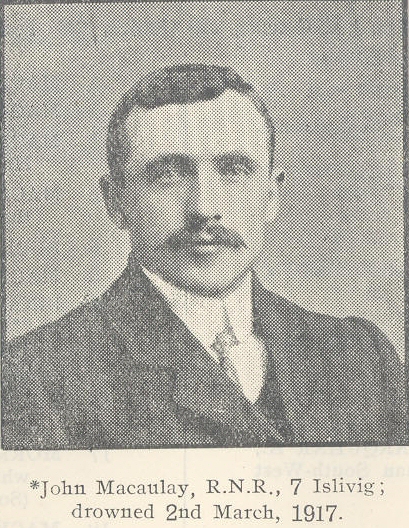 John Macaulay was lost when SS Kenmare was torpedoed in the Irish Sea on Saturday, 2 March 1918. He came from the village of Islivig in the district of Uig in Lewis. His remains turned up on the east coast of Ireland, north of Dublin, and lie buried in a grave in Balrothery. His grave is marked by a Commonwealth War¬graves Commission headstone.
This tribute is dedicated to his memory, and endeavours to tell the story of SS Kenmare, the German submarine U-104 which fired the fatal torpedo and John Macaulay’s final resting place.
John’s family history
John was the son of fisherman Donald Macaulay of Islivig and domestic servant Margaret Macaulay who were married at Miavaig on 4 April 1878. Both were aged 26 at the time. It is worth pointing out that in the Gaelic community, the name Margaret is sometimes converted to Peggy. They continued to live in Islivig after their marriage. Donald and Peggy were blessed with the birth of a son, John, on 7 December 1881. It has not been part of my investigations to find out whether they had any more children.
Thirty-six years later, on 16 January 1917, John (now living at 7 Islivig) was married to Catherine Ann Macaulay, a 29-year old nurse from 19 Brenish. She is the daughter of boat-builder John Macaulay and Isabella Matheson. The marriage was conducted at Seaforth House on Scotland Street in Stornoway.
By that time, John’s mother Peggy had died, and Donald, by that time aged 62, was a crofter. His son, John, was a seaman in the Merchant Service, but (1917 being a war year) also marked as being in the Royal Naval Reserve, as so many islanders were.
S.S. Kenmare
The Kenmare was launched on 16 February 1895 at Wigham, Richardson and Co. of Newcastle upon Tyne. She was powered by a triple-expansion steam engine, generating 437 hp. She was completed for the City of Cork Steam Packet Co. Ltd. Her dimensions were 264.5 x 36.5 x 16.9 feet, measuring 1,346 gross tons.
During the First World War, she found herself under attack by German submarines (U-boats) on four occasions. On 27 June 1915, SS Kenmare was attacked by gunfire off Youghall, but outran her attacker with minimal damage. Two years later, on 21 October 1917, Kenmare was off Holyhead, bound from Liverpool to Cork, when a torpedo passed only a few feet from her stern. A few weeks later, the Kenmare had to fire at a submarine that was chasing her. However, the last attack, on 2 March 1918, proved fatal.
That day, SS Kenmare was sailing from Liverpool to Cork with a general cargo at position 53°40’095”N 5°06’099”W. This is 60 km (approximately 35 nautical miles) north of east from Skerries, Co Dublin and 40kms (approximately 25 nautical miles) north west from The Skerries, Anglesey.. At around 7pm, U-104 fired a torpedo without warning. It inflicted severe damage, and Kenmare sank by the stern within two minutes. Only one lifeboat was serviceable, and the three who had managed to get into it tried to find other crew members. Three more were saved. In spite of shouting being heard, the occupants of the lifeboat did not manage to locate these unfortunates as it was dark by that time and the sea covered in wreckage. Twenty-nine members of crew perished, 24 of whom were in a boat which overturned – the weather being poor and the sea rough at the time. The First Mate, four crewmen and Gunner James Henry Chamberlain Brougham RNVR, aged 20 survived the torpedoing of the ship. This was remarkable, bearing in mind that the ship sank in just two minutes. Two other gunners, Able Seaman Albert Edward Aston RNVR and Leading Deck Hand John Macaulay RNR did not survive. Apparently, the ship’s gun had been thrown from its mountings by the force of the explosion. The survivors were picked up by the steamer Glenside the next morning, and taken to Dublin.
U-boat postscript
U-boat 104 had been in service for only five months at the time of the attack on the Kenmare. U-104 sank a total of eight ships, which accounted for a third of the number of ships (25) sunk by its commander, 32-year old Kapitän-Leutnant zur See Kurt Bernis, until he was killed in the sinking of his U-boat on 25 April 1918.
On 23 April 1918, U-104 was attacked by USS Cushing using depth charges. These damaged the submarine. Two days later, HMS Jessamine came across the submarine on the surface in St George’s Channel as its crew were attempting to repair the damage, caused by the depth charges. KLt Bernis dived his submarine, but depth charges from HMS Jessamine forced him to surface. The U-boat was finally sunk, taking 31 to the bottom with her. Ten sailors were left in the water, after their vessel went down, of whom only one was picked up by the warship. The other nine were left to drown in the sea.
Found in Ireland
John Macaulay was not saved from the sinking of the Kenmare. Although the one working lifeboat remained on the scene as long as possible, the shouting of the floundering seamen ceased after some 10 minutes. It is a matter of conjecture what happened during the next fourteen days.
 Coast Watchman John Doherty and Constable Masterson found the body of John Macaulay on a beach at King’s Point (shown left) north of Balbriggan Co. Dublin on Saturday 16th March 1918. Two other bodies of sailors were found on the same day washed up on nearby beaches at Skerries Co. Dublin and Gormanston Co. Meath, but only John Macaulay’s body could be identified. He carried a letter which is said to have identified him as George [sic] Mcauley of Stornaway. He is described as a fine young sailor of about 25 – however, at the time of his death, John Macaulay was actually aged thirty-five. All three were dressed in semi-naval uniform.
Inquests into the deaths of the three sailors were held by Coroners Friery and Corry, and the evidence disclosed nothing further than that two of the men carried beads and scapulars, while a disc showed that McAuley was a Presbyterian. The bodies, which were only a few days in the water, bore no sign of violence, and the medical testimony was that death was due to drowning. A verdict of “found drowned” was duly returned by the Jury under foreman Mr George Mongey.
News found its way to John’s native Isle of Lewis, and was relayed by local weekly newspaper Stornoway Gazette, on 15 March 1918.
“It is with deep regret we have to record the death by drowning of Seaman John Macaulay (Iain Dhomhnaill an Taillear) [John the son of Donald the Tailor] Islivig on Saturday 2nd inst. His boat the “Kenmore” [sic] was torpedoed, and only six out of a crew of thirty-five were saved. John was one of the finest young men that could be met in a day’s march. To his young and sorrowing widow, and to his other near relatives and friends, the heartfelt sympathy of the whole community is extended in their very sad and sore bereavement.”
John’s family had endeavoured to have the body transferred home, but the authorities would not sanction this. An account of the funeral was forwarded to his family by the Acting Divisional Officer of Coastguard at Rush, and the Stornoway Gazette copies this; I insert additional information as supplied by the Drogheda Independent and Drogheda Advertiser in their editions of March 23rd, 1918.


The funeral started from the Coastguard Station, Balbriggan (shown left, about 1920). The military supplied four horses and the coffin was place on the limber, and we marched through the town of Balbriggan. The military firing party, with a piper at its head, led the procession; a military funeral party and a body of police followed behind the coffin with as many of the Coastguard as could be obtained; and a large crowd of the inhabitants followed to the churchyard. the piper played a lament and other Scottish airs suitable for the occasion. (Pipers’ Band of the Royal Engineers playing the Dead March) The military also took photographs of the funeral and if they turn out successful you will be sent copies. Your son is buried at Balrothery Churchyard, and the funeral service was carried out by the Protestant minister (Rev. H. B. Good, Rector, Rev. C. Benson L.L.D. and Rev. R. Scriven). Your son was given the grandest funeral that was ever seen in Balbriggan and I think it is particularly gratifying to know that full honours were paid to his remains. Three volleys were fired over the grave and the piper played between each volley.”
Postscript
It would stand to reason that such a grand occasion would be remembered for many years to come in a small town like Balbriggan. Not in this instance. British armed forces burned and looted the centre of the town on 9 September 1920 in reprisal for the alleged killing of an R.I.C officer by the I.R.A. earlier in the evening, as the unfortunate policeman left a local pub. This would have eclipsed if not erased the burial in the collective and popular memory of the inhabitants of the town.
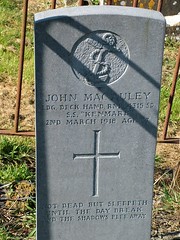
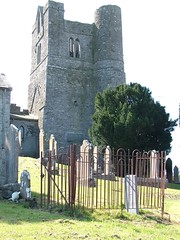
In the 1930s, the Commonwealth War Graves Commission commissioned the erection of a grave-stone over John Macaulay’s grave at Balrothery, a gravestone which faces east. His was one of many such gravestones in Ireland that were put up by the Office of Public Works, a branch of the Irish Government. In the 1920s, the family ordered the installation of iron railings around the grave site. The spelling of John Macaulay’s name on the gravestone (Macauley) is noted, but the information on the stone confirms the identity of the casualty.
Catherine Ann, John’s wife, died in Stornoway on 17 April 1961, aged 73. From the limited resources available to me, I have not been able to find out if she remarried and / or had children.
John’s father, Donald Macaulay, passed away in the district of Uig in 1933, aged 80.
John Macaulay is also remembered on the commemorative panel in Grangegorman Military Cemetery, Blackhorse Avenue, Dublin.

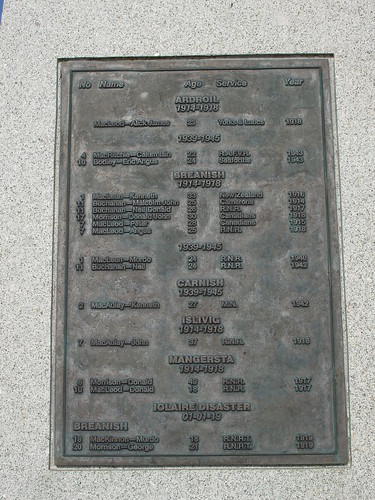
He is also mentioned on the West Uig division of the Lewis War Memorial at Stornoway

and on the Uig War Memorial at Timsgarry
Sources
• David J. Grundy, Skerries, Dublin
• Scotland’s People
• The Drogheda Historical Society, from the archives of The Drogheda Independent and The Drogheda Advertiser, Mellmount Museum, Drogheda, Co Louth, Ireland
• Stornoway Gazette, 15th March 1918 and 12th April 1918, from transcript of original copies, held on microfiche at Stornoway Library
• Comann Eachdraidh Uig, Uig Museum, Timsgarry, Isle of Lewis
• Commonwealth War Graves Commission
• Cork Examiner archives (now Irish Examiner), courtesy Brendan Mooney
• From book: The Irish Boats (Cork & Waterford), courtesy Brendan Mooney
• Uboat.net
• Portrait photograph: Loyal Lewis Roll of Honour 1914-1918, Stornoway Gazette, 1921 (held at Stornoway Library)
• Photographs of Balbriggan Coast Guard Station are the copyright of Mr. David Brangan and is reproduced with his kind permission.
Please note that further research into John, his ship and shipmates is relayed on this site.
John Macaulay was lost when SS Kenmare was torpedoed in the Irish Sea on Saturday, 2 March 1918. He came from the village of Islivig in the district of Uig in Lewis. His remains turned up on the east coast of Ireland, north of Dublin, and lie buried in a grave in Balrothery. His grave is marked by a Commonwealth War¬graves Commission headstone. This tribute is dedicated to his memory, and endeavours to tell the story of SS Kenmare, the German submarine U-104 which fired the fatal torpedo and John Macaulay’s final resting place.
John’s family history
John was the son of fisherman Donald Macaulay of Islivig and domestic servant Margaret Macaulay who were married at Miavaig on 4 April 1878. Both were aged 26 at the time. It is worth pointing out that in the Gaelic community, the name Margaret is sometimes converted to Peggy. They continued to live in Islivig after their marriage. Donald and Peggy were blessed with the birth of a son, John, on 7 December 1881. It has not been part of my investigations to find out whether they had any more children.
Thirty-six years later, on 16 January 1917, John (now living at 7 Islivig) was married to Catherine Ann Macaulay, a 29-year old nurse from 19 Brenish. She is the daughter of boat-builder John Macaulay and Isabella Matheson. The marriage was conducted at Seaforth House on Scotland Street in Stornoway.
By that time, John’s mother Peggy had died, and Donald, by that time aged 62, was a crofter. His son, John, was a seaman in the Merchant Service, but (1917 being a war year) also marked as being in the Royal Naval Reserve, as so many islanders were.
S.S. Kenmare
The Kenmare was launched on 16 February 1895 at Wigham, Richardson and Co. of Newcastle upon Tyne. She was powered by a triple-expansion steam engine, generating 437 hp. She was completed for the City of Cork Steam Packet Co. Ltd. Her dimensions were 264.5 x 36.5 x 16.9 feet, measuring 1,346 gross tons.
During the First World War, she found herself under attack by German submarines (U-boats) on four occasions. On 27 June 1915, SS Kenmare was attacked by gunfire off Youghall, but outran her attacker with minimal damage. Two years later, on 21 October 1917, Kenmare was off Holyhead, bound from Liverpool to Cork, when a torpedo passed only a few feet from her stern. A few weeks later, the Kenmare had to fire at a submarine that was chasing her. However, the last attack, on 2 March 1918, proved fatal.
That day, SS Kenmare was sailing from Liverpool to Cork with a general cargo at position 53°40’095”N 5°06’099”W. This is 60 km (approximately 35 nautical miles) north of east from Skerries, Co Dublin and 40kms (approximately 25 nautical miles) north west from The Skerries, Anglesey.. At around 7pm, U-104 fired a torpedo without warning. It inflicted severe damage, and Kenmare sank by the stern within two minutes. Only one lifeboat was serviceable, and the three who had managed to get into it tried to find other crew members. Three more were saved. In spite of shouting being heard, the occupants of the lifeboat did not manage to locate these unfortunates as it was dark by that time and the sea covered in wreckage. Twenty-nine members of crew perished, 24 of whom were in a boat which overturned – the weather being poor and the sea rough at the time. The First Mate, four crewmen and Gunner James Henry Chamberlain Brougham RNVR, aged 20 survived the torpedoing of the ship. This was remarkable, bearing in mind that the ship sank in just two minutes. Two other gunners, Able Seaman Albert Edward Aston RNVR and Leading Deck Hand John Macaulay RNR did not survive. Apparently, the ship’s gun had been thrown from its mountings by the force of the explosion. The survivors were picked up by the steamer Glenside the next morning, and taken to Dublin.
U-boat postscript
U-boat 104 had been in service for only five months at the time of the attack on the Kenmare. U-104 sank a total of eight ships, which accounted for a third of the number of ships (25) sunk by its commander, 32-year old Kapitän-Leutnant zur See Kurt Bernis, until he was killed in the sinking of his U-boat on 25 April 1918.
On 23 April 1918, U-104 was attacked by USS Cushing using depth charges. These damaged the submarine. Two days later, HMS Jessamine came across the submarine on the surface in St George’s Channel as its crew were attempting to repair the damage, caused by the depth charges. KLt Bernis dived his submarine, but depth charges from HMS Jessamine forced him to surface. The U-boat was finally sunk, taking 31 to the bottom with her. Ten sailors were left in the water, after their vessel went down, of whom only one was picked up by the warship. The other nine were left to drown in the sea.
Found in Ireland
John Macaulay was not saved from the sinking of the Kenmare. Although the one working lifeboat remained on the scene as long as possible, the shouting of the floundering seamen ceased after some 10 minutes. It is a matter of conjecture what happened during the next fourteen days.
Coast Watchman John Doherty and Constable Masterson found the body of John Macaulay on a beach at King’s Point (shown left) north of Balbriggan Co. Dublin on Saturday 16th March 1918. Two other bodies of sailors were found on the same day washed up on nearby beaches at Skerries Co. Dublin and Gormanston Co. Meath, but only John Macaulay’s body could be identified. He carried a letter which is said to have identified him as George [sic] Mcauley of Stornaway. He is described as a fine young sailor of about 25 – however, at the time of his death, John Macaulay was actually aged thirty-five. All three were dressed in semi-naval uniform. Inquests into the deaths of the three sailors were held by Coroners Friery and Corry, and the evidence disclosed nothing further than that two of the men carried beads and scapulars, while a disc showed that McAuley was a Presbyterian. The bodies, which were only a few days in the water, bore no sign of violence, and the medical testimony was that death was due to drowning. A verdict of “found drowned” was duly returned by the Jury under foreman Mr George Mongey.
News found its way to John’s native Isle of Lewis, and was relayed by local weekly newspaper Stornoway Gazette, on 15 March 1918.
“It is with deep regret we have to record the death by drowning of Seaman John Macaulay (Iain Dhomhnaill an Taillear) [John the son of Donald the Tailor] Islivig on Saturday 2nd inst. His boat the “Kenmore” [sic] was torpedoed, and only six out of a crew of thirty-five were saved. John was one of the finest young men that could be met in a day’s march. To his young and sorrowing widow, and to his other near relatives and friends, the heartfelt sympathy of the whole community is extended in their very sad and sore bereavement.”
John’s family had endeavoured to have the body transferred home, but the authorities would not sanction this. An account of the funeral was forwarded to his family by the Acting Divisional Officer of Coastguard at Rush, and the Stornoway Gazette copies this; I insert additional information as supplied by the Drogheda Independent and Drogheda Advertiser in their editions of March 23rd, 1918.


The funeral started from the Coastguard Station, Balbriggan (shown left, about 1920). The military supplied four horses and the coffin was place on the limber, and we marched through the town of Balbriggan. The military firing party, with a piper at its head, led the procession; a military funeral party and a body of police followed behind the coffin with as many of the Coastguard as could be obtained; and a large crowd of the inhabitants followed to the churchyard. the piper played a lament and other Scottish airs suitable for the occasion. (Pipers’ Band of the Royal Engineers playing the Dead March) The military also took photographs of the funeral and if they turn out successful you will be sent copies. Your son is buried at Balrothery Churchyard, and the funeral service was carried out by the Protestant minister (Rev. H. B. Good, Rector, Rev. C. Benson L.L.D. and Rev. R. Scriven). Your son was given the grandest funeral that was ever seen in Balbriggan and I think it is particularly gratifying to know that full honours were paid to his remains. Three volleys were fired over the grave and the piper played between each volley.”
Postscript
It would stand to reason that such a grand occasion would be remembered for many years to come in a small town like Balbriggan. Not in this instance. British armed forces burned and looted the centre of the town on 9 September 1920 in reprisal for the alleged killing of an R.I.C officer by the I.R.A. earlier in the evening, as the unfortunate policeman left a local pub. This would have eclipsed if not erased the burial in the collective and popular memory of the inhabitants of the town.
In the 1930s, the Commonwealth War Graves Commission commissioned the erection of a grave-stone over John Macaulay’s grave at Balrothery, a gravestone which faces east. His was one of many such gravestones in Ireland that were put up by the Office of Public Works, a branch of the Irish Government. In the 1920s, the family ordered the installation of iron railings around the grave site. The spelling of John Macaulay’s name on the gravestone (Macauley) is noted, but the information on the stone confirms the identity of the casualty.
Catherine Ann, John’s wife, died in Stornoway on 17 April 1961, aged 73. From the limited resources available to me, I have not been able to find out if she remarried and / or had children.
John’s father, Donald Macaulay, passed away in the district of Uig in 1933, aged 80.
John Macaulay is also remembered on the commemorative panel in Grangegorman Military Cemetery, Blackhorse Avenue, Dublin.

He is also mentioned on the West Uig division of the Lewis War Memorial at Stornoway
and on the Uig War Memorial at Timsgarry
Sources
• David J. Grundy, Skerries, Dublin
• Scotland’s People
• The Drogheda Historical Society, from the archives of The Drogheda Independent and The Drogheda Advertiser, Mellmount Museum, Drogheda, Co Louth, Ireland
• Stornoway Gazette, 15th March 1918 and 12th April 1918, from transcript of original copies, held on microfiche at Stornoway Library
• Comann Eachdraidh Uig, Uig Museum, Timsgarry, Isle of Lewis
• Commonwealth War Graves Commission
• Cork Examiner archives (now Irish Examiner), courtesy Brendan Mooney
• From book: The Irish Boats (Cork & Waterford), courtesy Brendan Mooney
• Uboat.net
• Portrait photograph: Loyal Lewis Roll of Honour 1914-1918, Stornoway Gazette, 1921 (held at Stornoway Library)
• Photographs of Balbriggan Coast Guard Station are the copyright of Mr. David Brangan and is reproduced with his kind permission.
Monday, 30 August 2010
30 August 1930
On that day, the villagers of St Kilda were packing up their belongings, before leaving the island of their birth forever. Some left a bowl of grain on the table, with the Bible open at the chapter of Exodus. A community, a culture, a way of life was coming to a close after thousands of years. Life on their outpost in the Atlantic had become untenable, to their minds, and the Hiorteachs had requested their own removal. The steamer Harebell took them to the village of Lochaline, on the mainland and on to Glasgow.
A lot has been written about St Kilda, with insights changing as the years and researches progress. Someone has recently mooted the idea to repopulate the islands with permanent inhabitants - an idea that is as fanciful as it is unrealistic. Even today, with modern, powerful boats, it is not always possible to cross the sea to the islands. In the past, there would be no communication with St Kilda for 8 months of the year, due to the severity of the weather and the ocean. That has not changed.
Work is in progress to establish a St Kilda Centre at Mangersta in Lewis, where culture and history of St Kilda will be remembered. For it is no longer alive.
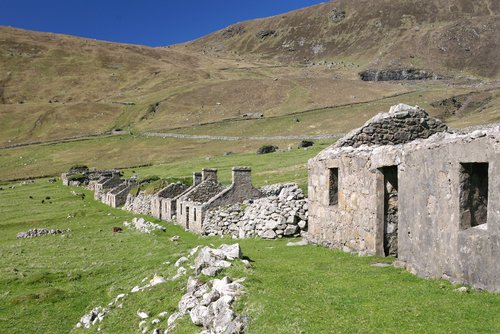
Image courtesy planetware.com
A lot has been written about St Kilda, with insights changing as the years and researches progress. Someone has recently mooted the idea to repopulate the islands with permanent inhabitants - an idea that is as fanciful as it is unrealistic. Even today, with modern, powerful boats, it is not always possible to cross the sea to the islands. In the past, there would be no communication with St Kilda for 8 months of the year, due to the severity of the weather and the ocean. That has not changed.
Work is in progress to establish a St Kilda Centre at Mangersta in Lewis, where culture and history of St Kilda will be remembered. For it is no longer alive.
Image courtesy planetware.com
Wednesday, 25 August 2010
Norge
In 2012, it will be 100 years since the sinking of RMS Titanic. The last survivor died a few years ago, aged 97. It is through reading up on local history that I have learned that the sinking of the Titanic need not have been as catastrophic in terms of loss of life as it turned out to be. Eight years before the Titanic sank, the emigrant ship SS Norge struck Hazelwood Rock, just east of Rockall in the Atlantic. The Norge went down in 20 minutes, taking 700 to the bottom with her.
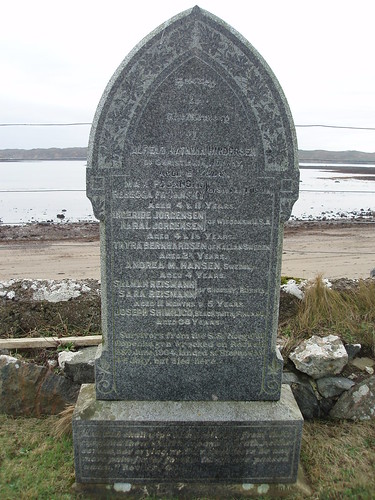 Not all eight of the lifeboats launched from the Norge stayed afloat; some sank at the moment of launch, but a handful were spotted by fishermen and taken to the United Kingdom. One lot of survivors was put ashore at Stornoway, and treated at the local hospital. Nine succumbed to their ordeal and lie buried at Sandwick Cemetery, a 15-minute walk from my position. One boat is thought to have drifted northeast to and beyond the Arctic Circle; but there is no confirmation of her fate.
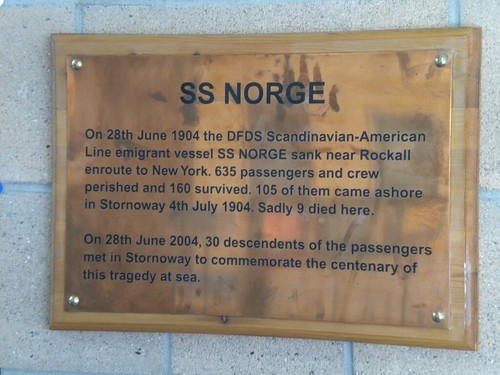 Nobody has heard of the Norge. No rich and famous on board that ship. Just dirt poor emigrants from Norway, Denmark, Sweden and Russia. In particular the Russian emigrants were the undesirables of that country. Jews, who had been packed away onto the western fringes of the Tsarist realm, and generally hated and detested in many circles of the Russia of 1904. The board of inquiry into the sinking of the Norge found that there were insufficient lifeboats for the number of people on board. A recommendation was issued that laws should be introduced, requiring ships to carry sufficient lifeboats, -rafts and other craft to accommodate all on board in the event of abandon-ship. This was not followed through.
This negligence was catastrophic for the passengers on board RMS Titanic on 14/15 April 1912.
Not all eight of the lifeboats launched from the Norge stayed afloat; some sank at the moment of launch, but a handful were spotted by fishermen and taken to the United Kingdom. One lot of survivors was put ashore at Stornoway, and treated at the local hospital. Nine succumbed to their ordeal and lie buried at Sandwick Cemetery, a 15-minute walk from my position. One boat is thought to have drifted northeast to and beyond the Arctic Circle; but there is no confirmation of her fate. Nobody has heard of the Norge. No rich and famous on board that ship. Just dirt poor emigrants from Norway, Denmark, Sweden and Russia. In particular the Russian emigrants were the undesirables of that country. Jews, who had been packed away onto the western fringes of the Tsarist realm, and generally hated and detested in many circles of the Russia of 1904. The board of inquiry into the sinking of the Norge found that there were insufficient lifeboats for the number of people on board. A recommendation was issued that laws should be introduced, requiring ships to carry sufficient lifeboats, -rafts and other craft to accommodate all on board in the event of abandon-ship. This was not followed through.This negligence was catastrophic for the passengers on board RMS Titanic on 14/15 April 1912.
Friday, 20 August 2010
Evicted
This is an excerpt from the Napier Commission's hearings in the Isle of Skye in 1883. Sitting in Uig, now well-known as a ferry port for sailings to North Uist and Harris, the Commission heard the verbatim account of an eviction, and the rather harsh treatment of a man who declined to pay an additional £1. Donald Nicolson is 78 in May 1883, but in 1878 he was kicked off his croft in Totescore, a few miles north of Uig. His account is translated from his native Gaelic.
Lord Napier starts off the examination after the preliminaries:
What have you to state to us?
—My rent was doubled, and I would not get it even then unless I would promise to pay an additional £1. My rent was £7, 10s., and it was doubled at once, and another pound added. I did not refuse to pay the double rent, but I declined to pay the extra £1. I then got warning. When the summer came, the officer came and ejected me. He put everything I had out of the house, and I was only wanting payment for my houses, and I would go. The doors were locked on me. The tacksman of Monkstadt sent word round to the rest of the crofters that any one who would open door for me would be treated the same way as I was next year—and they are here to-day—and not one of them would let me into his house, they were so afraid. I could not cut a peat. My son's wife was in with her two young children, and we were that night in the cart-shed, and our neighbours were afraid to let us in, and crying over us. The peats were locked up. They still had the mark upon us. We had not a fire to prepare a cake. There was plenty of meal outside, but we had not a fire to prepare it. I was then staying in the stable during the summer. I could only make one bed in it. My daughter and my son's wife and the two children were sleeping in that bed, and I myself was sleeping on the stones. The Presbytery of the Established Church, during a vacancy, allowed me to enter the glebe. The factor then shut up my outhouses, and I would not be permitted to enter one of them. I was afterwards staying in the house of a poor woman who was taking care of a sick friend, and the factor challenged Mr Stewart, the tacksman of Duntulm, for permitting me to have shelter in this house, for it was on his ground that this poor woman was; and it is Mr Grant, the minister of the parish, who is supporting me to-day,
Sheriff Nicolson: When did all this happen ?
—Five years ago. There was due to me £ 6 for the making of drains on the lot, and my neighbours got this, but none was allowed to me. The factor would not pay me a penny, and it is still due to me.
Did you get anything for the house?
—The sum due by me was £35, but I got credit for the value of the house, which was £7 ; I did not get value for the other houses. They were valued at £17, 10s. and I did not get the value for them.
Lord Napier: Who was the factor?
—Mr Alexander Macdonald, the present factor. He was law agent as well in the matter.
The Interpreter made the following statement:
—He was evicted twice, but when put out he had a shed to enter into, and he entered the shed and entered the stable, and then he was evicted out of these, and an interdict was issued against him forbidding him any more to enter the house or the lands. Under stress of circumstances, he entered a barn, the key of which was given to him for the purpose of securing the crop, but was had up for breach of interdict, and for this breach of interdict he was fined 10s. with the alternative of five days' imprisonment. The expense of the interdict was something like £8. In the £35 there was a whole year's rent due. He was charged, besides, violent profits, being the legal penalty for remaining in possession after the term.
Lord Napier starts off the examination after the preliminaries:
What have you to state to us?
—My rent was doubled, and I would not get it even then unless I would promise to pay an additional £1. My rent was £7, 10s., and it was doubled at once, and another pound added. I did not refuse to pay the double rent, but I declined to pay the extra £1. I then got warning. When the summer came, the officer came and ejected me. He put everything I had out of the house, and I was only wanting payment for my houses, and I would go. The doors were locked on me. The tacksman of Monkstadt sent word round to the rest of the crofters that any one who would open door for me would be treated the same way as I was next year—and they are here to-day—and not one of them would let me into his house, they were so afraid. I could not cut a peat. My son's wife was in with her two young children, and we were that night in the cart-shed, and our neighbours were afraid to let us in, and crying over us. The peats were locked up. They still had the mark upon us. We had not a fire to prepare a cake. There was plenty of meal outside, but we had not a fire to prepare it. I was then staying in the stable during the summer. I could only make one bed in it. My daughter and my son's wife and the two children were sleeping in that bed, and I myself was sleeping on the stones. The Presbytery of the Established Church, during a vacancy, allowed me to enter the glebe. The factor then shut up my outhouses, and I would not be permitted to enter one of them. I was afterwards staying in the house of a poor woman who was taking care of a sick friend, and the factor challenged Mr Stewart, the tacksman of Duntulm, for permitting me to have shelter in this house, for it was on his ground that this poor woman was; and it is Mr Grant, the minister of the parish, who is supporting me to-day,
Sheriff Nicolson: When did all this happen ?
—Five years ago. There was due to me £ 6 for the making of drains on the lot, and my neighbours got this, but none was allowed to me. The factor would not pay me a penny, and it is still due to me.
Did you get anything for the house?
—The sum due by me was £35, but I got credit for the value of the house, which was £7 ; I did not get value for the other houses. They were valued at £17, 10s. and I did not get the value for them.
Lord Napier: Who was the factor?
—Mr Alexander Macdonald, the present factor. He was law agent as well in the matter.
The Interpreter made the following statement:
—He was evicted twice, but when put out he had a shed to enter into, and he entered the shed and entered the stable, and then he was evicted out of these, and an interdict was issued against him forbidding him any more to enter the house or the lands. Under stress of circumstances, he entered a barn, the key of which was given to him for the purpose of securing the crop, but was had up for breach of interdict, and for this breach of interdict he was fined 10s. with the alternative of five days' imprisonment. The expense of the interdict was something like £8. In the £35 there was a whole year's rent due. He was charged, besides, violent profits, being the legal penalty for remaining in possession after the term.
Thursday, 19 August 2010
William Scambler
William Scambler was a 30-year old trimmer / cook on board His Majesty's Trawler "THOMAS STRATTEN", when this ship hit a mine off the Butt of Lewis on 20 October 1917. William's remains were buried at Sandwick Cemetery near Stornoway. Today, I managed to track down records of his birth and his death, which paints the following picture.
William Scambler
Birth record
Date of birth: July 23rd, 1887, 5h AM
Place of birth: Glorat, Campsie, Stirlingshire
Name of father: James Scambler, assistant gamekeeper (present at registry office)
Name of mother: Elizabeth Harriet Scambler, nee Dryden
Place and date of their marriage: Edinburgh, 14 October 1886.
Death record
Name: SCAMBLER, William
Rating: Trimmer / Cook
Official no and port division: 712.T.C. (Po)
Branch of service: R.N.R.
Ship or unit: H.M. Trawler "THOMAS STRATTEN"
Date and place of birth: 23.7.1887, Lennoxtown, Stirling
Date of death: 20.10.1917
Name and address of cemetery: Civil Cemetery, Sandwick, Stornoway, Isle of Lewis, grave O. 1321.
Relatives notified and their address: Wife, Alice; Branxton, Innerwick, Berwick, Scotland
Among William's shipmates, none of whom were recovered were (further details courtesy CWGC)
BOWSER, Walter, Trimmer, RNR, TS 6310 (aged 18), Son of Thomas Frederick and Lilian Bowser, of 42, Beecroft St., St. George's Rd., Hull. Remembered on Chatham Naval Memorial panel 27
BROWN, Charles John, Deck Hand, RNR, DA 5540 (aged 24). Son of Alice Mary Brown, of Clare Cottage, Caister-on-Sea, Great Yarmouth, and the late Charles John Brown. Remembered on Chatham
Naval Memorial panel 26.
COLLINSON, James, Deck Hand, RNR, SD 3895 (aged 21). Son of George Collinson, of 158, High St., East End, Sunderland, and the late Catherine Collinson; husband of Catherine Millar (formerly Collinson), of 58, Loudoun Square, Cardiff. Remembered on Chatham Naval Memorial panel 26.
PARRISH, Charles, Ordinary Telegraphist, RNVR, Tyneside Z 10209 (aged 20). Son of Willie and Amanda Matilda Parrish, of 75, Carr House Rd., Shelf, Halifax. Remembered on Chatham Naval Memorial panel 27
PIRIE, James, Deck Hand, RNR, DA 3948. Remembered on Chatham Naval Memorial panel 28
PLAYFORD, John, Deck Hand, RNR, DA 10703 (aged 26). Son of Sarah Ann Playford, of Pockthorpe, Raveningham, Norwich. Remembered on Chatham Naval Memorial, panel 26.
POLLARD, Thomas Edward, Deck Hand, RNR, DA 12923. Son of Fanny Pollard, of Gorran Haven, Gorran, Cornwall. Remembered on Plymouth Naval Memorial, panel 24.
William Scambler
Birth record
Date of birth: July 23rd, 1887, 5h AM
Place of birth: Glorat, Campsie, Stirlingshire
Name of father: James Scambler, assistant gamekeeper (present at registry office)
Name of mother: Elizabeth Harriet Scambler, nee Dryden
Place and date of their marriage: Edinburgh, 14 October 1886.
Death record
Name: SCAMBLER, William
Rating: Trimmer / Cook
Official no and port division: 712.T.C. (Po)
Branch of service: R.N.R.
Ship or unit: H.M. Trawler "THOMAS STRATTEN"
Date and place of birth: 23.7.1887, Lennoxtown, Stirling
Date of death: 20.10.1917
Name and address of cemetery: Civil Cemetery, Sandwick, Stornoway, Isle of Lewis, grave O. 1321.
Relatives notified and their address: Wife, Alice; Branxton, Innerwick, Berwick, Scotland
Among William's shipmates, none of whom were recovered were (further details courtesy CWGC)
BOWSER, Walter, Trimmer, RNR, TS 6310 (aged 18), Son of Thomas Frederick and Lilian Bowser, of 42, Beecroft St., St. George's Rd., Hull. Remembered on Chatham Naval Memorial panel 27
BROWN, Charles John, Deck Hand, RNR, DA 5540 (aged 24). Son of Alice Mary Brown, of Clare Cottage, Caister-on-Sea, Great Yarmouth, and the late Charles John Brown. Remembered on Chatham
Naval Memorial panel 26.
COLLINSON, James, Deck Hand, RNR, SD 3895 (aged 21). Son of George Collinson, of 158, High St., East End, Sunderland, and the late Catherine Collinson; husband of Catherine Millar (formerly Collinson), of 58, Loudoun Square, Cardiff. Remembered on Chatham Naval Memorial panel 26.
PARRISH, Charles, Ordinary Telegraphist, RNVR, Tyneside Z 10209 (aged 20). Son of Willie and Amanda Matilda Parrish, of 75, Carr House Rd., Shelf, Halifax. Remembered on Chatham Naval Memorial panel 27
PIRIE, James, Deck Hand, RNR, DA 3948. Remembered on Chatham Naval Memorial panel 28
PLAYFORD, John, Deck Hand, RNR, DA 10703 (aged 26). Son of Sarah Ann Playford, of Pockthorpe, Raveningham, Norwich. Remembered on Chatham Naval Memorial, panel 26.
POLLARD, Thomas Edward, Deck Hand, RNR, DA 12923. Son of Fanny Pollard, of Gorran Haven, Gorran, Cornwall. Remembered on Plymouth Naval Memorial, panel 24.
Wednesday, 11 August 2010
Frederick Cyril Crocker
I found this old email from December last year, in which Frederick Cyril Crocker is suggested as a WW1 casualties whose roots lie in Stornoway. And so they do. He was born at 18 Newton Street on 22 December 1888 to Lieutenant John Crocker. of Claremont. Portishead, Somerset, formerly of Lerwick and Stornoway. R.N. Divisional Officer of Coast Guards, Southend Division, who was married to Annie, daughter of the late James Bardsley. Cyril was educated at Wexford, and Andemon Institute, Lerwick, Shetland, and prior to the outbreak of war was an Officer of Excise at Gateshead. He married at Glasgow, 10 June, 1011, Janet, daughter of Peter Macleod, of Stornoway, and had two daughters.: Patricia Joan Mary, born 28 April, 1912; and Annie Valerie, born 4 Feb. 1915.
Cyril joined the Northumberland Fusiliers at the beginning of 1914. volunteered for Imperial service when war began, was severely wounded in action at St. Julien, 26 April, 1915, while leading the platoon in a bayonet charge after his platoon officer, Lieut. Garton, had fallen, and died in the East Suffolk Hospital, Ipswich 1 June, following.
With thanks to Alastair Macewen and Anne Brooks' Genealogy.
Cyril joined the Northumberland Fusiliers at the beginning of 1914. volunteered for Imperial service when war began, was severely wounded in action at St. Julien, 26 April, 1915, while leading the platoon in a bayonet charge after his platoon officer, Lieut. Garton, had fallen, and died in the East Suffolk Hospital, Ipswich 1 June, following.
With thanks to Alastair Macewen and Anne Brooks' Genealogy.
Subscribe to:
Posts (Atom)