On this day, four sailors from Barra, Eriskay and Vatersay were lost in the sinking of SS Bagdale. The steamer was heading from the Clyde to Naples, when she was sunk by U-boat UC-66 off Ushant, Brittany, France, with the loss of 23 lives. UC-66 was lost about six weeks after the sinking of the Bagdale, on 12 June 1917. The story is that she was forced to dive and when she was depth-charged by HMT Sea King, her own mines blew up. Like in the sinking of the Bagdale, 23 lives were lost with UC-66, among them her captain, Herbert Pustkuchen.
Sailor John Macdonald
At the age of 17
Iain Néill Ghréitheir
Son of Neil MacDonald, of No. 14, Cleat, Barra, Oban, Scotland. Born at Barra.
Last known address in Barra: Cleat
Service unit: Merchant Navy, SS Bagdale
Memorial: Tower Hill Memorial
Local memorial: Barra & Vatersay
Sailor John Macdougall
At the age of 20
Son of Effie McDougall (nee McInnes), of Coilleac, Eriskay, South Uist, Inverness, and the late Donard McDougall.
Last known address in Eriskay: Eriskay
Service unit: Merchant Navy, SS Bagdale
Memorial: Tower Hill Memorial
Local memorial: South Uist
Able Seaman Donald Macneil
At the age of 23
Dòmhnull Iagainn Dhòmhnuill
Son of Angus and Ann McNeil, of The Square, Watersay, Barra, Oban, Scotland.
Last known address in Vatersay:
Service unit: Merchant Navy, SS Bagdale
Memorial: Tower Hill Memorial
Local memorial: Barra & Vatersay
Able Seaman Neil Macneil
At the age of 24
Son of D. McNeil, of The Square, Watersay, Barra, Inverness. Born at Barra.
Last known address in Vatersay:
Service unit: Merchant Navy, SS Bagdale
Memorial: Tower Hill Memorial
Local memorial: Barra & Vatersay
Showing posts with label maritime. Show all posts
Showing posts with label maritime. Show all posts
Saturday, 6 December 2014


Saturday, 19 March 2011
Carloway
I am continuing my little series about vessels in port around the Isle of Lewis at the time of the 1901 census. I was quite surprised to find 68 names in the census return for men on board vessels at Carloway. This village on the west coast of Lewis, has a pier and is a fishing port. Nowadays, there is not much going on around the pier there. 110 years ago, it was a veritable hive of activity.
Or appeared to be. The census enumerators, who wrote up the returns, made a breathtaking mess of the east coast fishermen at Carloway. The total number of names is actually 35, meaning that with one exception, they are all written up twice. I shall endeavour to disentangle the web of confusion.
On that night of March 31st / April 1st, 1901, there are four fishing vessels at Carloway. These are:
White Queen,
Consolation,
Johanna Petrie
Glenalva
The confusion starts when the men are counted more than once in any of the following locations
1. On board their vessel
2. At the quay in Carloway
3. On board their vessel in Loch Carloway
Worse than that, several of the men from the Glenalva are counted with another vessel when ashore at the quay. Some of the names are suffixed with BF 348, which could refer to the vessel's registration. This tallies with the fishing vessel Onward, which carried the BF 348 registration from 1879. However, that name does not appear on the census forms.
All this means that they are counted under different "Household schedules".
Schedule 80: Consolation
Schedule 81: Glenalva
Schedule 82: Johanna Petrie; White Queen, at Carloway Pier or in Loch Carloway
Schedule 83: White Queen; Johanna Petrie in Loch Carloway
Schedule 84: Consolation at Carloway Quay
Well, that is enough to turn anyone's head. Let's clear this up and bring each crew member to his boat.
White Queen
Peter Buchan, 28, St Combs
Joseph Buchan, 48, Buchanhaven, Master
John Buchan, 30, St Combs
Robert Buchan, 23, St Combs
William Cormack, 39, Banff - also quoted with Glenalva
Alexander Glass, 25, Aberdeen, ship's engineer
William Mason, 40, Kincardineshire, fireman
Peter Reed, 45, Burnhaven, Mate
Andrew Strachan, 37, Inverlochy, Cook
William Strachan, 25, Inverlochy
Consolation
George Bruce, 49, Portnockie
William George (or Wiliam J. ) Bruce, 22, Banff
William Innes (or William James), 36, Portnockie
John Mair Johns, 36, Portnockie
James Mair, 34, 6 Fountain Street, Banff - also quoted with Glenalva and BF 348
Alexander Mair, 21, Portnockie - also quoted with BF 348
James Wood Reid, 31, Peterhead, Master
Francis Slater, 48, Portknockie, Mate
George Slater, 19, Portknockie
Francis Slater, 16, Portknockie, Cook
Alexander Watt, 40, Fraserburgh, also quoted with Glenalva
John Watt, 19, Banff - also quoted with BF 348
Alexander Wood, 39, Portessie
William Wood, 39, Portknockie - also quoted with Glenalva and BF 348John Wood, 20, Banff, - also quoted with Glenalva and BF 348
Johanna Petrie
John Buchan, 44, St Combs, Master
Charles Buchan, 38, St Combs, Mate
Andrew Buchan, 24, St Combs
William Davidson, 37, Aberdeen, engineer
Andrew Duthie, 37, Inverlochy
Gilbert Duthie, 27, Inverlochy
Charles Fait (or Fax), 27, Inverlochy
Alexr Milne, 35, Peterhead
Glenalva
Alexander Mair, 27, Portknockie
Alexander Watt, 40, Banff also quoted with Consolation
William Wood, 39, Portknockie, Master also quoted with Consolation and BF 348
John Wood, 22, Banff also quoted with BF 348
Or appeared to be. The census enumerators, who wrote up the returns, made a breathtaking mess of the east coast fishermen at Carloway. The total number of names is actually 35, meaning that with one exception, they are all written up twice. I shall endeavour to disentangle the web of confusion.
On that night of March 31st / April 1st, 1901, there are four fishing vessels at Carloway. These are:
White Queen,
Consolation,
Johanna Petrie
Glenalva
The confusion starts when the men are counted more than once in any of the following locations
1. On board their vessel
2. At the quay in Carloway
3. On board their vessel in Loch Carloway
Worse than that, several of the men from the Glenalva are counted with another vessel when ashore at the quay. Some of the names are suffixed with BF 348, which could refer to the vessel's registration. This tallies with the fishing vessel Onward, which carried the BF 348 registration from 1879. However, that name does not appear on the census forms.
All this means that they are counted under different "Household schedules".
Schedule 80: Consolation
Schedule 81: Glenalva
Schedule 82: Johanna Petrie; White Queen, at Carloway Pier or in Loch Carloway
Schedule 83: White Queen; Johanna Petrie in Loch Carloway
Schedule 84: Consolation at Carloway Quay
Well, that is enough to turn anyone's head. Let's clear this up and bring each crew member to his boat.
White Queen
Peter Buchan, 28, St Combs
Joseph Buchan, 48, Buchanhaven, Master
John Buchan, 30, St Combs
Robert Buchan, 23, St Combs
William Cormack, 39, Banff - also quoted with Glenalva
Alexander Glass, 25, Aberdeen, ship's engineer
William Mason, 40, Kincardineshire, fireman
Peter Reed, 45, Burnhaven, Mate
Andrew Strachan, 37, Inverlochy, Cook
William Strachan, 25, Inverlochy
Consolation
George Bruce, 49, Portnockie
William George (or Wiliam J. ) Bruce, 22, Banff
William Innes (or William James), 36, Portnockie
John Mair Johns, 36, Portnockie
James Mair, 34, 6 Fountain Street, Banff - also quoted with Glenalva and BF 348
Alexander Mair, 21, Portnockie - also quoted with BF 348
James Wood Reid, 31, Peterhead, Master
Francis Slater, 48, Portknockie, Mate
George Slater, 19, Portknockie
Francis Slater, 16, Portknockie, Cook
Alexander Watt, 40, Fraserburgh, also quoted with Glenalva
John Watt, 19, Banff - also quoted with BF 348
Alexander Wood, 39, Portessie
William Wood, 39, Portknockie - also quoted with Glenalva and BF 348John Wood, 20, Banff, - also quoted with Glenalva and BF 348
Johanna Petrie
John Buchan, 44, St Combs, Master
Charles Buchan, 38, St Combs, Mate
Andrew Buchan, 24, St Combs
William Davidson, 37, Aberdeen, engineer
Andrew Duthie, 37, Inverlochy
Gilbert Duthie, 27, Inverlochy
Charles Fait (or Fax), 27, Inverlochy
Alexr Milne, 35, Peterhead
Glenalva
Alexander Mair, 27, Portknockie
Alexander Watt, 40, Banff also quoted with Consolation
William Wood, 39, Portknockie, Master also quoted with Consolation and BF 348
John Wood, 22, Banff also quoted with BF 348
Rambler
This vessel is proving enigmatic for me. She was in Stornoway harbour at the time of the 1901 census, during the night of 31st March / 1st April. Only three men are quoted on board, namely:
John Bain, master, aged 34, Stornoway
Allan Mcleod, mate, aged 32, Stornoway
D Mcdonald, ordinary seaman, aged 20, Stornoway
Although there was a Royal Navy ship, HMS Rambler, in service around 1901, it was in port in Malta on the night of the census. HMS Rambler was built in 1879, and saw service in China, the Boer War and the Mediterranean, finally to be sold in 1907. The nature of the Rambler in Stornoway is presently a mystery. Any further info of course welcome.
John Bain, master, aged 34, Stornoway
Allan Mcleod, mate, aged 32, Stornoway
D Mcdonald, ordinary seaman, aged 20, Stornoway
Although there was a Royal Navy ship, HMS Rambler, in service around 1901, it was in port in Malta on the night of the census. HMS Rambler was built in 1879, and saw service in China, the Boer War and the Mediterranean, finally to be sold in 1907. The nature of the Rambler in Stornoway is presently a mystery. Any further info of course welcome.
Claymore
A vessel of that name was in Stornoway harbour at the time of the 1901 Census, on the night of 31st March / 1st April. She was probably the Macbrayne ferry plying between Kyle of Lochalsh and Stornoway. An image of the vessel docked at Kyle can be viewed on this page on the Am Baile website. There is also an extensive history of the ship on the same page, to which I refer.
On that night in 1901, there were 27 members of crew on board.
When going back through the previous censes, it is noticeable that several crewmembers had shorebound occupations before going to sea. One was a carpenter, another was a tailor. As they originated outside the Outer Hebrides, further perusal of this subject lies outwith the remit of this blog.
John Allan 58, fireman, Glasgow
John Mackinlay 27, 2nd officer, Glasgow
Theodore Sobenson 49, chief engineer, Norwegian
Neil MacCaig 21, 2nd engineer, Glasgow
Archd Macculloch 43, AB seaman, South Knapdale, Argyll
Robert Urquhart 50, AB seaman, Gairloch, Rossshire
Malcolm Macdougall 23, AB seaman, Tobermory [Mull], Argyll
Alexr Mackinnon 24, seaman, Strath, Inverness
Angus Nicolson 58, AB seaman, Portree, Inverness
Lachlan Buie 38, AB seaman, Small Isles [Jura], Argyll
Andrew Munro 46, AB seaman, Snizort [Skye], Inverness
George McTuilkan 28, AB seaman, Tarbert, Argyll
John Maclean 55, seaman, Portree, Inverness
John Fullerton 36, donkey man, Arran, Bute
John Cameron 49, fireman, Tiree, Argyll
Kenneth Macdonald 31, fireman, Kilmuir, Inverness
Wm J Diamond 35, fireman, Glasgow
John Allan 58, fireman, Glasgow
James L Masson 44, purser, Inverness
John Fisher 21, asst purser, Ardchattan Muckairn, Argyll
Mary Brown 44, stewardess, Gairloch, Ross
Angus Campbell, 64, master mariner, Tarbert, Argyll
Charles Harkness, 26, steward, Port Glasgow, Renfrew
William Irvine, 23, asst stewart, Glasgow
Donald MacTavish, 26, chief officer, North Knapdale, Argyll
Wm Timpson, 21, steward, Glasgow
Thomas Wattling, 40, cook, Edinburgh
Walter Weir, 15, steward, Greenock
On that night in 1901, there were 27 members of crew on board.
When going back through the previous censes, it is noticeable that several crewmembers had shorebound occupations before going to sea. One was a carpenter, another was a tailor. As they originated outside the Outer Hebrides, further perusal of this subject lies outwith the remit of this blog.
John Allan 58, fireman, Glasgow
John Mackinlay 27, 2nd officer, Glasgow
Theodore Sobenson 49, chief engineer, Norwegian
Neil MacCaig 21, 2nd engineer, Glasgow
Archd Macculloch 43, AB seaman, South Knapdale, Argyll
Robert Urquhart 50, AB seaman, Gairloch, Rossshire
Malcolm Macdougall 23, AB seaman, Tobermory [Mull], Argyll
Alexr Mackinnon 24, seaman, Strath, Inverness
Angus Nicolson 58, AB seaman, Portree, Inverness
Lachlan Buie 38, AB seaman, Small Isles [Jura], Argyll
Andrew Munro 46, AB seaman, Snizort [Skye], Inverness
George McTuilkan 28, AB seaman, Tarbert, Argyll
John Maclean 55, seaman, Portree, Inverness
John Fullerton 36, donkey man, Arran, Bute
John Cameron 49, fireman, Tiree, Argyll
Kenneth Macdonald 31, fireman, Kilmuir, Inverness
Wm J Diamond 35, fireman, Glasgow
John Allan 58, fireman, Glasgow
James L Masson 44, purser, Inverness
John Fisher 21, asst purser, Ardchattan Muckairn, Argyll
Mary Brown 44, stewardess, Gairloch, Ross
Angus Campbell, 64, master mariner, Tarbert, Argyll
Charles Harkness, 26, steward, Port Glasgow, Renfrew
William Irvine, 23, asst stewart, Glasgow
Donald MacTavish, 26, chief officer, North Knapdale, Argyll
Wm Timpson, 21, steward, Glasgow
Thomas Wattling, 40, cook, Edinburgh
Walter Weir, 15, steward, Greenock
Friday, 18 March 2011
SS Coverdale
Fellow researcher Direcleit has looked extensively into the census forms for Lewis and Harris, and I am quite happy to refer you to his blog for some of his work with the census returns.
I have done a little bit for my research into WW1 and its impact on the Lewis contingent. This evening I came across the census record for Stornoway, under the heading of Vessels. The address is given as Stornoway Outer Harbour. There are several vessels in port, with their name used for an enumeration district. One of them was the John Coverdale. I shall highlight others in days to come.
The SS John Coverdale was operated by Coverdale & Co of West Hartlepool (Sunderland) from 1899 until 1911. In that year, the steamer was sold to Maclay & Mcintyre of Glasgow for £14,500. They operated the vessel as SS Kassanga. She was torpedoed in the Irish Sea on 20 March 1918 by U-103, at position 52.27N, 05.26W, between Wexford in Ireland and Aberystwyth in Wales. The Kassanga had been en-route from Glasgow with a cargo of coal. No life was lost.
In Stornoway, 17 years earlier, the John Coverdale was recorded with the following crew:
George Dixon, 46, Master, England
Alfred Olsen, 47, 1st Mate, foreign subject (Sweden)
Wm Bromley 24, 2nd Mate, England
G A T Dixon 25, 3rd Mate, England
T Lawrie 44, Cook, Leith (Mid Lothian)
G Jaben 30, AB (seaman), foreign subject (Holland)
T Hutchinson 21, AB (seaman), Leith (Mid Lothian)
A Groat 24, AB (seaman), Westray (Orkney)
D Groat 22, AB (seaman), Edinburgh
T Hughes 29, AB (seaman), Wales
J W Bulman 31, 1st Engineer, England
J Airey 25 2nd Engineer, England
T Sweeting 26, 3rd Engineer, England
Ra Pease 21, 4th Engineer, England
J Campbell 49, Fireman, Leith (Mid Lothian)
A Carter 28, Fireman, US
O Stanke 25, Fireman, foreign subject, Germany
R Lord 18, Mess Room Boy, Leith (Mid Lothian)
J Fernie 31, Steward, Musselburgh (Mid Lothian)
T Luttle 20, AB (seaman), Barbados
W A Olsen 22, AB (seaman), foreign subject (Sweden)
R Waterson 18, Ordinary seaman, England
J Anson 46, carpenter, England
J Boyle 32, fireman, Ireland
J Matthew 32, fireman, Ireland
G Cannon 27, fireman, England
P Lohirra 27, fireman, foreign subject (Germany)
I have done a little bit for my research into WW1 and its impact on the Lewis contingent. This evening I came across the census record for Stornoway, under the heading of Vessels. The address is given as Stornoway Outer Harbour. There are several vessels in port, with their name used for an enumeration district. One of them was the John Coverdale. I shall highlight others in days to come.
The SS John Coverdale was operated by Coverdale & Co of West Hartlepool (Sunderland) from 1899 until 1911. In that year, the steamer was sold to Maclay & Mcintyre of Glasgow for £14,500. They operated the vessel as SS Kassanga. She was torpedoed in the Irish Sea on 20 March 1918 by U-103, at position 52.27N, 05.26W, between Wexford in Ireland and Aberystwyth in Wales. The Kassanga had been en-route from Glasgow with a cargo of coal. No life was lost.
In Stornoway, 17 years earlier, the John Coverdale was recorded with the following crew:
George Dixon, 46, Master, England
Alfred Olsen, 47, 1st Mate, foreign subject (Sweden)
Wm Bromley 24, 2nd Mate, England
G A T Dixon 25, 3rd Mate, England
T Lawrie 44, Cook, Leith (Mid Lothian)
G Jaben 30, AB (seaman), foreign subject (Holland)
T Hutchinson 21, AB (seaman), Leith (Mid Lothian)
A Groat 24, AB (seaman), Westray (Orkney)
D Groat 22, AB (seaman), Edinburgh
T Hughes 29, AB (seaman), Wales
J W Bulman 31, 1st Engineer, England
J Airey 25 2nd Engineer, England
T Sweeting 26, 3rd Engineer, England
Ra Pease 21, 4th Engineer, England
J Campbell 49, Fireman, Leith (Mid Lothian)
A Carter 28, Fireman, US
O Stanke 25, Fireman, foreign subject, Germany
R Lord 18, Mess Room Boy, Leith (Mid Lothian)
J Fernie 31, Steward, Musselburgh (Mid Lothian)
T Luttle 20, AB (seaman), Barbados
W A Olsen 22, AB (seaman), foreign subject (Sweden)
R Waterson 18, Ordinary seaman, England
J Anson 46, carpenter, England
J Boyle 32, fireman, Ireland
J Matthew 32, fireman, Ireland
G Cannon 27, fireman, England
P Lohirra 27, fireman, foreign subject (Germany)
Saturday, 27 November 2010
Bàthadh Chunndail
Bàthadh Chunndail is an event in the history of Ness which occurred in 1885. Twelve fishermen were lost as they were setting out from the bay at Cunndal, west of Eoropie. Angus Morrison, 36 Eoropie, was the skipper and his remains were the last to be recovered from the sea. He was buried on the machair nearby, just above Eoropie Beach (Traigh Shanndaigh). A memorial cairn has been placed there.
Today (27 November 2010), a ceremony was held at the Comunn Eachdraidh in Habost (Ness) to commemorate the loss, and to dedicate a new memorial cairn to remember all those lost, 125 years ago. The event was to have taken place at Traigh Shanndaigh, but due to the inclement weather it was relocated indoors.
I apologise for the scant information available, which is based on a reference in the report of the 2006 Ness Archeological Landscape Survey. Apparently, more info is held at the CE Nis office; if I learn more, I shall add it to this post.
Today (27 November 2010), a ceremony was held at the Comunn Eachdraidh in Habost (Ness) to commemorate the loss, and to dedicate a new memorial cairn to remember all those lost, 125 years ago. The event was to have taken place at Traigh Shanndaigh, but due to the inclement weather it was relocated indoors.
I apologise for the scant information available, which is based on a reference in the report of the 2006 Ness Archeological Landscape Survey. Apparently, more info is held at the CE Nis office; if I learn more, I shall add it to this post.
Wednesday, 29 September 2010
Fallen from aloft
I am presently trawling the archives of the Stornoway Gazette, looking for tributes to men who fell in the service of King and country during the First World War. The Gazette was not published until January 1917, meaning that the first half of the Great War was not covered. The tributes are incorporated into my WW1 tribute site "Faces from the Lewis War Memorial" (link leads to page with links to tributes).
Apart from that, I have also come across a tragic accident, in which a sailor was killed on board his ship. The Gazette reported on 4 May 1917 that the Norwegian barque Yuba had been brought in for inspection. The captain reported that he had found one of his seaman lying dead on the deck. He had gone up the rigging in the dark, and had evidently fallen from aloft. The remains were buried at Sandwick Cemetery.
I intend to visit Sandwick Cemetery to find that sailor's grave, and have also found out that the Yuba did not outlive its unfortunate crewmember for very long. German U boat U-50 torpedoed the sailing ship some five weeks later, on 7 June 1917, 110 miles north of Stornoway. The ship was reported to have been en route from Savannah (Georgia, USA) to Aarhus (Denmark). No lives were lost in the attack. The U-boat was destroyed by a mine off the Dutch island of Terschelling on 31 August 1917, with the loss of all hands.
Apart from that, I have also come across a tragic accident, in which a sailor was killed on board his ship. The Gazette reported on 4 May 1917 that the Norwegian barque Yuba had been brought in for inspection. The captain reported that he had found one of his seaman lying dead on the deck. He had gone up the rigging in the dark, and had evidently fallen from aloft. The remains were buried at Sandwick Cemetery.
I intend to visit Sandwick Cemetery to find that sailor's grave, and have also found out that the Yuba did not outlive its unfortunate crewmember for very long. German U boat U-50 torpedoed the sailing ship some five weeks later, on 7 June 1917, 110 miles north of Stornoway. The ship was reported to have been en route from Savannah (Georgia, USA) to Aarhus (Denmark). No lives were lost in the attack. The U-boat was destroyed by a mine off the Dutch island of Terschelling on 31 August 1917, with the loss of all hands.
Wednesday, 25 August 2010
Norge
In 2012, it will be 100 years since the sinking of RMS Titanic. The last survivor died a few years ago, aged 97. It is through reading up on local history that I have learned that the sinking of the Titanic need not have been as catastrophic in terms of loss of life as it turned out to be. Eight years before the Titanic sank, the emigrant ship SS Norge struck Hazelwood Rock, just east of Rockall in the Atlantic. The Norge went down in 20 minutes, taking 700 to the bottom with her.
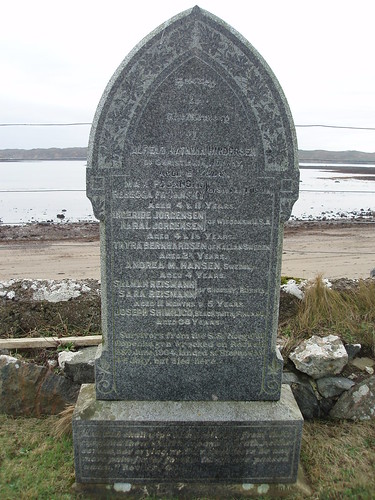 Not all eight of the lifeboats launched from the Norge stayed afloat; some sank at the moment of launch, but a handful were spotted by fishermen and taken to the United Kingdom. One lot of survivors was put ashore at Stornoway, and treated at the local hospital. Nine succumbed to their ordeal and lie buried at Sandwick Cemetery, a 15-minute walk from my position. One boat is thought to have drifted northeast to and beyond the Arctic Circle; but there is no confirmation of her fate.
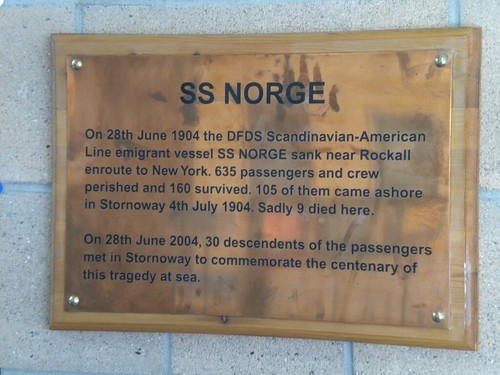 Nobody has heard of the Norge. No rich and famous on board that ship. Just dirt poor emigrants from Norway, Denmark, Sweden and Russia. In particular the Russian emigrants were the undesirables of that country. Jews, who had been packed away onto the western fringes of the Tsarist realm, and generally hated and detested in many circles of the Russia of 1904. The board of inquiry into the sinking of the Norge found that there were insufficient lifeboats for the number of people on board. A recommendation was issued that laws should be introduced, requiring ships to carry sufficient lifeboats, -rafts and other craft to accommodate all on board in the event of abandon-ship. This was not followed through.
This negligence was catastrophic for the passengers on board RMS Titanic on 14/15 April 1912.
Not all eight of the lifeboats launched from the Norge stayed afloat; some sank at the moment of launch, but a handful were spotted by fishermen and taken to the United Kingdom. One lot of survivors was put ashore at Stornoway, and treated at the local hospital. Nine succumbed to their ordeal and lie buried at Sandwick Cemetery, a 15-minute walk from my position. One boat is thought to have drifted northeast to and beyond the Arctic Circle; but there is no confirmation of her fate. Nobody has heard of the Norge. No rich and famous on board that ship. Just dirt poor emigrants from Norway, Denmark, Sweden and Russia. In particular the Russian emigrants were the undesirables of that country. Jews, who had been packed away onto the western fringes of the Tsarist realm, and generally hated and detested in many circles of the Russia of 1904. The board of inquiry into the sinking of the Norge found that there were insufficient lifeboats for the number of people on board. A recommendation was issued that laws should be introduced, requiring ships to carry sufficient lifeboats, -rafts and other craft to accommodate all on board in the event of abandon-ship. This was not followed through.This negligence was catastrophic for the passengers on board RMS Titanic on 14/15 April 1912.
Wednesday, 15 April 2009
97 years ago
The SS Titanic went down in early hours of 15 April 1912 with the loss of 1517 lives, although 706 survived. Only one of that number is left alive today - a lady now aged 97, then aged only 9 weeks. In remembering those who drowned in Titanic, I would like to point to other maritime disasters in peacetime which claimed large numbers of lives as well.
SS Norge was holed on Rockall in June 1904 and sank in minutes, taking 635 emigrants to the bottom with her. Lifeboats did manage to take 160 to safety, but there were nowhere near enough lifeboats on the Norge to take all. Nine casualties made it ashore at Stornoway, but did not survive. They lie buried at Sandwick Cemetery, 20 minutes' walk from the town. The lessons that should have been learned from her sinking (which was to provide sufficient lifeboats and rafts for all on board) could have saved hundreds of lives on Titanic. But false economies meant that the recommendations, drawn up by the Danish maritime authorities in the wake of the tragedy, were never implemented.
HMY Iolaire went down on rocks just outside Stornoway Harbour on 1 January 1919. She was carrying 300 sailors from the Outer Hebrides home after four years of war. The two lifeboats were useless, as they were smashed against the rocks immediately after launch - and would never have been enough to carry all on board.
SS Norge was holed on Rockall in June 1904 and sank in minutes, taking 635 emigrants to the bottom with her. Lifeboats did manage to take 160 to safety, but there were nowhere near enough lifeboats on the Norge to take all. Nine casualties made it ashore at Stornoway, but did not survive. They lie buried at Sandwick Cemetery, 20 minutes' walk from the town. The lessons that should have been learned from her sinking (which was to provide sufficient lifeboats and rafts for all on board) could have saved hundreds of lives on Titanic. But false economies meant that the recommendations, drawn up by the Danish maritime authorities in the wake of the tragedy, were never implemented.
HMY Iolaire went down on rocks just outside Stornoway Harbour on 1 January 1919. She was carrying 300 sailors from the Outer Hebrides home after four years of war. The two lifeboats were useless, as they were smashed against the rocks immediately after launch - and would never have been enough to carry all on board.
Saturday, 6 December 2008
Not at the helm
6 November 2008
A fishing boat went down off Bayble, some 5 miles east of Stornoway. Fortunately, all crew were saved uninjured. An inquiry has revealed that the skipper had left the wheelhouse of the Faithful Friend II a few minutes beforehand to make a cup of coffee, leaving the boat to proceed on auto-pilot. She struck a rock, which was well charted, and sank fairly quickly. A quick Mayday call, nearby vessels and a rapid response from the Coastguard prevented loss of life. The owner of the Faithful Friend II has been forcefully reminded of the necessity of watch-keeping on his boats at all times.
1 June 2006
Fishing boat Brothers leaves the harbour of Gairloch in Wester Ross (southeast of Stornoway) and proceeds to head west across the Minch. It never returned to port, and sound nor sight was seen of it again. A massive search was launched in the Minch, but the wreck of the Brothers was finally located beneath 40 feet / 12 metres of water off an island just north of Skye. The bodies of the two men on board were not in the wreck. One of them turned up in Gruinard Bay, 35 miles to the northeast 3 weeks later. The other was never found. It is thought they left port after a few drinks the evening before and dropped off to sleep. When the boat ran aground, it must have sunk quickly, leaving them no chance to save themselves.
19 December 2004
Fishing boat Audacious leaves Stornoway harbour in the early hours of the morning. The crew leave the boat on auto-pilot, which appears to malfunction. The boat runs aground just south of the lighthouse at Arnish. The skipper drowned, but two other crew were rescued.
A memorial to the skipper was later erected near the lighthouse.
A fishing boat went down off Bayble, some 5 miles east of Stornoway. Fortunately, all crew were saved uninjured. An inquiry has revealed that the skipper had left the wheelhouse of the Faithful Friend II a few minutes beforehand to make a cup of coffee, leaving the boat to proceed on auto-pilot. She struck a rock, which was well charted, and sank fairly quickly. A quick Mayday call, nearby vessels and a rapid response from the Coastguard prevented loss of life. The owner of the Faithful Friend II has been forcefully reminded of the necessity of watch-keeping on his boats at all times.
1 June 2006
Fishing boat Brothers leaves the harbour of Gairloch in Wester Ross (southeast of Stornoway) and proceeds to head west across the Minch. It never returned to port, and sound nor sight was seen of it again. A massive search was launched in the Minch, but the wreck of the Brothers was finally located beneath 40 feet / 12 metres of water off an island just north of Skye. The bodies of the two men on board were not in the wreck. One of them turned up in Gruinard Bay, 35 miles to the northeast 3 weeks later. The other was never found. It is thought they left port after a few drinks the evening before and dropped off to sleep. When the boat ran aground, it must have sunk quickly, leaving them no chance to save themselves.
19 December 2004
Fishing boat Audacious leaves Stornoway harbour in the early hours of the morning. The crew leave the boat on auto-pilot, which appears to malfunction. The boat runs aground just south of the lighthouse at Arnish. The skipper drowned, but two other crew were rescued.
A memorial to the skipper was later erected near the lighthouse.
Tuesday, 18 November 2008
Tragedy at Arnol
In June 2007, a man of 60 went out canoeing with his youngest son. He was a father of 11, living in the village of Arnol, 15 miles north of Stornoway. That afternoon, the two were seen by a chance walker off the coast by the next village, Bragar. Thinking nothing of it, the walker went on her way, and after a little while came to the beach by the cemetery at Bragar.
Where one of the canoes was found washed up. She immediately raised the alarm, and the Coastguard found the man in the water. He was quickly transferred to hospital, but did not survive. His son was not found for another 3 weeks, in spite of intense search efforts which were carried on quite late in the evening, on account of the long evenings in June.
Whenever I pass through Arnol, I pass the house where the family used to live - I seem to remember they moved away - and feel the sadness. As in all communities by the sea, this is only too common an occurrence. Even in the few years I've been here, several tragedies like this have occurred. Those left behind remain in my thoughts.
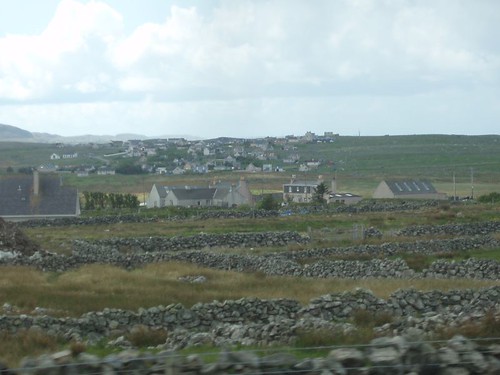
View across the walls of Arnol to the next village, Bragar.
Where one of the canoes was found washed up. She immediately raised the alarm, and the Coastguard found the man in the water. He was quickly transferred to hospital, but did not survive. His son was not found for another 3 weeks, in spite of intense search efforts which were carried on quite late in the evening, on account of the long evenings in June.
Whenever I pass through Arnol, I pass the house where the family used to live - I seem to remember they moved away - and feel the sadness. As in all communities by the sea, this is only too common an occurrence. Even in the few years I've been here, several tragedies like this have occurred. Those left behind remain in my thoughts.
View across the walls of Arnol to the next village, Bragar.
Tuesday, 1 April 2008
Fisherman's memorial
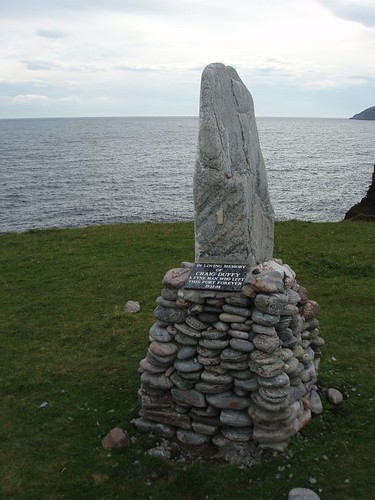
The Isle of Lewis has more than its fair share of poignant memorials, and this is one of them. Taken in September 2006, this picture shows a personal memorial to a young fisherman, Craig Duffy, who drowned on 19 December 2004, when his fishing boat Audacious foundered on rocks nearby. His three crew were rescued.
The memorial stands about a hundred yards from the Arnish Lighthouse, and with the lighthouse I see the memorial every day from my location. A fancy-dress party was held in Stornoway a week or so ago in his memory.
It is noteworthy that this memorial stands within sight of the Iolaire Memorial, on the other side of Stornoway Harbour. As I have often mentioned on here, the Iolaire was a troopship which foundered on New Year's Day 1919, with the loss of 205 seamen who were returning home from World War I.
Wednesday, 12 March 2008
The Politician

On 12 March 1941, the SS Politician was making her way from the United Kingdom to America, but was hopelessly lost in fog around the Hebrides. Although the captain thought he was near Skerryvore, he was in fact a good few miles further west, and heading into the narrow channel between the isles of South Uist and Eriskay. With a grinding crunch, the boat ran aground on a reef, just off Eriskay.
The Politician's crew decided she was not going to come off in a hurry, either refloated or sinking, so they rowed ashore at Eriskay and alerted the authorities. The islanders were alerted in the process and they went over to have a look around the wreck. Its cargo consisted of cases of Jamaican banknotes, several grand pianos, bathroom suites and... many thousands of cases of all kinds of whisky.
The story has become legendary, with the islanders helping themselves to unimaginable quantities of uisge bheatha [water of life] and having a high old time. Compton Mackenzie immortalised the story in his book Whisky Galore, changing a few names along the way. Apart from the whisky, the bathroom suites also found a good home. One set is reportedly still sitting outside a house in Eriskay, in daily use.
After a couple of days, the authorities intervened and retrieved part of the cargo. Several islanders were prosecuted for illegally retrieving goods off a wrecked ship. Bottles of 'polly' still turn up every now and again, If they have been in the sea, the spirits will have become undrinkable. But it's a nice story.
Sunday, 24 February 2008
Titanic's predecessor
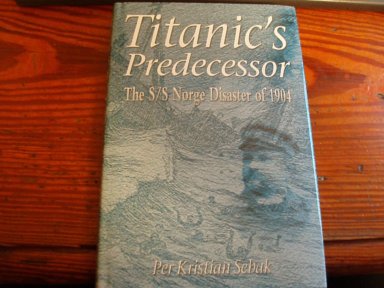
I bought this book on Amazon (last copy in stock in the UK), as it has some bearing on local history here. It is about the sinking of SS Norge in 1904, in which 635 passengers and crew drowned. This Scandinavian liner was crossing from Copenhagen, Christiania (now Oslo) and Christiansand to New York in late June 1904 when she hit rocks at Rockall. This is a tiny islet, rising 70 feet out of the Atlantic some 250 miles west of Scotland.
The Norge had insufficient spaces on board lifeboats for all the about 780 on board (in fact only 250), meaning a certain death for most. One lifeboat was wrecked as it was launched, others could only carry a few dozen. The ship, which carried emigrants from Russia and Scandinavia, went down 20 minutes after it struck rocks. Five lifeboats managed to get away. Survivors from four were picked up by other ships within about a week. A fifth boat was never recovered, and may have drifted into the Arctic - we shall never know. Survivors were landed at Grimsby (northern England), Aberdeen, Stornoway and Torshavn (Faeroes), in a pitiful state. Some died shortly after arriving on dry land; 11 of them lie buried in a communal grave at Sandwick, just down the road from me.
The book gives a good impression of life in the early 1900s, the huge wave of emigration to America that was taking place, as well as the appalling circumstances in which Jewish people were made to live in the Russian Empire of the Czars. It is heartwarming to read the welcome that survivors were awarded in all places they came ashore - it is heartrending to read the hardships they had to endure on the way there.
This entry is dedicated to the memory of those lost in the sinking of SS Norge.
Tuesday, 3 July 2007
Gloup Disaster
I was listening to a program on BBC Scotland about the Gloup Disaster. This occurred on 20 July 1881, and claimed the lives of 36 fishermen from the Isle of Yell in Shetland. As the 126th anniversary is coming up, I would like to dedicate this entry to their memory. Although I am obviously blogging from Lewis, the theme is common to many island communities.
Following a period of bad weather, a clearance prompted the fishermen of Gloup to take to the fishing grounds, 40 miles out to the west. Unbeknown to them, a summer storm raced towards Shetland and fell ont hem with hurricane force winds. Many boats were found overturned with no sign of life.
Fifty-eight fishermen drowned, 36 of whom came from Gloup. They left 34 widows and 85 orphans.
Following a period of bad weather, a clearance prompted the fishermen of Gloup to take to the fishing grounds, 40 miles out to the west. Unbeknown to them, a summer storm raced towards Shetland and fell ont hem with hurricane force winds. Many boats were found overturned with no sign of life.
Fifty-eight fishermen drowned, 36 of whom came from Gloup. They left 34 widows and 85 orphans.
Saturday, 11 March 2006
Tragedy - South Lochs
In the 1960s, a boat left Stornoway bound for Marvig, 10 miles further south in the Lochs area of Lewis. It was carrying a large amount of timber. A young couple were going down to the village to build themselves a new home, and the young woman's uncle went along to steer the boat. Barely out of port, the engine failed and a storm blew up. It was some storm. They were unable to turn round, and gradually the boat was blown onto the reef of Sgeir Mhor, between Newton and Lower Sandwick. The uncle decided that he should jump overboard with a line, as this had been the way in which 75 people were saved on the Iolaire, in 1919. The other passengers thought the better of following him. Screams for help from the terrified woman could be heard in houses in Lower Sandwick. Finally, the lifeboat managed to come in and saved the couple by breecher's buoy.
The storm blew itself out, and the next morning the sea blinked innocently in the sunlight. The boat was sitting high and dry on the Sgeir Mhor. The body of the uncle was found on the shingle of the beach, in amongst all the timber. In the afternoon, people could walk out to the vessel as it sat on the reef. It was unbelievable that just 12 hours before a raging storm had made it impossible for any but the lifeboat to come near.

Forty years before, people from Marvig were involved in another tragedy, this time to the south of their village. Again, a young couple were taking the contents of their house and some timber around to Steimreway. This village was vacated in the Clearances of the 1830s, but they wanted to rebuild the houses. It is located along the coast, about 3 miles west of Lemreway, on the shore of Loch Shell. The boat was caught in a storm and foundered, drowning all on board. Although Steimreway was reoccupied between 1921 and 1945, this tragedy did little to inspire confidence. When central government refused to provide amenities like a school and a road, the villagers abandoned Steimreway for a final time at the end of the Second World War. You can still visit the site of the settlement by walking 2 miles across rough moorland from Orinsay. It is a very pretty location, but my attempts to reach it foundered in bad weather.
The story of Steimreway is told in an article on the Lochs Community website.

The storm blew itself out, and the next morning the sea blinked innocently in the sunlight. The boat was sitting high and dry on the Sgeir Mhor. The body of the uncle was found on the shingle of the beach, in amongst all the timber. In the afternoon, people could walk out to the vessel as it sat on the reef. It was unbelievable that just 12 hours before a raging storm had made it impossible for any but the lifeboat to come near.
Forty years before, people from Marvig were involved in another tragedy, this time to the south of their village. Again, a young couple were taking the contents of their house and some timber around to Steimreway. This village was vacated in the Clearances of the 1830s, but they wanted to rebuild the houses. It is located along the coast, about 3 miles west of Lemreway, on the shore of Loch Shell. The boat was caught in a storm and foundered, drowning all on board. Although Steimreway was reoccupied between 1921 and 1945, this tragedy did little to inspire confidence. When central government refused to provide amenities like a school and a road, the villagers abandoned Steimreway for a final time at the end of the Second World War. You can still visit the site of the settlement by walking 2 miles across rough moorland from Orinsay. It is a very pretty location, but my attempts to reach it foundered in bad weather.
The story of Steimreway is told in an article on the Lochs Community website.
Monday, 20 February 2006
Norge
In remembrance of those lost on the Norge, 28 June 1904.
The sinking of the Titanic in 1912 was one of the worst peacetime maritime disasters of the 20th century. Others have happened before and since, some of which have faded from memory. I have highlighted one other before, the sinking of the Iolaire on the Beasts of Holm, on 1st January 1919.
The story and images below are partly taken from www.norwayheritage.com.

In 1904, the emigrant vessel Norge sank off Rockall, 200 miles west of here in the Atlantic. Rockall is a rock which juts out of the oceanfloor, and sticks some 70 feet above the waves. A nearby reef is partially submerged, Hazelwood Rock, and both constitute a danger to shipping.
On 28th June 1904, the SS Norge was heading from Norway to America, when she struck Rockall. Her bow became embedded in the rocks. Lifeboats were readied, but the captain ordered the engines in reverse to extricate his ship. Unfortunately, there was severe damage below the waterline, and the Norge sank, taking 700 emigrants with her to the bottom. A number of them were picked up by a British merchantman, the Cerwona. Some lifeboats made it to the Outer Hebrides, and were cared for in Stornoway. Nine of them succumbed to the effects of their ordeal and are buried in Sandwick Cemetery, near Stornoway.
This link leads to transcripts of newspaper articles about the disaster, as they were printed in 1904. A book has been written about the sinking of this ship, but otherwise the event seems to have faded from memory.
The sinking of the Titanic in 1912 was one of the worst peacetime maritime disasters of the 20th century. Others have happened before and since, some of which have faded from memory. I have highlighted one other before, the sinking of the Iolaire on the Beasts of Holm, on 1st January 1919.
The story and images below are partly taken from www.norwayheritage.com.
In 1904, the emigrant vessel Norge sank off Rockall, 200 miles west of here in the Atlantic. Rockall is a rock which juts out of the oceanfloor, and sticks some 70 feet above the waves. A nearby reef is partially submerged, Hazelwood Rock, and both constitute a danger to shipping.
On 28th June 1904, the SS Norge was heading from Norway to America, when she struck Rockall. Her bow became embedded in the rocks. Lifeboats were readied, but the captain ordered the engines in reverse to extricate his ship. Unfortunately, there was severe damage below the waterline, and the Norge sank, taking 700 emigrants with her to the bottom. A number of them were picked up by a British merchantman, the Cerwona. Some lifeboats made it to the Outer Hebrides, and were cared for in Stornoway. Nine of them succumbed to the effects of their ordeal and are buried in Sandwick Cemetery, near Stornoway.
This link leads to transcripts of newspaper articles about the disaster, as they were printed in 1904. A book has been written about the sinking of this ship, but otherwise the event seems to have faded from memory.
Subscribe to:
Comments (Atom)