Showing posts with label hiort. Show all posts

Monday, 30 August 2010

30 August 1930

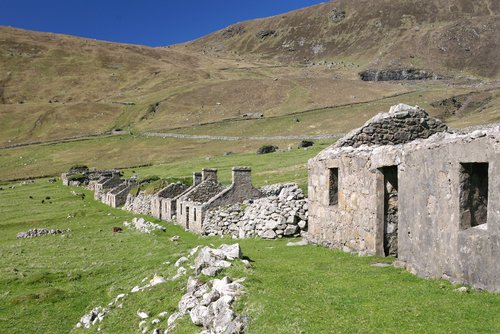
On that day, the villagers of St Kilda were packing up their belongings, before leaving the island of their birth forever. Some left a bowl of grain on the table, with the Bible open at the chapter of Exodus. A community, a culture, a way of life was coming to a close after thousands of years. Life on their outpost in the Atlantic had become untenable, to their minds, and the Hiorteachs had requested their own removal. The steamer Harebell took them to the village of Lochaline, on the mainland and on to Glasgow.

A lot has been written about St Kilda, with insights changing as the years and researches progress.  Someone has recently mooted the idea to repopulate the islands with permanent inhabitants - an idea that is as fanciful as it is unrealistic. Even today, with modern, powerful boats, it is not always possible to cross the sea to the islands. In the past, there would be no communication with St Kilda for 8 months of the year, due to the severity of the weather and the ocean. That has not changed.

Work is in progress to establish a St Kilda Centre at Mangersta in Lewis, where culture and history of St Kilda will be remembered. For it is no longer alive.


Image courtesy planetware.com

Monday, 24 May 2010

Napier Commission in St Kilda

On August 29th this year, it will be 80 years ago since the people of St Kilda left their native isle, never to return (to live there). They had requested to be removed as life there had become untenable. It is perhaps noteworthy to read the submissions to the Napier Commission, which visited St Kilda in June 1883. The replies by the three people who were called to give evidence have been transcribed into separate postings on the blog. Read the entries first, then return here, I ask.

In order to get an idea of the attitude of the “have’s” versus the “have-nots” of the day, I copy a few lines from a submission from the factor for St Kilda, in effect the landowner’s manager of the islands. John T. Mackenzie was not a bad man, as he did not pressurise any people if they could not pay the rent. Others in his position  would have their tenants evicted in case of default.
[...] the ” land question” to a great extent is in the hands of educated people, who know the danger of breaking the law, and who are responsible for their own actions. The crofter grievance is the ” land question ” in another form, but in the hands of a class who, fancying they have some hardships, know not what to do, but who are under the guidance and advice of irresponsible and, I am afraid in many cases, of thoughtless leaders, eager to gain notoriety through the simplicity and credulity of their followers
If you feel anger when seeing condescension and arrogance at such a breathtaking degree, stop for a minute and reflect upon the era we’re talking about. In the Great Britain of 1883, there was a gaping divide between classes in society. St Kilda people were regarded as “noble savages”, who could not look after themselves, and needed the benevolent hand of an educated and munificent landowner to guide their ignorant ways. Looking at this from a 21st century perspective, it is in fact the landowners who contributed in no mean proportion to the plight of their tenants - as the Napier Commission was finding out in 1883. Not all lairds were bad and evil, and neither were all their agents.

I can tell you that I have found the attitude, stated in the blockquote from John T. Mackenzie above, echoed to this day in certain quarters of those studying the social history of the Highlands and Islands. I am still angry at the Scottish First Minister who hailed the achievements of the emigrant Highlanders overseas, without making reference to the fact that many of them were kicked out under the most excruciating circumstances. Achievements that certainly deserve to be acknowledged - but why were they not allowed to make them at home.

I’ll get off my high horse now.

Wednesday, 28 April 2010

St Kilda

his year, it will be 80 years ago since the islanders of St Kilda (Hiort) were evacuated to the Scottish mainland at their own request. It was on 29th August 1930 that the culture of St Kilda died with the passing to other shores of its inhabitants. This evening, Monty Halls in his Hebridean Hideaway visited the islands. The scenery was absolutely stunning. But otherwise, there was nothing there. There are no permanent residents left, the houses are ruinous, with a few exceptions, and the storage huts (cleits) stand empty and derelict. In other words, St Kilda is dead.

Monty Halls, who stayed in North Uist for six months from July 2009 onwards, got involved with the controversy surrounding the location of the St Kilda Centre. It will be a point where the culture and people of St Kilda will be celebrated and kept alive. The strife was bitter, and already reflected in Monty's programme. The other contestants were Mangersta (Lewis) and Leverburgh (Harris). Cleitraval (North Uist) is a hilltop location near Sollas, where a plaque sits on the hill, pointing out where St Kilda can be seen, 41 miles (70 km) away to the west.

In the end, the St Kilda Centre was allocated to Lewis, and will be erected off the road between Mangersta and Islivig, overlooking the cliffs of Mangersta to be reminiscent of the St Kilda clifftops. (This link will take you to the location courtesy Google Streetview). The people of Harris and North Uist are deeply upset over losing out over the centre. It will obviously bring tourists to the location involved, and Uig (in which Mangersta lies) can very well do with the revenue.

Some people in these islands have voiced misgivings over having a St Kilda Centre in the first place. I can have some sympathy with those who say it is not right to make money off people who were cruelly neglected by the Government of the day - and neglected they were. Conversely though, nothing will bring them back, and it is a way of keeping their memory and the memory of their culture alive.