Tuesday, 18 March 2008
Abuse of power
3596[...]— Statements prepared by the Tenants of Edinbane. Our lots are from 6 to 8 acres of arable land. There are about 20 half lots from subdivision. A large piece of the hill has been taken from us called Ben Dhu, and no compensation, given. Several of our lots have been taken down by 1 acre, and no reduction of rents. The proprietor has never done anything for the land. The houses are built and maintained by ourselves. On removal we get compensation for the roof only. We think our rents too high, when so much land has been taken from us, and the rent in many cases raised. They were last raised to give the factor Mr Robertson votes. We are not in arrears. Seven days' work is claimed by Mr Robertson from each lot, and 2s. is taken from us for every day we miss. He likes us to give him the first offer of stock, but he does not fix the prices. A lot is allowed four cows and twenty-four sheep. Four cows are too many for the pasture. The profits from sheep go direct to Mr Robertson for rent. We never touch a penny of the money. The money from our sheep for the rent, instead of being put in the bank for us until Martinmas -when it is due, is kept by Mr Robertson for his own use, and we get no interest from him for it. We cannot utilise fishing for the want of proper boats, &c. Fishing should be distinct from crofting. There were plenty of evictions in Grishornish and Coshletter before the time of the late Mr M'Leod. Many of us have seen the law officers come and strip the roofs in Edinbane, and pour water down on the fires. The people evicted mostly emigrated. They got no compensation. The land is now largely in the hands of Mr Robertson, the factor. We would migrate, not emigrate. No Gaelic is taught at our schooL We would like our children taught to read the Gaelic Bible. The school rates are a shilling. Fees for standard IIL Is. 6d. There are eight paupers on the estate; most of these on Ben-Dhu have come from other places. Several cottars have been removed by the late Mr M'Leod and by Mr Robertson from Grishornish and Coshletter and put upon us. The poor-rates are 8d. Mr Robertson, the factor, has the lands once belonging to us of Kerrol and Ben-Dhu in his own hands. We received no reduction when these lands were taken from us. Mr Robertson keeps a meal-store, and we nearly all deal with him. We are this year already very deep in his books for meal. When Mr Robertson put the money on to our rents, for votes for himself as he said, he promised to make it good to us, but he has never done so, although we protest every year. We can give many other instances of oppression. One man took in a lodger against Mr Robertson's wish. He was fined a £1, and had to pay the £1 for five or six years, and was only pardoned last Martinmas. Another man for selling a stack of corn off the farm, although he had offered it to Mr Robertson several times, and was in sore need of ready money, was punished by having his rent raised from £3, 8s. 5d. to £4, which he still pays. The year before last two men quarreled about the march of their crofts. Mr Robertson ended the quarrel by fining the man with the largest croft 10s. a year on to his rent, and no corresponding reduction to the man with the small croft. In November last the factor put 7s. on to a half lot, with the reason stated, " I want to make a gentleman of you, and give you a vote." Mr Robertson has two shares of sheep in the hill, and although we complained, he will not pay for the grazing, and he refuses to let our sheep go over the lands of Kerrol, which is our right in winter, and makes us twice a year build up the dyke that keeps our own sheep out of our own grazings. We have to submit to such things as these, for fear of being evicted. Reforms wanted. More land and fixity of tenure. We cannot improve our lands at present as they will not support our families while we are improving them; but if we had enough of land to keep us on it the whole year round, and if we were made secure against fines and evictions from petty spite of the factor or other causes, we would improve it, and there would be no more heard of destitution in hard years like this. When the credit which this bad year drove us into is settled for, there will not be much of our stock left to us we think.


Sunday, 16 March 2008
In the army - in the 1850s
Join the army in the Crimean war, mid 19th century. What did you get? Well, paragraph 1123 from the Napier Commission inquiry into the conditions of the poor of the Highlands and Islands gives a flavour:
But when you were in [the army]?
—Well, for one time I had two years and four months without ever stripping or going to bed. From the time I left Portsmouth till I returned, I never stripped. I was in clothes all the time, and it was hard enough work for all I got.
But when you were in [the army]?
—Well, for one time I had two years and four months without ever stripping or going to bed. From the time I left Portsmouth till I returned, I never stripped. I was in clothes all the time, and it was hard enough work for all I got.
Saturday, 15 March 2008
The Napier Commission
On 8 May 1883, Lord Napier visited the Isle of Skye and other areas in the Highlands and Islands. He had been charged by Queen Victoria to investigate the grievances of crofters and cottars against the prevailing system of land ownership, security of tenure (or lack thereof) and living conditions. I have a transcript of the report, and it makes for deeply depressing reading. However, if anyone wants to understand the recent history of the north of Scotland, this is compulsory reading.
I copy the first 21 paragraphs, which gives a flavour of society in those days.
For reference: the man interviewed, Angus Stewart, lives in an area called the Braes, 8 miles southeast of Skye's main town, Portree. When the landowner found that the local cottars were not paying the rent, he sent in the constabulary. The police were met with a fully fledged riot, and retreated bloodied to Portree. A Royal Navy ship was sent to the area, by which time the uprising had come to the attention of the authorities in London.
1. The Chairman.—Would you have the goodness to state what is your occupation ?—A crofter.
2. Have you also been engaged in fishing ?—Yes.
3. Were you born here, at the Braes?—Born at the Braes.
4. Have you lived here all your life?—Not all my life. I have been away, but not very far off.
5. From time to time?—From time to time.
6. But you are thoroughly acquainted with the feelings and interests of the people here?—Yes.
7. Have you been freely elected by the people to be their delegate!— Yes.
8. Now, will you have the goodness to state to me what are the hardships or grievances of which the people complain who have elected you ?— Yes; but it is in Gaelic that I prefer to speak.
9. You desire to be examined in Gaelic?—Yes. [From this point the examination of the witness and of subsequent witnesses in Skye was conducted through Mr Dugald McLachlan, sheriff-clerk depute, as interpreter.]
10. Then you wit! have the goodness to state what are the hardships and grievances, if any, of which the people whom you represent at this place complain?—I would wish that I should have an opportunity of saying a few words before I tell that, and that is that I should have the assurance that I will not be evicted from my holding by the landlord or factor, as I have seen done already. I would not have a fire in my house at Whitsunday I want the assurance that I will not be evicted, for I cannot bear evidence to the distress of my people without bearing evidence to the oppression and high-handedness of the landlord and his factor.
11. Have you anything more to add to your preparatory statement?— No.
12. It is impossible for the Commission to give you any absolute security of the kind which you desire. The Commission cannot interfere between you and your landlord, or between you and the law, but we trust that no act of oppression or severity would ever be exercised towards you or any one else by the landlord in consequence of your courage and goodness in telling the absolute truth.
Mr ALEXANDER MACDONALD, Factor for Lord Macdonald—examined.
13. The Chairman.—You are at liberty to speak if you desire to make any observations?—In the first place, I may say that I am surprised at this man's statement, because he is not one of our crofters at all. He is a crofter's son; he is not a crofter. That is the first thing. In the next place, I do not think that he has any reason whatever, or that any person has any reason whatever, if he tells the truth, and nothing but the truth, to fear anything. In fact, we consider it rather insulting to us to insinuate anything of the sort. We despise to do anything of the sort. We expect and trust that the men will tell the truth and nothing but the truth, and the whole truth.
14. There is something rather ambiguous in the statement which you have made. Am I to understand that you publicly state that no proceeding will be taken against any tenant or inhabitant of this place in consequence of what they state before the Commission on this occasion?—I believe not.
15. You say you believe not, but do you engage that no proceedings will be taken?—That is all I can state: on my own property certainly there will not be, and, I believe, on no property. In fact, such an idea never entered our heads; but we expect the people will tell the truth, the whole truth, and nothing but the truth.
16. Mr Cameron.—Would you engage on behalf of the proprietors for whom you act; for all properties with which you are connected?—Most certainly; but this I would say, if we hear any man making a grossly false statement against us, which we can prove to be false, I do not think that in human nature it would be found we should like to continue that man as our tenant. If there is any statement which is made by a man thinking and believing it to be true, even though we ourselves differ from it, we would never dream of using any power that we have, but if the man tells a parcel of unfounded lies—which I do not believe any man here or elsewhere in Skye will do until I hear it—that is a different matter altogether. So far as we are concerned the people have full liberty to tell everything they have to say, without any fear.
17. The Chairman.—If you are able to do so I would rather that you availed yourself of this occasion to make a distinct declaration that whatever the people say no proceeding will ever be taken against them on that account,—that on this particular occasion whatever they may say, however mistaken you may think them, however erroneous or false, no proceeding will be attempted?—These are my own personal feelings, and certainly so far as the properties for which I am factor are concerned they will never know or hear anything about it—so far as I, as factor, am concerned.
18. Then I am authorised by you to assure this gentleman before me that nothing will ever be done to his prejudice on this occasion?—I expect that he will tell the truth, the whole truth, and nothing but the truth, and so far as I am concerned as factor, I will visit in no way anything upon him, and I believe Lord Macdonald will do nothing.
19. Mr Cameron.—You have heard what this witness has said, that except under certain conditions he refuses to give us evidence. We have been appointed by the Queen to investigate this subject thoroughly, and it is impossible that we can do so unless we get proper evidence from witnesses such as Mr Angus Stewart. Now, I am sure you would not Macdonald, wish that the evidence should fail to be recorded from any disinclination on your part to give the assurance which has been asked by the chairman — I give him the fullest assurance.
20. And I think all we wish was contained in the observation which I formerly made, namely, that so far as concerns the estates under your management nothing shall happen to any witness in consequence of any statement which he may make, whether you consider it truthful or not, before this Commission. If you give that assurance we may at once proceed ?—Certainly we expect the man to tell the truth.
21. The Chairman.—But let us come to a point on this matter. Will you state yes or no in reply to my question,—will you authorise me to state absolutely to this man that nothing will ever be done prejudicial to his interest or that of his family in consequence of anything he may say on this occasion ?—I believe I am quite at liberty to say so. I believe I am perfectly at liberty to say so, and from the first I could have said so.
I copy the first 21 paragraphs, which gives a flavour of society in those days.
For reference: the man interviewed, Angus Stewart, lives in an area called the Braes, 8 miles southeast of Skye's main town, Portree. When the landowner found that the local cottars were not paying the rent, he sent in the constabulary. The police were met with a fully fledged riot, and retreated bloodied to Portree. A Royal Navy ship was sent to the area, by which time the uprising had come to the attention of the authorities in London.
1. The Chairman.—Would you have the goodness to state what is your occupation ?—A crofter.
2. Have you also been engaged in fishing ?—Yes.
3. Were you born here, at the Braes?—Born at the Braes.
4. Have you lived here all your life?—Not all my life. I have been away, but not very far off.
5. From time to time?—From time to time.
6. But you are thoroughly acquainted with the feelings and interests of the people here?—Yes.
7. Have you been freely elected by the people to be their delegate!— Yes.
8. Now, will you have the goodness to state to me what are the hardships or grievances of which the people complain who have elected you ?— Yes; but it is in Gaelic that I prefer to speak.
9. You desire to be examined in Gaelic?—Yes. [From this point the examination of the witness and of subsequent witnesses in Skye was conducted through Mr Dugald McLachlan, sheriff-clerk depute, as interpreter.]
10. Then you wit! have the goodness to state what are the hardships and grievances, if any, of which the people whom you represent at this place complain?—I would wish that I should have an opportunity of saying a few words before I tell that, and that is that I should have the assurance that I will not be evicted from my holding by the landlord or factor, as I have seen done already. I would not have a fire in my house at Whitsunday I want the assurance that I will not be evicted, for I cannot bear evidence to the distress of my people without bearing evidence to the oppression and high-handedness of the landlord and his factor.
11. Have you anything more to add to your preparatory statement?— No.
12. It is impossible for the Commission to give you any absolute security of the kind which you desire. The Commission cannot interfere between you and your landlord, or between you and the law, but we trust that no act of oppression or severity would ever be exercised towards you or any one else by the landlord in consequence of your courage and goodness in telling the absolute truth.
Mr ALEXANDER MACDONALD, Factor for Lord Macdonald—examined.
13. The Chairman.—You are at liberty to speak if you desire to make any observations?—In the first place, I may say that I am surprised at this man's statement, because he is not one of our crofters at all. He is a crofter's son; he is not a crofter. That is the first thing. In the next place, I do not think that he has any reason whatever, or that any person has any reason whatever, if he tells the truth, and nothing but the truth, to fear anything. In fact, we consider it rather insulting to us to insinuate anything of the sort. We despise to do anything of the sort. We expect and trust that the men will tell the truth and nothing but the truth, and the whole truth.
14. There is something rather ambiguous in the statement which you have made. Am I to understand that you publicly state that no proceeding will be taken against any tenant or inhabitant of this place in consequence of what they state before the Commission on this occasion?—I believe not.
15. You say you believe not, but do you engage that no proceedings will be taken?—That is all I can state: on my own property certainly there will not be, and, I believe, on no property. In fact, such an idea never entered our heads; but we expect the people will tell the truth, the whole truth, and nothing but the truth.
16. Mr Cameron.—Would you engage on behalf of the proprietors for whom you act; for all properties with which you are connected?—Most certainly; but this I would say, if we hear any man making a grossly false statement against us, which we can prove to be false, I do not think that in human nature it would be found we should like to continue that man as our tenant. If there is any statement which is made by a man thinking and believing it to be true, even though we ourselves differ from it, we would never dream of using any power that we have, but if the man tells a parcel of unfounded lies—which I do not believe any man here or elsewhere in Skye will do until I hear it—that is a different matter altogether. So far as we are concerned the people have full liberty to tell everything they have to say, without any fear.
17. The Chairman.—If you are able to do so I would rather that you availed yourself of this occasion to make a distinct declaration that whatever the people say no proceeding will ever be taken against them on that account,—that on this particular occasion whatever they may say, however mistaken you may think them, however erroneous or false, no proceeding will be attempted?—These are my own personal feelings, and certainly so far as the properties for which I am factor are concerned they will never know or hear anything about it—so far as I, as factor, am concerned.
18. Then I am authorised by you to assure this gentleman before me that nothing will ever be done to his prejudice on this occasion?—I expect that he will tell the truth, the whole truth, and nothing but the truth, and so far as I am concerned as factor, I will visit in no way anything upon him, and I believe Lord Macdonald will do nothing.
19. Mr Cameron.—You have heard what this witness has said, that except under certain conditions he refuses to give us evidence. We have been appointed by the Queen to investigate this subject thoroughly, and it is impossible that we can do so unless we get proper evidence from witnesses such as Mr Angus Stewart. Now, I am sure you would not Macdonald, wish that the evidence should fail to be recorded from any disinclination on your part to give the assurance which has been asked by the chairman — I give him the fullest assurance.
20. And I think all we wish was contained in the observation which I formerly made, namely, that so far as concerns the estates under your management nothing shall happen to any witness in consequence of any statement which he may make, whether you consider it truthful or not, before this Commission. If you give that assurance we may at once proceed ?—Certainly we expect the man to tell the truth.
21. The Chairman.—But let us come to a point on this matter. Will you state yes or no in reply to my question,—will you authorise me to state absolutely to this man that nothing will ever be done prejudicial to his interest or that of his family in consequence of anything he may say on this occasion ?—I believe I am quite at liberty to say so. I believe I am perfectly at liberty to say so, and from the first I could have said so.
Wednesday, 12 March 2008
The Politician

On 12 March 1941, the SS Politician was making her way from the United Kingdom to America, but was hopelessly lost in fog around the Hebrides. Although the captain thought he was near Skerryvore, he was in fact a good few miles further west, and heading into the narrow channel between the isles of South Uist and Eriskay. With a grinding crunch, the boat ran aground on a reef, just off Eriskay.
The Politician's crew decided she was not going to come off in a hurry, either refloated or sinking, so they rowed ashore at Eriskay and alerted the authorities. The islanders were alerted in the process and they went over to have a look around the wreck. Its cargo consisted of cases of Jamaican banknotes, several grand pianos, bathroom suites and... many thousands of cases of all kinds of whisky.
The story has become legendary, with the islanders helping themselves to unimaginable quantities of uisge bheatha [water of life] and having a high old time. Compton Mackenzie immortalised the story in his book Whisky Galore, changing a few names along the way. Apart from the whisky, the bathroom suites also found a good home. One set is reportedly still sitting outside a house in Eriskay, in daily use.
After a couple of days, the authorities intervened and retrieved part of the cargo. Several islanders were prosecuted for illegally retrieving goods off a wrecked ship. Bottles of 'polly' still turn up every now and again, If they have been in the sea, the spirits will have become undrinkable. But it's a nice story.
Sunday, 24 February 2008
Titanic's predecessor
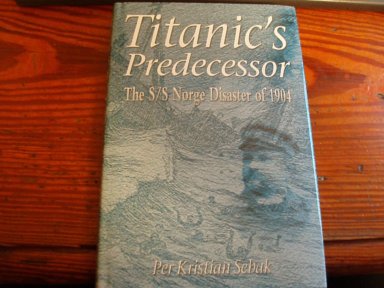
I bought this book on Amazon (last copy in stock in the UK), as it has some bearing on local history here. It is about the sinking of SS Norge in 1904, in which 635 passengers and crew drowned. This Scandinavian liner was crossing from Copenhagen, Christiania (now Oslo) and Christiansand to New York in late June 1904 when she hit rocks at Rockall. This is a tiny islet, rising 70 feet out of the Atlantic some 250 miles west of Scotland.
The Norge had insufficient spaces on board lifeboats for all the about 780 on board (in fact only 250), meaning a certain death for most. One lifeboat was wrecked as it was launched, others could only carry a few dozen. The ship, which carried emigrants from Russia and Scandinavia, went down 20 minutes after it struck rocks. Five lifeboats managed to get away. Survivors from four were picked up by other ships within about a week. A fifth boat was never recovered, and may have drifted into the Arctic - we shall never know. Survivors were landed at Grimsby (northern England), Aberdeen, Stornoway and Torshavn (Faeroes), in a pitiful state. Some died shortly after arriving on dry land; 11 of them lie buried in a communal grave at Sandwick, just down the road from me.
The book gives a good impression of life in the early 1900s, the huge wave of emigration to America that was taking place, as well as the appalling circumstances in which Jewish people were made to live in the Russian Empire of the Czars. It is heartwarming to read the welcome that survivors were awarded in all places they came ashore - it is heartrending to read the hardships they had to endure on the way there.
This entry is dedicated to the memory of those lost in the sinking of SS Norge.
Sunday, 3 February 2008
Calum Zachary

Calum Zachary [Calum Sgaire] lived in the middle of the 19th century at Bosta (see image above), in the island of Great Bernera, off the west coast of Lewis. He fell in love with Margaret MacLeod from Breaclete, but her family wanted her to marry an older but wealthier man. The couple decided to elope, but missed each other in the night. Disappointed and convinced the other had reneged, Calum sailed for Quebec the next day on an emigrant ship from Tolsta Chaolais, never to return. Margaret married the older man, but even tried to drown herself whilst the rest of the village were still celebrating the wedding. She died within a year of a broken heart. If you click on the link above, you'll hear a recording by Gaelic folkgroup Gleusda, during a performance during the Royal National Mod in October 2005. The lyrics can be found below.
| Sèist: | Chorus (after each verse): |
| Air fail a ra u | Air fail a ra u |
| Fail eile 's a ra u | Fail eile 's a ra u |
| Fail eile 's a ra u | Fail eile 's a ra u |
| Hogaidh o 's na ho i | Hogaidh o 's na ho i |
| Och a Rìgh gur trom m' osna | Oh Lord, I've a heavy, sighing heart |
| 'S fhada ò mo luaidh anochd mi | My love is far away from me tonight |
| Mise tuath air Ceann Lochlainn | I'm away in the north at the Cape of Norway |
| 'S ise aig Loch an Fhir Mhaoil | While she's at Loch an Fhir Mhaoil |
| Dh' fhalbh i, ghlais i leinn dhaichaidh | It set sail for home with us |
| Chuir i chuairt ud air Arcaibh | It sailed 'round Orkney |
| Cruinn ùra 's siùil gheala | New masts and white sails on her |
| Tìde mhara 's i leinn | She was running with the tide |
| Ged is math a bhith seòladh | Though it is enjoyable to be sailing |
| 'S olc a tha i 'gam chòrdadh | I cannot say I'm enjoying it just now |
| 'S mòr gum b' fheàrr a bhith 'm Bòsta | I would rather be in Bosta |
| Cur an eòrna 'san raon | Planting the corn in the field |
| Ach nam bithinn-sa aig baile | If only I could be at home |
| A shamhradh 's a dh' earrach | Both summer and spring |
| 'S mi nach leigeadh mo leannan | I would never allow another man |
| Ri balach gun strìth | To have my love without a fight |
Saturday, 25 August 2007
A story of internment
1 March 1916 - Groningen, Holland
The 1,500 men of the Royal Naval Division have been interned in this northern city since late 1914. Among them are just over 100 men from the Isle of Lewis. Donald Macleod is one of them. He was born in the village of Gearrannan near Carloway in December 1891. Donald was in the 1st Royal Naval Division, Benbow Battallion. His former schoolmaster at the Nicolson Institute, Mr Gibson, wrote him a Christmas card at the camp in December 1915. Donald replied on 2nd January 1916, extending best wishes to teachers and pupils at his school. He also expressed the wish that Holland would go to war, which would release his companions in Benbow Battallion and himself back into service for Great Britain.
On 1 March 1916, Donald was lying ill in the University Hospital. He died of pleurisy that day. A collection is held among the burghers of Groningen to buy a huge Celtic cross, out of sympathy with this lad of only 24, who died so far away from home. His mates from D company, Benbow Battallion have organised a huge wreath, in the shape of an anchor.
On passing along Groningen’s main street, people stop and bare their heads. Shopworkers stand outside their premises, residents outside their doors, including maids and servants. The cortege finally pulls up at the Southern Cemetery, where Donald is laid to rest.
Donald’s wish was not to be granted. Benbow, Drake, Collingwood and Hawke Battallions were to remain interned until the Armistice, in November 1918. Those that returned to the island after the war would not readily speak of their experiences. They felt it a matter of shame that they had led the ‘cushy life’ of an internment camp, where their fathers, brothers and sons had fought and died in the trenches or in the North Atlantic.
Two more Lewismen would not return home, but lie buried at Groningen: John MacLeay, of Shader, Barvas and John Smith of Lower Bayble. A fourth, Angus MacLeod of Portnaguran, was discharged home for being unserviceable - suffering from pulmonary tuberculosis. He died at Plymouth.
There are suggestions that four internees from Lewis perished in the Iolaire disaster of 1919, when the ship returning them to the island foundered outside Stornoway Harbour.
The 1,500 men of the Royal Naval Division have been interned in this northern city since late 1914. Among them are just over 100 men from the Isle of Lewis. Donald Macleod is one of them. He was born in the village of Gearrannan near Carloway in December 1891. Donald was in the 1st Royal Naval Division, Benbow Battallion. His former schoolmaster at the Nicolson Institute, Mr Gibson, wrote him a Christmas card at the camp in December 1915. Donald replied on 2nd January 1916, extending best wishes to teachers and pupils at his school. He also expressed the wish that Holland would go to war, which would release his companions in Benbow Battallion and himself back into service for Great Britain.
On 1 March 1916, Donald was lying ill in the University Hospital. He died of pleurisy that day. A collection is held among the burghers of Groningen to buy a huge Celtic cross, out of sympathy with this lad of only 24, who died so far away from home. His mates from D company, Benbow Battallion have organised a huge wreath, in the shape of an anchor.
On passing along Groningen’s main street, people stop and bare their heads. Shopworkers stand outside their premises, residents outside their doors, including maids and servants. The cortege finally pulls up at the Southern Cemetery, where Donald is laid to rest.
Donald’s wish was not to be granted. Benbow, Drake, Collingwood and Hawke Battallions were to remain interned until the Armistice, in November 1918. Those that returned to the island after the war would not readily speak of their experiences. They felt it a matter of shame that they had led the ‘cushy life’ of an internment camp, where their fathers, brothers and sons had fought and died in the trenches or in the North Atlantic.
Two more Lewismen would not return home, but lie buried at Groningen: John MacLeay, of Shader, Barvas and John Smith of Lower Bayble. A fourth, Angus MacLeod of Portnaguran, was discharged home for being unserviceable - suffering from pulmonary tuberculosis. He died at Plymouth.
There are suggestions that four internees from Lewis perished in the Iolaire disaster of 1919, when the ship returning them to the island foundered outside Stornoway Harbour.
Subscribe to:
Posts (Atom)