Tomorrow, November 11th, is the 94th anniversary of the Armistice at the end of the First World War. To commemorate the sacrifice of those from the Outer Hebrides who made the supreme sacrifice in the major conflicts of the 20th century, I have put up several website, listing the names and (where available) details of each casualty.
Lewis
Faces from the Lewis War Memorial with further details in Lewismen lost in the Great War (incomplete)
Iolaire Disaster 1919
Lewismen in Canadian service
Lewismen in Australian service
Wargraves in Lewis
Isle of Lewis War Memorials
World War II casualties from Lewis
Roll of Honour - Isle of Lewis 1914-1919
Collaborations
HMS TIMBERTOWN
John Macaulay and the Kenmare
Other islands
Harris War Memorial
Berneray to Vatersay Tribute
Saturday, 10 November 2012


Sunday, 7 October 2012
Wrong Island
From the book "The Journal of Private Fraser", edited by Reginald H. Roy (ISBN 1-896979-28-9), published by CEF Books, PO Box 29123, Nepean, Ont. K2J4A9.
Page 179
Sunday 23 July 1916
We spent a very quiet time in the trenches. Cpl Matthews of the Scouts was wounded. Donald Mcleod, who transferred to the Stokes Gun, was severely wounded and I heard died later in Blighty. It was reported that a curious mix-up resulted in his burial. We had two Donald Macleods in the Company, the other Macleod being a native of one of the islands of Uist in the Outer Hebrides. His body was forwarded to this out-of-the-way island for interment in the local churchyard and advice sent to his supposed relatives. The body arrived, but apparently, the relations had recent word from Donald Macleod No 2 and so refused to take charge of the remains. The lid was unscrewed and the mistake found out. After lying around for about a week, "Big Don" was lulled to sleep in the island within roar of the mighty Atlantic. Though he spent practically all his life time in Canada, his birth place was the island of Lewis, so his final resting place was a fitting for a scion of the race of Torquil.
[ends]

Of course, Benbecula is not exactly near Lewis (in fact 60 miles away). Big Don was not a misnomer by any means; his attestation papers put his height at 5 ft 11 in, larger than average in those years. I am trying to find out whereabouts he was from in Lewis, but the usual problem has reared its head: there are so many men named Donald Macleod in that island.
Donald Mcleod
Date of birth: 9 June 1888
Place of birth: Isle of Lewis
Height: 5 ft 11 in
Complexion: Dark
Eyes: Grey
Hair: Brown
Religion: Presbyterian
Trade / occupation: Miner
Last address in Lewis: Stornoway
Not married
Military unit: Canadians
Service number: 79110
Volunteered at Calgary on 16 November 1914
Date of death: 4 August 1916
Interred: Nunton Cemetery, Benbecula.
Page 179
Sunday 23 July 1916
We spent a very quiet time in the trenches. Cpl Matthews of the Scouts was wounded. Donald Mcleod, who transferred to the Stokes Gun, was severely wounded and I heard died later in Blighty. It was reported that a curious mix-up resulted in his burial. We had two Donald Macleods in the Company, the other Macleod being a native of one of the islands of Uist in the Outer Hebrides. His body was forwarded to this out-of-the-way island for interment in the local churchyard and advice sent to his supposed relatives. The body arrived, but apparently, the relations had recent word from Donald Macleod No 2 and so refused to take charge of the remains. The lid was unscrewed and the mistake found out. After lying around for about a week, "Big Don" was lulled to sleep in the island within roar of the mighty Atlantic. Though he spent practically all his life time in Canada, his birth place was the island of Lewis, so his final resting place was a fitting for a scion of the race of Torquil.
[ends]
Of course, Benbecula is not exactly near Lewis (in fact 60 miles away). Big Don was not a misnomer by any means; his attestation papers put his height at 5 ft 11 in, larger than average in those years. I am trying to find out whereabouts he was from in Lewis, but the usual problem has reared its head: there are so many men named Donald Macleod in that island.
Donald Mcleod
Date of birth: 9 June 1888
Place of birth: Isle of Lewis
Height: 5 ft 11 in
Complexion: Dark
Eyes: Grey
Hair: Brown
Religion: Presbyterian
Trade / occupation: Miner
Last address in Lewis: Stornoway
Not married
Military unit: Canadians
Service number: 79110
Volunteered at Calgary on 16 November 1914
Date of death: 4 August 1916
Interred: Nunton Cemetery, Benbecula.
WW1 casualty from Valamus
Valamus is an abandoned settlement in the Eishken area of Lewis, cleared of permanent residents in the 1820s. The farmhouse has been in intermittent use since then, and was in fact the site of a birth back in 1891. Young James Mackenzie came into the world at 3 am on the morning of 6 December 1891. His birth was not registered at Keose until 2 January 1892. His father, John, was a gamekeeper, married to Henrietta nee Munro.

Image courtesy Flickr user Chrismurray2
View Valamus in a larger map
By the time James enlisted with the New Zealand Machine Gun Corps, his parents had moved to Lairg in Sutherland. He himself signed up from Herbertville, Dannevirke in New Zealand and embarked on 16 October 1914 on either the Limerick or the Arawa for Suez in Egypt. At the time he was with the main body of the Wellington Infantry Battalion. He died of wounds on 25 June 1917 and lies buried at the Trois Arbres Cemetery, Steenwerck in French Flanders.
Image courtesy Flickr user Chrismurray2
View Valamus in a larger map
By the time James enlisted with the New Zealand Machine Gun Corps, his parents had moved to Lairg in Sutherland. He himself signed up from Herbertville, Dannevirke in New Zealand and embarked on 16 October 1914 on either the Limerick or the Arawa for Suez in Egypt. At the time he was with the main body of the Wellington Infantry Battalion. He died of wounds on 25 June 1917 and lies buried at the Trois Arbres Cemetery, Steenwerck in French Flanders.
Friday, 5 October 2012
HMS Curacao
HMS Curacao was sunk on 2 October 1942 with the loss of several hundred naval personnel. She was sliced into by the troop carrier and former liner the Queen Mary off the coast of Ireland. Several casualties from this disaster were washed up on shores in the islands off the Scottish west coast. Some of them at Elgol, according to the West Highland Free Press of 5 October 2012, and a service of commemoration was held at Ashaig cemetery in Skye on the 70th anniversary of the sinking.
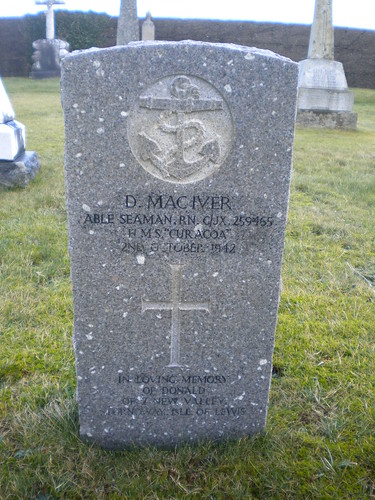
One of the casualties was from Lewis, AB Donald Maciver of 2 Newvalley, Stornoway. He was the son of Malcolm and Catherine Maciver, aged 26 at the time of his death. He was serving in the Royal Navy, registration C/JX259465. He is remembered on the Lewis War Memorial as well as on a CWGC gravestone in Sandwick Cemetery near Stornoway.

The Stornoway Gazette for 27 November 1942 writes:
In October, Donald Maciver, son of Mr and Mrs Maciver, 2 New Valley, Laxdale, was reported missing. His death has since been confirmed. The body was found at Kilmory Bay, Isle of Rhum, and buried there by the civil authorities.
Only 20 years of age, Donald was a student in Arts at Glasgow University. He joined the Navy for the duration and served for some time on a well-known cruiser. He was a fine, cheerful and upright young man of good promise, exceedingly well liked, and is much missed in the district. Much sympathy is felt for the sorrowing parents and family.
It should be noted that Donald's age at death was 26, not 20 as quoted by the Gazette; how he was transferred from the Isle of Rum is not recorded.
Not far from Rhum, in the neighbouring island of Eigg, we find two graves in Kildonan Cemetery, also casualties from HMS Curacao. The identity of these casualties is Known Unto God.

Image courtesy Maggie Fyffe, Isle of Eigg
One of the casualties was from Lewis, AB Donald Maciver of 2 Newvalley, Stornoway. He was the son of Malcolm and Catherine Maciver, aged 26 at the time of his death. He was serving in the Royal Navy, registration C/JX259465. He is remembered on the Lewis War Memorial as well as on a CWGC gravestone in Sandwick Cemetery near Stornoway.
The Stornoway Gazette for 27 November 1942 writes:
In October, Donald Maciver, son of Mr and Mrs Maciver, 2 New Valley, Laxdale, was reported missing. His death has since been confirmed. The body was found at Kilmory Bay, Isle of Rhum, and buried there by the civil authorities.
Only 20 years of age, Donald was a student in Arts at Glasgow University. He joined the Navy for the duration and served for some time on a well-known cruiser. He was a fine, cheerful and upright young man of good promise, exceedingly well liked, and is much missed in the district. Much sympathy is felt for the sorrowing parents and family.
It should be noted that Donald's age at death was 26, not 20 as quoted by the Gazette; how he was transferred from the Isle of Rum is not recorded.
Not far from Rhum, in the neighbouring island of Eigg, we find two graves in Kildonan Cemetery, also casualties from HMS Curacao. The identity of these casualties is Known Unto God.
Image courtesy Maggie Fyffe, Isle of Eigg
Thursday, 23 August 2012
Campbells, 16 Habost, Ness
Donald Macsween very kindly gave me permission to use this image of medals, recently retrieved from a house in Habost. They commemorate the deaths of two of his great-granduncles, Malcolm and Angus Campbell, during the First World War.

Private ANGUS CAMPBELL

Last address in Lewis: 16 Habost, Ness,
Son of Finlay and Marghed McLean Campbell, of 16, Habost, Port of Ness, Stornoway.
Service unit: 1st Seaforth Highlanders
Service number: C/7174
Date of death: 9 May 1915 at the age of 20
Killed in action at Neuve Chapelle
Memorial: Le Touret Memorial, Panel 38 and 39
Local memorial: North Lewis, Cross
Private MALCOLM CAMPBELL

Last address in Lewis: 16 Habost, Ness,
Service unit: 2nd Seaforth Highlanders
Service number: 3/7204
Date of death: 24 May 1915
Killed in action
Memorial: Ypres (Menin Gate) Memorial, panel 38
Local memorial: North Lewis, Cross
Private ANGUS CAMPBELL
Last address in Lewis: 16 Habost, Ness,
Son of Finlay and Marghed McLean Campbell, of 16, Habost, Port of Ness, Stornoway.
Service unit: 1st Seaforth Highlanders
Service number: C/7174
Date of death: 9 May 1915 at the age of 20
Killed in action at Neuve Chapelle
Memorial: Le Touret Memorial, Panel 38 and 39
Local memorial: North Lewis, Cross
Private MALCOLM CAMPBELL
Last address in Lewis: 16 Habost, Ness,
Service unit: 2nd Seaforth Highlanders
Service number: 3/7204
Date of death: 24 May 1915
Killed in action
Memorial: Ypres (Menin Gate) Memorial, panel 38
Local memorial: North Lewis, Cross
Wednesday, 22 August 2012
Norman Maclean, 5 Vatisker
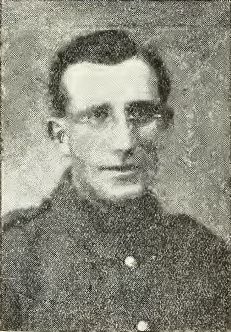
Gunner NORMAN MACLEAN
Last address in Lewis: 5 Vatisker,
Son of Donald Maclean, of 5, Vatisker Back, Stornoway.
Service unit: 4th Highland Mountain Bde, Royal Garrison Artillery
Service number: 4335
Enlisted at Stornoway
Date of death: 18 May 1915 at the age of 22
Died in Egypt
Interred: Alexandria (Chatby) Military and War Memorial Cemetery, grave L. 194
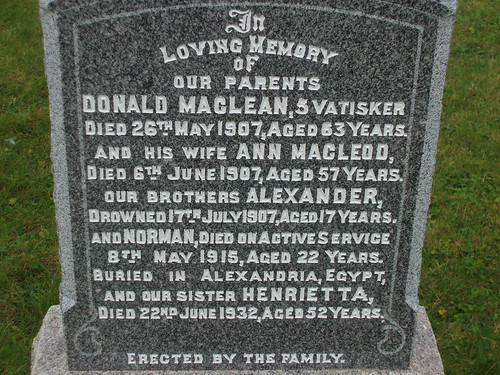
Mentioned on family gravestone in Gress Cemetery, Lewis
Local memorial: Back; Nicolson Institute WW1, middle panel
Norman was 19 years and 6 months old when he enlisted on 29 April 1912. He was sent to the Mediterranean Expeditionary Force on 19 March 1915. He arrived at Alexandria, Egypt on 2 April, and proceeded to Gallipoli on April 8th. On 7 May 1915, he was admitted to hospital in Gallipoli for a nervous breakdown. His death, according to official records, was caused by acute religious mania.
Norman is shown on the 1901 census aged 8, the son of Donald (56) and Ann (50) and brother to Catherine (25), Mary (17), Kenneth (13) and Alexander (11). By the time Norman died in Egypt, his parents had both passed away within days of each other in 1907, and his brother Alexander had drowned a few weeks after the death of his parents. Although pre-dating the birth of Norman in 1893, the 1891 census also reveals two elder sisters, Henrietta (11) and Ann (9).
His brother Kenneth served in the RNR and survived the war.
Thursday, 2 August 2012
Change
I was recently shown a navigational chart for Stornoway Harbour, which dates back to 1919. Modifications were entered on the chart, to show (e.g.) the causeway to Goat Island. However, there were a few features on the chart that no longer exist today. The most prominent changes are on the Arnish Peninsula. The construction of the Fabrication Yard there in the 1970s changed the landscape beyond recognition.
This first image is from the early 20th century, showing Arnish House (Kildun Farm), which was demolished in the mid 1970s. A most intrigueing feature is the smearing house at the neck of the peninsula, which I will describe a little later in this post. The hill immediately northwest of the neck of the peninsula, height 77 ft, was partly bulldozed out of existence. In fact, the hill on which Kildun Cottage once stood has been removed and is now occupied by the Fabrication Yard.
The smearing house was the place where the sheep were smeared. Nowadays, to combat infestations by parasites, sheep are dipped with chemicals. Until recently, organophosphates were used. At the start of the 20th century, a mixture of salt butter and tar was used for applying onto the sheep. Tobar an Dualchais have published a recording from 1964 about the practice. In summary, groups of men went round the Highlands and Islands to smear the sheep, a dirty practice by all accounts, and great stories were told in the smearing sheds.

This first image is from the early 20th century, showing Arnish House (Kildun Farm), which was demolished in the mid 1970s. A most intrigueing feature is the smearing house at the neck of the peninsula, which I will describe a little later in this post. The hill immediately northwest of the neck of the peninsula, height 77 ft, was partly bulldozed out of existence. In fact, the hill on which Kildun Cottage once stood has been removed and is now occupied by the Fabrication Yard.
The smearing house was the place where the sheep were smeared. Nowadays, to combat infestations by parasites, sheep are dipped with chemicals. Until recently, organophosphates were used. At the start of the 20th century, a mixture of salt butter and tar was used for applying onto the sheep. Tobar an Dualchais have published a recording from 1964 about the practice. In summary, groups of men went round the Highlands and Islands to smear the sheep, a dirty practice by all accounts, and great stories were told in the smearing sheds.


Subscribe to:
Posts (Atom)