Thursday, 23 August 2012

Campbells, 16 Habost, Ness

Donald Macsween very kindly gave me permission to use this image of medals, recently retrieved from a house in Habost. They commemorate the deaths of two of his great-granduncles, Malcolm and Angus Campbell, during the First World War.


Private ANGUS CAMPBELL

Last address in Lewis: 16 Habost, Ness,
Son of Finlay and Marghed McLean Campbell, of 16, Habost, Port of Ness, Stornoway.
Service unit: 1st Seaforth Highlanders
Service number: C/7174
Date of death: 9 May 1915 at the age of 20
Killed in action at Neuve Chapelle
Memorial: Le Touret Memorial, Panel 38 and 39
Local memorial: North Lewis, Cross

Private MALCOLM CAMPBELL

Last address in Lewis: 16 Habost, Ness,
Service unit: 2nd Seaforth Highlanders
Service number: 3/7204
Date of death: 24 May 1915
Killed in action
Memorial: Ypres (Menin Gate) Memorial, panel 38
Local memorial: North Lewis, Cross

Wednesday, 22 August 2012

Norman Maclean, 5 Vatisker


Gunner NORMAN MACLEAN
Last address in Lewis: 5 Vatisker,
Son of Donald Maclean, of 5, Vatisker Back, Stornoway.
Service unit: 4th Highland Mountain Bde, Royal Garrison Artillery
Service number: 4335
Enlisted at Stornoway

Date of death: 18 May 1915 at the age of 22
Died in Egypt
Interred: Alexandria (Chatby) Military and War Memorial Cemetery, grave L. 194
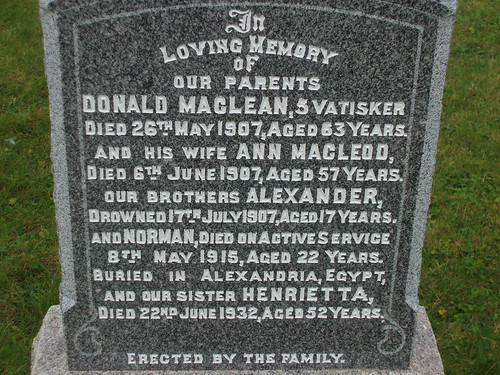
Mentioned on family gravestone in Gress Cemetery, Lewis
Local memorial: Back; Nicolson Institute WW1, middle panel


Norman was 19 years and 6 months old when he enlisted on 29 April 1912. He was sent to the Mediterranean Expeditionary Force on 19 March 1915. He arrived at Alexandria, Egypt on 2 April, and proceeded to Gallipoli on April 8th. On 7 May 1915, he was admitted to hospital in Gallipoli for a nervous breakdown. His death, according to official records, was caused by acute religious mania.

Norman is shown on the 1901 census aged 8, the son of Donald (56) and Ann (50) and brother to Catherine (25), Mary (17), Kenneth (13) and Alexander (11). By the time Norman died in Egypt, his parents had both passed away within days of each other in 1907, and his brother Alexander had drowned a few weeks after the death of his parents. Although pre-dating the birth of Norman in 1893, the 1891 census also reveals two elder sisters, Henrietta (11) and Ann (9).


His brother Kenneth served in the RNR and survived the war.

Thursday, 2 August 2012

Change

I was recently shown a navigational chart for Stornoway Harbour, which dates back to 1919. Modifications were entered on the chart, to show (e.g.) the causeway to Goat Island. However, there were a few features on the chart that no longer exist today. The most prominent changes are on the Arnish Peninsula. The construction of the Fabrication Yard there in the 1970s changed the landscape beyond recognition.

This first image is from the early 20th century, showing Arnish House (Kildun Farm), which was demolished in the mid 1970s. A most intrigueing feature is the smearing house at the neck of the peninsula, which I will describe a little later in this post. The hill immediately northwest of the neck of the peninsula, height 77 ft, was partly bulldozed out of existence. In fact, the hill on which Kildun Cottage once stood has been removed and is now occupied by the Fabrication Yard.

The smearing house was the place where the sheep were smeared. Nowadays, to combat infestations by parasites, sheep are dipped with chemicals. Until recently, organophosphates were used. At the start of the 20th century, a mixture of salt butter and tar was used for applying onto the sheep. Tobar an Dualchais have published a recording from 1964 about the practice. In summary, groups of men went round the Highlands and Islands to smear the sheep, a dirty practice by all accounts, and great stories were told in the smearing sheds.


Saturday, 28 July 2012

The Danish connection

Crossposted from Atlantic Lines
This evening, I found a comment, made on one of my local history sites by a Danish man who had visited the Outer Hebrides. Upon crossing North Uist, he visited the cemetery of Clachan Sands, about 6 miles west of Lochmaddy on the road to Berneray. I visited that graveyard in July 2009 and photographed the gravestone of Ewen Nicholson, who was lost during the First World War. An image of the actual gravestone in the Railway Dugouts Cemetery can be viewed on this link.


My Danish correspondent researched the fate of Ewen, displaying some very graphic and gruesome images of conditions on the frontline. I have looked into Ewen Nicholson's information and came out with the following:

Ewen Nicholson
Born: Grimsay, North Uist
Date of birth: 29 May 1892
Trade / calling: Labourer
Married: No
Volunteered at Valcartier on 23 September 1914
Age upon enlistment: 22 years 4 months
Height: 5 ft 10¼ in
Complexion: fresh
Eyes: light brown
Hair: brown
Religious denomination: presbyterian

Son of Alexander and Ann Nicholson, of Grimsay, Lochmaddy, North Uist.
Last known address in North Uist: 4 Aird nan Sruban Grimsay
Military unit: 7th Canadian Infantry (British Columbia Regiment)
Service number: 21065
Date of death: 3 June 1916 at the age of 24
Interred: Railway Dugouts Burial Ground, Sp Mem G. 29

In 1901, Ewen was 8 years old. His father Alexander was a crofter, 41 years of age, married to Ann. There were four other children in the family: Mary (12), John Archie (10), Alexander (5) and Andrew John Macalpine, age 1 month.

Five days after his 24th birthday, Ewen lost his life in fierce battles near Ypres. He was buried in one of the many cemeteries around the town.

Tuesday, 17 July 2012

The first Lewisman to fall in the Great War


Saddler PHILIP MACLEOD
Last address in Lewis: Golf House Stenish,
Son of Roderick McLeod, of Sandwick Hill, North St., Stornoway, Isle of Lewis.
Service unit: 123rd Bty. 28th Bde. Royal Field Artillery
Service number: 54183
Enlisted at Richmond, Yorkshire
Date of death: 26 August 1914 at the age of 27
Killed in action
Interred: Troisville Communal Cemetery, Sp. Mem
Local memorial: Lewis War Memorial
Killed during retreat from Mons.
First Lewisman to fall in the War

Philip is shown in the 1891 census at 8 North Road, Skipsea, Yorkshire. He is aged 3, the son of Roderick (36) and Jean (35) and brother to Christina (12), Kenneth (9), Roderick (6) and Catherine (3 months).

His brothers Roderick and Kenneth both served in the Royal Navy; his brother Angus was in the Ross Mountain Battery. These three survived the war.

Wednesday, 11 July 2012

3 Shell Street, Stornoway

This week, the bulldozers have started work to demolish number 3 Shell Street, the house behind the fuel depot at the roundabout on James Street, Shell Street and South Beach Street. It was the only inhabited house left on the street, but as it backs onto a live fuel depot, I am not surprised it is being demolished. We'll be left with an open view of the depot. A browse of the census of 1901 finds the Mair family in residence.

James Mair (52): fishcurer, born at Portknockie, Banff; his wife Maggie (45) and children Elsie (15), Joseph James (14), Maggie (13), Williamena A (11), Hugh Murray (10), Victoria (7) and Eliza J G (5).

Joseph James and Hugh Murray both lost their lives as a result of the First World War.

In 1891, the house was occupied by Elizabeth Murray (63), a seamstress.

In 1881, Shell Street was known as Imersligach, the name still used as the Gaelic streetname. Number 3 was occupied by a family of Mcleans: Kenneth (64, shoemaker), his wife Mary (55) and mother Chirsty (85) as well as son Murdo (13, scholar) and general servant Elizabeth Martin (25).

In 1871, the family of Macleans is in residence at 3 Imersligach. Kenneth (54, shoemaker) and Mary (45) and their offspring John (15), Murdoch (3) and Elizabeth (1), as well as Janet Munro, general servant (17).

In 1861, the family of Macleans is in residence at Imarsligoch Street (no number quoted). Kenneth (45, shoemaker), his wife Mary (35) and children Kenneth (11), Margaret (9) and John (5). An Alexander Maclean (21, cooper) is listed as a boarder.

Since this post was put up on 11 July 2012, it has been pointed out to me that the house was in fact 39 South Beach Street in the 19th century. 3 Shell Street was a little further east, towards Newton.


Sunday, 1 July 2012

96 years ago today

Twenty-one Lewismen were lost on the first day of the Battle of the Somme, today in 1916.

Private MALCOLM CAMPBELL, Seaforth Highlanders, 26 Cross aged 22
Private KENNETH GRAHAM, Seaforth Highlanders, Aird Dell aged 19
Private MALCOLM GUNN, Seaforth Highlanders, 15 Eorodale
Lance-Corporal DONALD MACARTHUR, Seaforth Highlanders, 29 Breasclete aged 19
Private ALLAN MACDONALD, Seaforth Highlanders, 18 Habost, Ness aged 19
Company Sergeant-Major MURDO MACGREGOR, Seaforth Highlanders, 12C Tolsta Chaolais aged 30
Private JOHN DUNCAN MACKAY, Seaforth Highlanders, 8 Kershader aged 19
Private WILLIAM J MACKAY, Seaforth Highlanders, 20 Adabrock aged 19
Private EVANDER MACKENZIE, Seaforth Highlanders, 5 Upper Garrabost aged 19
Private JOHN MACRAE MACKENZIE, Highland Light Infantry, 26 James Street, Stornoway aged 25
Private WILLIAM MACKENZIE, Seaforth Highlanders, 1A Mid Borve aged 19
Private ALEX MACLEOD, Seaforth Highlanders, 30 Lower Garrabost aged 23
Lance-Corporal ANGUS MACLEOD, Gordon Highlanders, 6 North Tolsta aged 24
Private JOHN MACLEOD, Seaforth Highlanders, 1 Hill Street North Tolsta aged 18
Lance-Corporal JOHN MACLEOD, Gordon Highlanders, 20 North Tolsta aged 22
Sergeant JOHN MACLEOD, Seaforth Highlanders, 24 Tolsta Chaolais aged 24
Private MURDO MACLEOD, Seaforth Highlanders, 65 Back aged 21
Private ALEX MORRISON, Seaforth Highlanders, 14 Eorodale aged 20
Private JOHN MORRISON, Seaforth Highlanders, 16 Skigersta aged 18
Seaman MURDO MORRISON, Royal Navy, 37 Breasclete aged 45
Private KENNETH SMITH, Seaforth Highlanders, 25 Leurbost